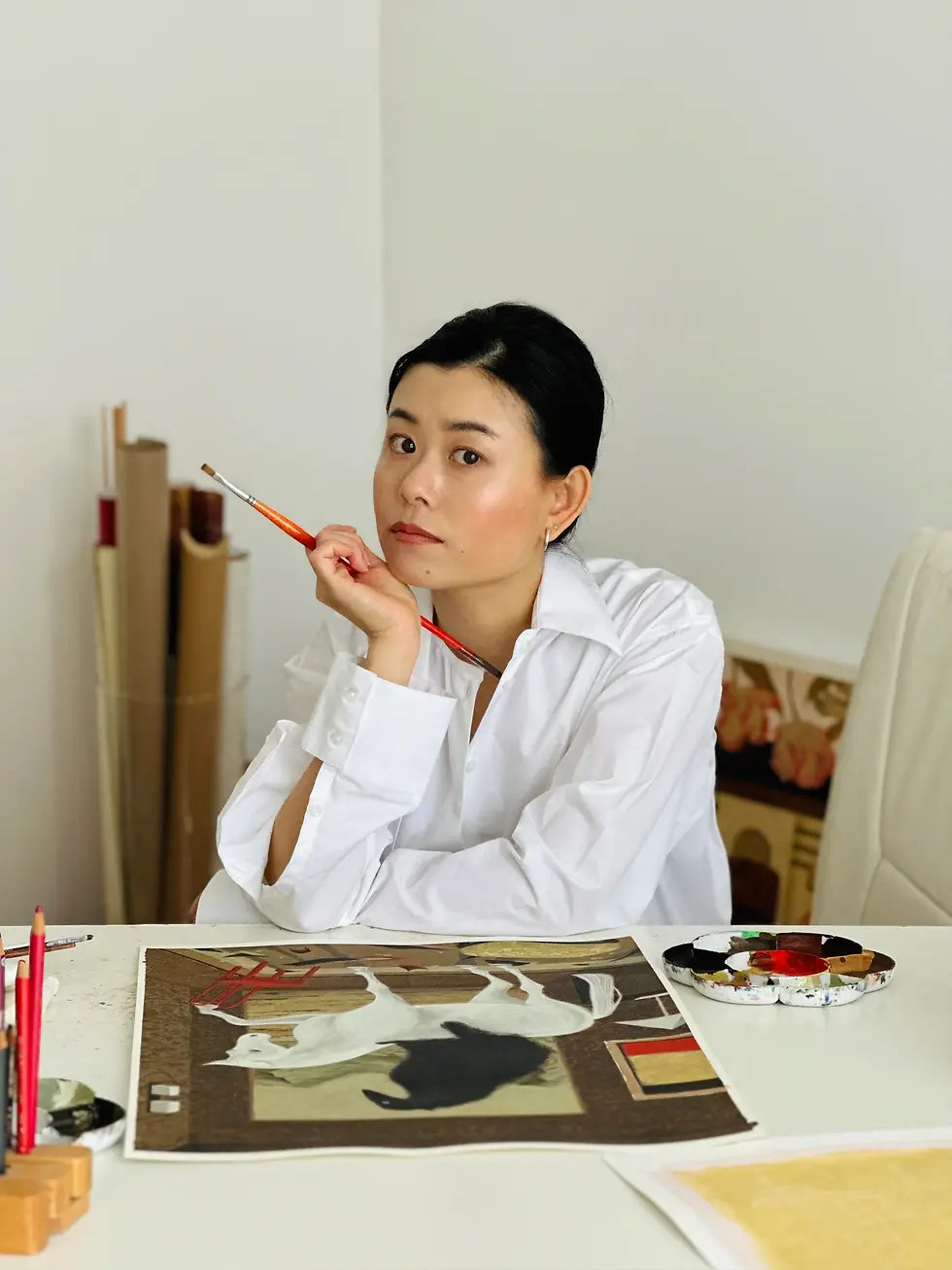
Aurora Lacirignola
Updated: Jun 30, 2025
Aurora Lacirignola’s practice circles around how we make sense of things through language, sound, and image. Trained as a painter, she’s interested in how symbols shift over time and how meaning can stay fluid. Her visual works often connect to her sound-based experiments, which play with rhythm, layering, and atmosphere. She also takes part in collaborative projects and curatorial work, keeping her research open and connected to a wider conversation.

Q: What first drew you to the idea of altering existing objects and meanings instead of starting from scratch?
A: I believe it’s connected to a kind of idiosyncrasy to pre-established things. What is already structured has a sort of fascination and repulsion on me. In a certain way, altering and manipulating something that is already constituted and delineated feels like a questioning, a provocation towards something that is imposed and has a subtle dynamic of conveying visions. My process is similar to a paradigm crisis: I try to propose new layers of interpretation against univocity, implying at the same time codified languages that detour from their conventional use. If I chose scratch as a substrate to my practice, it wouldn’t have the same meaning, the same process of opposing and offering alternative points of view to something already arranged. Scratch comes from “from below” and has a contingent nature; existing objects have a subtle hierarchy in them…

Q: How does your interest in etymology shape the way you approach both language and image?
A: Etymology has the power of reshaping both in the most astonishing ways because it is an “analyzer” of constructs.
Every time I start a project, I start with a random term where I “dive” in, because it has an illimitate stratigraphy of socio-cultural, historical and symbolic contents and information, so studying the etymologies permits me to research the heterogeneous morphology of that same term. The shapes I give to my works are, in a certain sense, a synchronous re-arrangement of every aspect of the studied word, and so a multiple visualization of both text/language and image/object.
Q: You often use archaeological fragments in your work. What kind of histories or absences do you feel you're working with?
A: Pretty much I work with that fascination I have, as a 21st century inhabitant, towards something I witness in a posthumous way. I think my lack of understanding deeply what those objects really meant to their owners in the ancient times generates a sort of romantic and sentimental reading that leads to the construction of fictional architectures that can compensate the unknown. So the absence of information is a focal point of experimentation and freedom in my modus cogitandi and operandi.
Q: When did sound become more than a side project for you, and how does it now sit alongside your visual practice?
A: Sound, in general, has always had a strong impact on me since I was a child, growing happily up in a rural context where natural sounds meet the far, atmospheric anthropic noises. I think this deeply affected the way I wanted to create my soundworks, but initially it was difficult to do because I honestly didn’t really know how to convey those sonorities.
After some fortunate experiences as a musical performer in the late years, I started to notice that what I needed to make sprouting this way of expression was just to do it, to experiment not minding what was canonic or academic, or other standardizations. Then, sounds and visual practice started to align. Sound and images are not so different at all, it’s just a matter of finding which medium or process could declare better what you want to express.

Q: In your process of détournement, do you see yourself more as a translator, a critic, or something else?
A: For sure a translator. Translating is a way of betraying the original meaning of a word – or an object – so every time I operate on my works, I do betray their semantics. Whoever translates, knows that they have the license to partially alter the form or the metrics of the text under examination: what is important is to communicate the sense of this text. A translation is another visualization as well as an interpretation. So yes, fundamentally I’m a translator. At the same time, translating has a basic and fundamental critical process, and I can’t deny being, in my artistic practice, a critic of what I submit to my research. As I said before, I oppose myself against the univocity: this is, in fact, a critical position.
Q: What kind of tension do you like to leave unresolved in your work — something the viewer has to carry with them?
A: I love leaving unresolved the explanation of my works. If not requested, I do not describe them because I’m always curious about what someone could read or think about.
People really have the most incredible explanations, based upon their sensitivity, cultural and artistic background, and different ways of analysing the object under examination. What moves my enthusiasm is the different and heterogeneous interpretations and readings that people give to me. In the moment we exchange conversations and thoughts on my works, I’m really happy because every person is contributing to expand the semantic plurality of my works. For this I prefer not to go deep into the description of each of them, not before people have said their point of view.