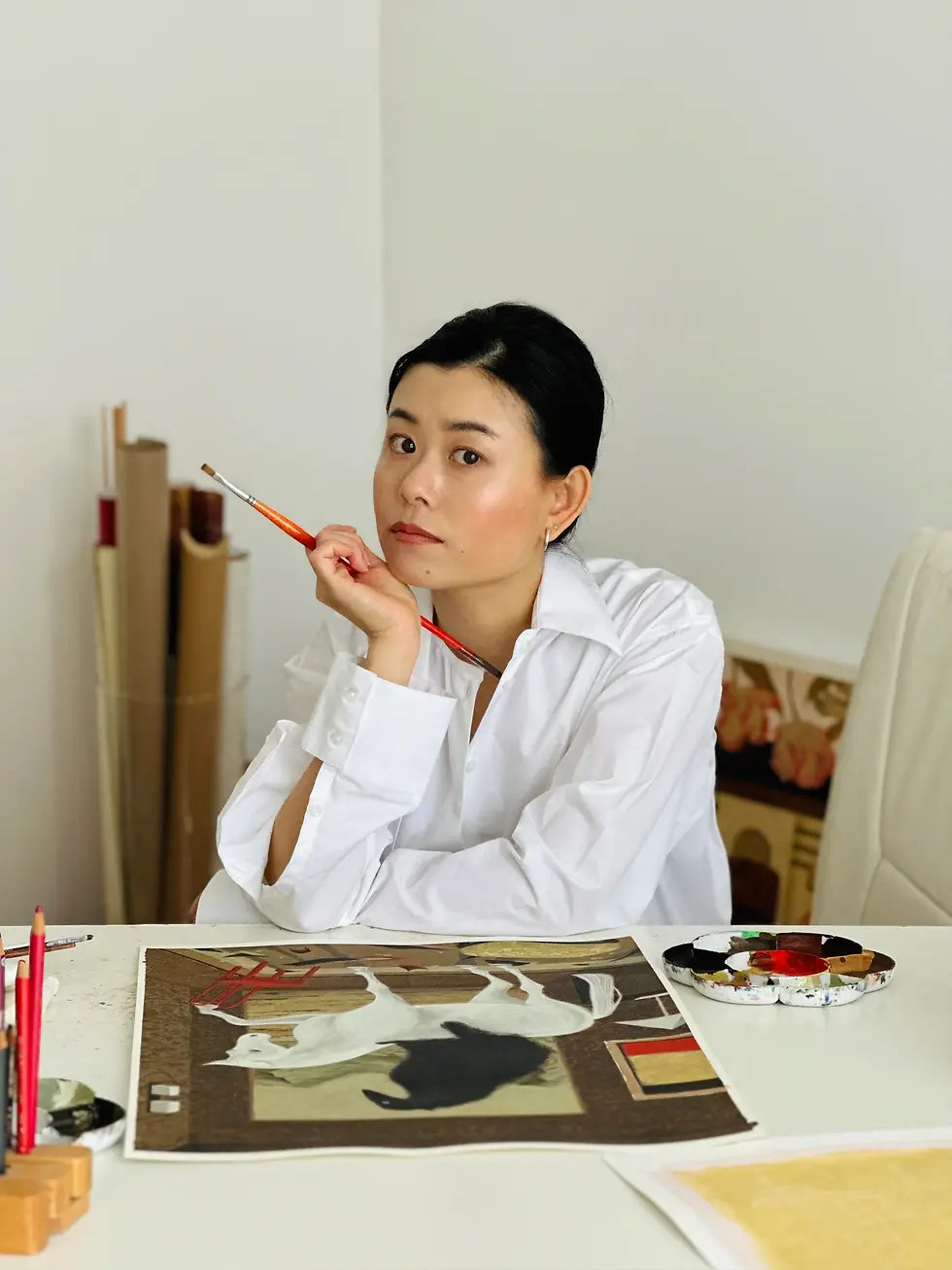
Amber Geuns
Amber Geuns is a painter based in Belgium. She designs and wears her own life-size costumes, then uses photographs of these staged scenes as the basis for her paintings. Fabric, movement, and the body are central, and her figures appear without faces, often caught mid-fall or mid-action. She studied at the Royal Academy of Fine Arts in Antwerp and has shown work in Belgium, Italy, London, and Venice.

Q: When did you start making costumes as part of building a painting?
A: When I first began painting, I worked extensively with drapery. I have always been fascinated by fabrics and shimmering garments in classical painting. In my earliest works, figures sometimes consisted entirely of fabric, almost like grotesque, ghostly apparitions. Human elements initially played a subordinate role and only gradually moved more into the foreground. As I began to use myself more frequently as a model, I realized that loose draperies did not always suffice to achieve a very specific image or desired posture. In order to gain more control over form, movement, and presence, I increasingly started sewing different pieces of fabric together. Over time, this process evolved from working with loose drapery to designing and creating full costumes, which now often form the starting point for my paintings.
Q: How do you move from an imagined character into a physical figure and then back into paint?
A: Lately, my process has increasingly begun in a sketchbook. It starts with loose words that describe the feeling or atmosphere I want to capture visually. From there, sketches follow, and then I begin taking photographs. In the past, I worked directly from photography, and images often emerged from a coincidental convergence of circumstances. Although I usually had a particular character or state in mind, the final result could differ greatly from the initial idea. I then take the collected photographic material into my studio. I lay the photographs out in front of me like a kind of menu of parts: a leg from photo three, an arm from photo fifteen, the torso from photo one. In the painting phase, the figure is reassembled. It is there that the character truly takes on a fixed form — an assembled body that comes into being through paint.


Q: Your figures don’t show facial features. What does that choice change for you while painting?
A: I always use myself as a model for my work, initially for practical reasons — after all, I am always present in my studio. As my practice developed, however, this choice increasingly shifted toward a more autobiographical approach. At the same time, I feel little need to repeatedly immortalize my own face; it feels too literal and too vain. By omitting facial features and thus withholding part of the image from the viewer, I shift the focus away from the face toward other elements within the composition. This gives me more freedom to represent myself without being tied to an exact likeness. The design process thus becomes a game of concealment and revelation. I aim to paint a scene in which the absence of a face feels just as natural to the viewer as the presence of one does for most people. To achieve this, I sometimes use masks or headpieces as part of the costume, windswept hair, or poses that obscure the face from view.
Q: How do fabric and movement affect the way a scene comes together for you?
A: Fabric and movement form the fundamental building blocks of a scene for me. They often lie at the origin of a work and determine the figure’s posture, and thus the final composition.
I therefore often begin my works with a small, intimate performance without an audience, in which I perform the movement myself and capture it through photographs. In this way, movement is integrated into the process from the very beginning. I have a strong preference for dynamism. Movement makes it possible to work with billowing fabrics, hair, or other fleeting elements that show the body in action while simultaneously obscuring the face in a playful, almost incidental way. This interplay between movement and concealment is an essential part of the image and closely aligns with my way of working and representing.

Q: Falling appears in several of your works. Why does this motion keep returning?
A: The falling figure, as seen in "Falling for You", recurs in my work as a body caught in a movement whose origin lies outside of itself. Like someone being pushed over an edge, these figures are trapped in a fall that results from the action of another. There is no clear outcome after the fall — only the overwhelming, helpless moment in between. In "Falling for You", the “perpetrator” is love itself, yet the sensation it produces is no less intense or destabilizing. With these works, I wanted to deliberately move away from the often cheerful, saccharine depiction of being in love that is so frequently portrayed.
Pushed or pierced by an arrow, the figures in "Falling for You", "Take My Breath Away", and "Blown
Away" are captured in the midst of an unavoidable fall — one that seems to be initiated in a tragicomic, slightly violent manner. In "Turbulence" and "A Dance with the Sky", on the other hand, the figures initiate their own descent, preceded by a flight — or an attempt at one. My interest therefore lies less in the act of falling itself and more in its cause: the meaning and context that have created the situation.
Q: What are you interested in exploring next?
A: The tactility of fabric continues to strongly attract me. In my upcoming works, I want to further explore what the existing building blocks of my practice — fabric, movement, and the body — can generate. My focus is also shifting toward the possibilities of three-dimensional elements: components that literally extend out of the work and move toward the viewer. I am interested in how this spatiality can influence my visual language, as well as how it can anchor the work more firmly in the here and now. In addition, I want to experiment with the integration of light and sound, and explore what these elements can add to the overall experience of the work and the way a scene is perceived.