Allie Kell
Allie Kell is a self-taught abstract painter based in Saskatoon, Saskatchewan. She started painting after a traumatic birth with her second child. She works in acrylic, oil stick and mixed media, mostly large, and uses music to set the direction of each session. She teaches intuitive painting and includes her kids in her own process, drawing from their marks and their freedom.

Q: Painting became a lifeline for you during a really intense time in your life. How did it start?
A: It started almost by accident, but I’ve always felt like it was something that would find me eventually. Like it had been quietly on its way to me, waiting for the right moment to arrive. It showed up during a time in my life when I truly needed it, and I was finally open enough to let it in.
I was postpartum with my second child, in therapy after a traumatic birth, and looking for artwork for our new home. I went to a store planning to buy something generic but ran into a friend who nudged me to paint my own. I remember telling her I was scared to. Up until then, I had only worked small with alcohol ink, but I had always dreamed about painting large with acrylic. I just never gave myself permission.
So I did. I brought home two canvases, set my daughter beside me, and painted. Something shifted in me that day. It felt familiar, like a calling, like something I was meant to be doing. It felt natural, grounding, and honest in a way I hadn’t experienced before. It became deeply healing for me and continues to lead me back to myself.

Q: You're self-taught and actively taking courses and workshops. What has that learning process been like without a formal art school background?
A: I’ve always felt like I had an innate knowing when it comes to creating, even without formal training. For a long time, I didn’t trust that, but I do now.
I genuinely love learning. Every class I take gives me a new perspective, pushes me out of my comfort zone, and helps me see things differently. I also really value the community and peer support that comes with it.
I see self-taught practice and formal learning as working together. Being self-taught first helped me build trust in my own voice and instincts. Classes then build on that foundation, adding layers and little nuggets of knowledge to my toolbox along the way, without pulling me away from my own path. Both have shaped me in the right way.
My process is very personal. I learn the most when I follow curiosity, experiment, and trust what feels right rather than only what is taught. I’d love to study more art history, but my work always comes back to self-trust and intuition. That’s where my best work comes from.

Q: Some of your work is very still and minimal, other times it's wild and physical. Do you know which one is coming when you walk into the studio?
A: I usually have a sense going in, like an emotion, style, or colour I want to explore. I use music to get out of my head and into my body, and that has a big influence on the vibe for the day. Each song can switch up my brushstrokes, my speed, my palette. Sometimes the energy stays consistent, and other times it shifts completely halfway through.
No two paintings are ever the same, and I actually like that I can’t replicate what I’ve already done. In life, I feel like a different version of myself every day, and my work reflects that.
It’s less about controlling the outcome and more about responding to the moment I’m in.

Q: You also teach intuitive painting. What do you see happen to people when they let go of trying to get it right?
A: I truly believe everyone is creative, even if they’ve convinced themselves otherwise. In my classes, people often come in wanting structure or something to follow. But once they start letting go, something shifts. They surprise themselves. What comes out is usually the last thing they expected, and that’s the magic of it. There’s a moment where they realize they don’t need permission to create.
It’s not about getting it right, it’s about expressing something real. And more often than not, they end up loving what they made because it actually feels like them.
Q: You paint on a big scale. What does working that large give you?
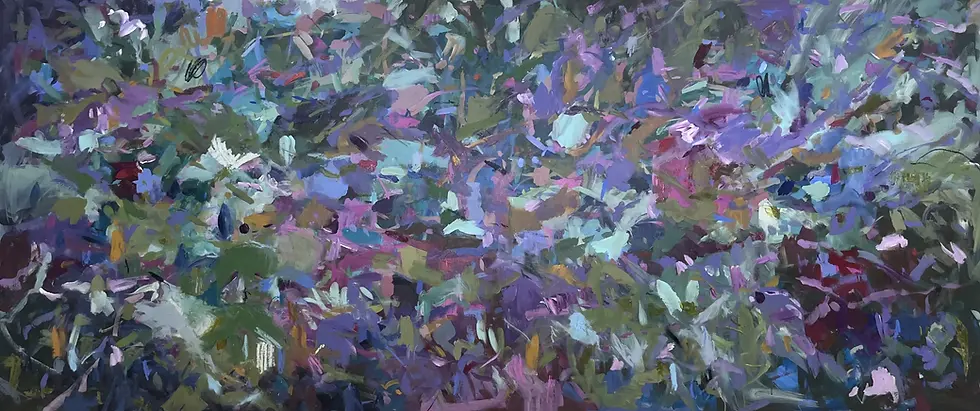
A: Painting large feels like a full-body experience, like a dance. It’s a release of what I’ve been holding in. Smaller works can feel limiting. On a large canvas, I can breathe, be bold, and take up space. Because of the scale, I spend more time with each piece, which means more time with myself to sit with my thoughts and feelings. It becomes about reflection and release, which is important for me. It also allows me to experiment more with detail and colour. I love observing how colours interact and letting each layer inform the next. It starts to feel more like an uncovering than discovering.
I want my paintings to be something you move through visually, to slow down with, and get lost in. Each area holds something different, like multiple emotions existing at once.
Q: What are you working toward these days?
A: Right now, I’m exploring motherhood and identity, and how painting helps me stay connected to myself within that. A big part of my work is inner child healing and holding onto a sense of whimsy into adulthood. I include my kids in the process, drawing from their marks and their freedom.
I’m really interested in the fleeting nature of childhood. Watching them grow so quickly means constantly letting go of who they were while learning to love who they’re becoming. It’s a bittersweet mix of grief and gratitude. Painting has become a way for me to hold onto those moments, like creating a time capsule of who they are right now.


