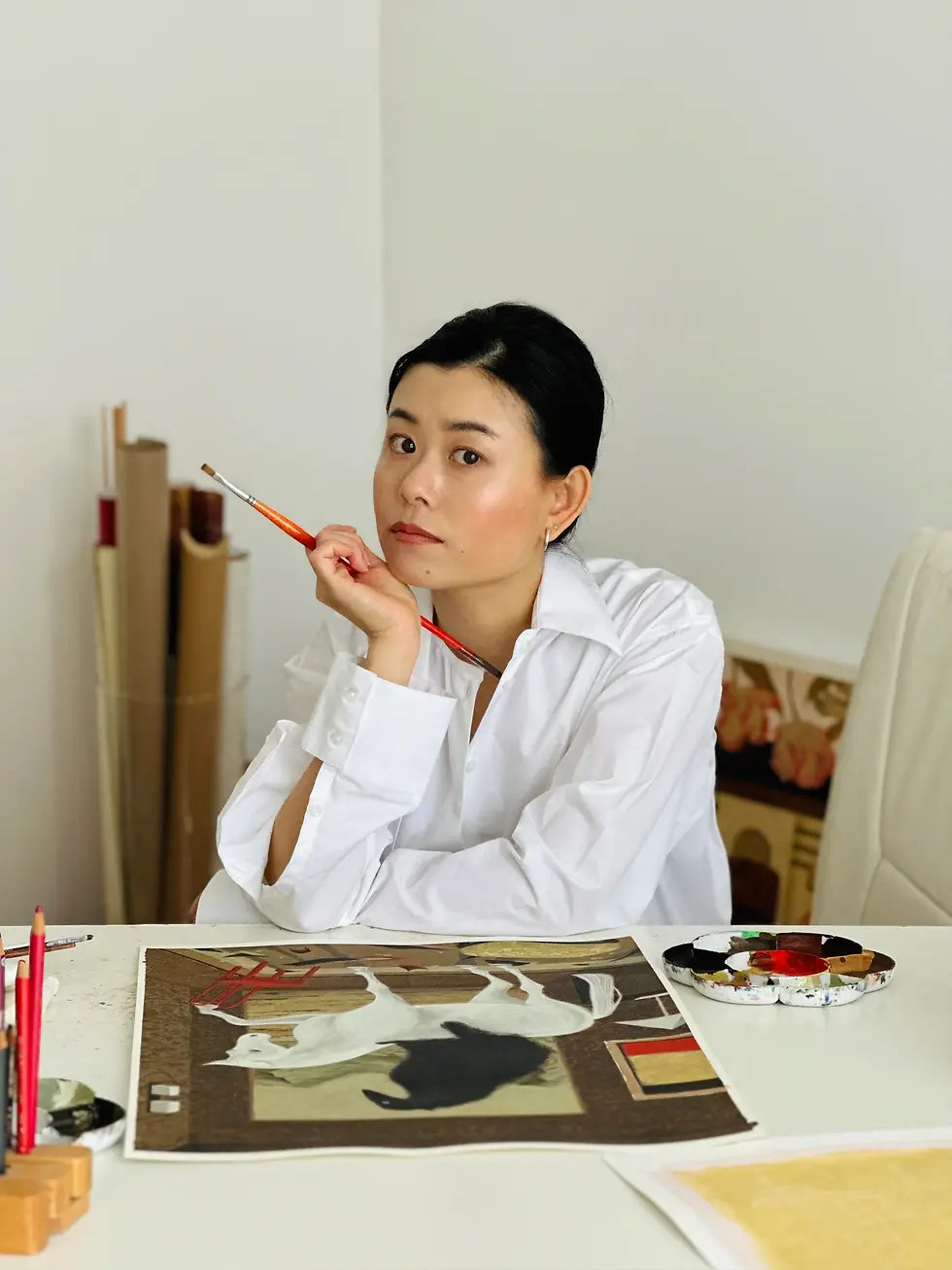
Aleksandr Vladimirovich Nuss
Aleksandr Vladimirovich Nuss works with images through sanding, erasing and slow observation. He uses paper, ink, sandpaper and sponges to follow how a surface reacts to abrasion, disappearance and slight survival. Each work begins with close reading and lets the material guide the process. He is drawn to the fragile space just before an image becomes clear, shaped by vision, memory and dream. His ongoing "Dreams Notebooks" also feed into this way of seeing. Based in Modena and Bologna, his work is currently on view in "Libraries. Bildung Venice Intelligence" at the Venice Architecture Biennale.

Q: How did sanding and removing layers become part of your painting process?
A: I have always been fascinated by the knowledge that the paintings I see in museums, galleries, or studios are the result of a long procedure: the preparation of the canvas, the composition, and the selection of colors… Almost nothing has changed since the preparation of sacred icons, such as those Florenskij described in "Iconostasis"... Yet, I never felt part of this ritual; it was not mine: I would lose, every time, the fleeting image. I have always relied on the rapid registration of ideas and mental images imprinted on the retina of my innermost self. This process needs to be swift, not merely to capture the surface of the image itself, but to trace and preserve as long as possible that impression, that empathy I felt at the precise moment when I had that exact gaze upon that particular image.

Q: When did you start paying attention to the images that form before conscious thought sets in?
A: I feel as if I was born not so much under the liminal space of the sky between Libra and Scorpio, but rather under the sign of the Dream, as if it were a fraternal guide and simultaneously as if I had always been immersed in it; whether it was made of horn or ivory, whether it was Morpheus, Icelon, Phobetor, or Phantasos… I mean, I unconsciously trained and refined this attention from an early age, starting with my very first dreams and nightmares. It was not so much the narrative of what happened in them, but the perception of nocturnal images and gazes: seeing that I was seeing even though everything happened with closed eyes at night. From this curiosity arose the current "Dreams Notebooks", a collection of notes, dream transcriptions, and memories of dreams, hypnagogic images, and visions dating back to 2004. The closed-circuit nature of this unilateral, self-analytical, and autobiographical discourse led me to seek a comparison, a counterpart to what happened with writing also in my artistic practice, so as to achieve an open and reflective perception and sensation for the viewer.
Q: Tools like sanding paper and sponges seem as important as brushes in your work. How much do you control the image, and how much do you let the material take the lead?
A: These tools are indeed fundamental for me. Since 2022, they have become the most substantial and significant part of my overall work. They hold almost the value of a statement; I still do not tire of using such an approach with the material. The alchemy and mnemonic technique linked to "imaginal involvement" will save the world, with beauty as a consequence. Working with abrasion, disappearance, and survival has allowed me to actualize and personalize, through a confused and anachronistic "poetic grammar", the fact that images are usually organisms independent of those who conceived, created, and externalized them.
Often, we perceive only their superficial skin and do not always notice their nervous systems, capillaries, or molecular exchanges, as Eugenio Garin reminds us in his introduction to the Italian edition of Fritz Saxl’s "Lectures": "The image is like a coagulum of ‘mnemonic waves’ that must be recorded and traced back to their origins and paths. Only with this method," by positioning oneself "as an ‘ultra-sensitive seismograph,’ can one ‘read an image by grasping every internal vibration and every meaning’."
Working through abrasion — but I believe with actions bordering between artistic pictorial necessity and ritual, sacred, and interior form-gesture — is realizing that one is working on a body in a state of transubstantiation still in progress, therefore not completely stabilized, manageable, or controllable. One is half-blind and thus perceives the image as vibration, maintaining a dowsing-like listening to sense the deep, subterranean current.

Q: You often erase or cover parts of the image to bring something else forward. What helps you decide what stays?
A: I am convinced that it is the image itself that accomplishes everything. I study the image I am about to work on; simultaneously, I observe its structure and enter it to understand how, this time compared to previous ones, that specific surface will react to my existence, how the paper on which the image is printed will react, and how the inks fossilized in the sheet’s fabric will respond… how these elements will react to the passage of the abrasive layer. I dwell on this each time because it is fundamental. It is neither the initial image, nor the resulting image, nor the support, nor even the sandpaper, but I — the artist — who am the instrument, the conduit of these thinking bodies, because they are the first to respond to exogenous stimuli.
Therefore, those times when there is a complete or partial erasure are because these factors agreed on the points of survival and abandonment to themselves.
Q: Light plays a strong role in your paintings. How do you think about its presence across the surface?
A: In the beginning was Light… I conceive it as the origin, a constitutive origin of looking, vision, and spatial perception. I could not imagine another way of seeing without considering the idea — or rather that deep and innate perception we have of light, not only solar light but also the light within us and our gaze, beyond the eyelids, which, like a lampshade, casts a soft light on fleeting dreamlike scenes and spaces.
It is not really a synesthetic "listening to the image"; rather, it facilitates for myself and others the perception I have of these processes that are implicitly daily. In reality, it is a search for a liminal state of vision as dust refractions to restore those overlaps of lights and glimmers, of gaze curvatures, of those almost molecular opaque liquid dusts that, like churning, blend with the observed reality: my abraded images are worked in the same way.

Q: In "It’s not right but it’s no more body: a visual being", currently exhibited in "Libraries. Bildung Venice Intelligence" at the Venice Pavilion during the 19th Architecture Biennale of Venice, you continue to explore surface and structure. What has this project opened up for you in particular?
A: I wouldn’t know… in the sense that if we talk about the content of the various images and my works, it is clear that several parallel discourses and narratives intersect, but formally and in terms of the attitude towards abrasion and destruction-creation,
I remain consistent with what I said before, continuing an organic path from 2022 to today.
Specifically regarding abrasion in the Venice Pavilion installation at the Biennale… I too noticed a certain openness or at least a new attitude of the image, even more direct or pungent. But I had this approach much later, practically at the end of 2024. Starting from reading Benjamin Moser’s biography about Susan Sontag, the words I read overlapped with the new gaze I had towards that 2023 abrasion and interpreted a new meaning. I found analogies with the mood of the reading I was doing at that time. Indeed, shortly after, while observing that abrasion, I wrote: "I feel wounded, or I need to feel my body, to feel myself existing and living: therefore, I need a blunt body, an arrow, a bloodied lance, a knight caught in the act, in flagrante. I need an Image that makes me ‘see’ more, ‘hear’ more, ‘feel’ more."