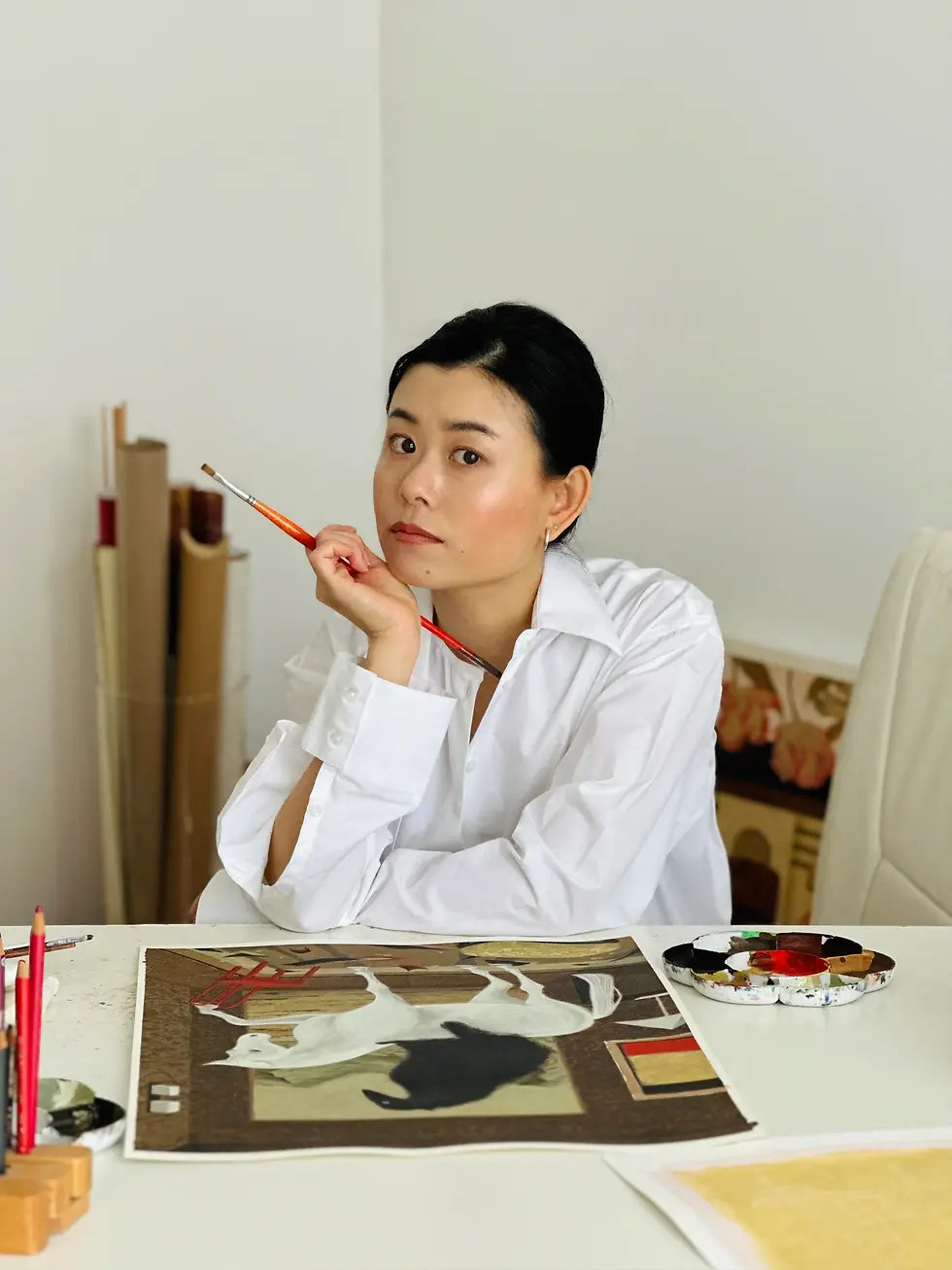
Xufei Qiao
Xufei Qiao work focuses on the relationship between nature and culture. Having lived in various parts of the world, she has developed a practice that draws on both traditional patterns and natural elements to explore how people connect with the environment around them. After transitioning from the fast-paced world of fashion design, Qiao embraced a slower, more thoughtful approach to creating art. She often uses motifs like plum blossoms and peonies, reflecting on her cultural heritage while also looking at how these symbols relate to the present. Her work is about capturing the quiet moments in life and finding a deeper meaning in nature, people, and the connections between them.

Q: What stayed with you from those quiet nights riding through the neighborhood with your sketchbook?
A: When I first started learning painting at art school, my daily schedule consisted of copying classical oil paintings in the studio from 9 AM to 6 PM and wandering around the neighborhood alone at night. I felt that drawing gave me the motivation to explore the world around me, filling me with curiosity about everyday things. Following this impulse, I started riding shared bikes to places I'd never been before. Despite living in the same area for over twenty years, I discovered there were still many unexplored scenes within a two-kilometer radius.
What's fascinating is that whenever I plan to travel, the first thing I do is check Google Maps. Rather than following others' recommendations for popular attractions, I prefer the process of discovering things myself.
One cool summer evening, I followed the navigation to an urban forest park. I rode along the rubber running track, stopping to sketch whenever I saw scenery I liked. As darkness gradually fell, I reached a relatively open area with cobblestone paths and sand, with a playground slide made of wooden posts, stones, and cement at its center.
I could imagine how lively this place would be during the day, with parents chatting after dinner while their children played, people coming and going. But at night, the slide stood silent and solemn.
For me, the meaning of art is to guide us to discover those things in daily life that are overlooked, forgotten, or undervalued. I still can't clearly explain what exactly this experience brought me, but I will keep searching. And as long as this motivation exists, I can continue to draw.

Q: How did your shift from the pace of fashion to country life change what you wanted from art?
A: Between 2020–2023, I worked as a teacher at a fashion design college. Due to the pandemic, I worked from home for over a year, during which my daily work mainly consisted of responding to emails and attending video conferences.
Therefore, I had free time to drive to the mountains to see snowy landscapes, buy fresh vegetables at the market, and do aimless sketching. I never thought I would show these drawings to anyone, nor did I think about becoming an artist.
Later, I returned to the city to continue my design work. The cycle of creating fashion prints was quite fast—sometimes more than ten designs per month—which meant there was little time for research and not enough time to appreciate the results.
Gradually, I began yearning for longer-term projects and ultimately decided to shift my career focus to painting. It was that year-plus of rural living that led me to make this decision.

Q: You mention sketching trees and rocks by hand—what does that slower process give you?
A: While living in the countryside by the mountains, I led a relatively simple life. When surrounded by fewer material possessions and immersed in nature, I felt compelled to create something with my hands, using drawing to enrich my spiritual world.
The surrounding area was filled with hillsides and valleys, dotted with sparse coniferous and deciduous trees. I believe few people specifically go out to draw bare tree branches in winter, but I was drawn to the intricate complexity of the trunks and branches.
In winter, except for the dark green of pine trees, everything else was brown and gray, and without leaves and grass in the way, it was easier to observe the direction of branches. From the bottom roots connected to rocks, to the trunk, to the forked branches, and up to the smaller twigs in the crown, I would draw these curves on paper while imagining the tree's growth trajectory.
At those moments, what mattered was the energy connection, not accurate composition and proportion.
Trees represent my yearning for nature, and even after returning to city life, I still frequently observe the trees around me.
Sometimes I'm amazed to discover that the plants and trees surviving in road medians or building crevices grow straighter and taller than those in the mountains—their vitality isn't suppressed, but rather becomes more resilient.
Q: In your work, cultural memory and natural forms seem to overlap. How do you know when they're in balance?
A: I think this question can be understood from several perspectives: visual elements, painting themes, and self-identity.
Natural elements frequently appear in my artwork, from small things like plants and animals to large features like mountains and sky. Especially when sketching from life,
I tend to use relatively abstract lines and pointillism to represent natural objects, while in contrast, I use geometric blocks to depict human-made landscapes, buildings, and streets.
This way, order and chaos coexist in my work. The harmonious unity between humans and nature has also been a long-term theme I pursue. Paintings like "A Brief History of Forests" and "The Canary" both revolve around the symbiotic relationship between humans and nature—the former tells the history of forests in a more rational way, while the latter is more personal.
For a long time, I kept pet birds at home. Between the ages of four and five, my closest daily companion was a white-collared starling that my grandfather had rescued. As a result, I learned how to communicate with animals before I learned how to communicate with people.
Sometimes I find it easier to interact with animals than with humans. Perhaps I don't deliberately try to balance human and natural elements in my work, but rather honestly present the world as I see it.
Q: How do traditional motifs like plum blossoms or peonies carry personal meaning for you?
A: This relates to my ten years of experience as a textile print designer for fashion. During this time, I did a lot of freelance work, and one of my most memorable experiences was designing Chinese silk at a traditional fashion house.
Besides doing extensive historical pattern research, I encountered many Qing Dynasty antique embroideries that were part of the owner's collection. I would often excitedly search for design inspiration among boxes full of embroidered fragments.
Plum blossoms, peonies, orchids, and bamboo are common motifs in Chinese silk patterns, and I would willingly spend time understanding the thousands of different interpretations of the same design element—different weaving methods, yarn materials, color combinations, flower arrangements—where slight variations in any of these details would create new designs.
This experimental method of variation has followed me into my painting practice. Moreover, these pattern elements are symbols of my cultural identity; they are my spiritual home.
Q: Has moving between cities and countries shaped the way you understand stillness or place in your work?
A: Stillness to me means "continuous change." For a long time, I struggled to describe and analyze things clearly and logically. I think this stems from growing up in different cultural backgrounds as a child.
Each language has its own culture and way of thinking, and if you speak several languages, the language you use most when thinking becomes your dominant mode of thought.
These experiences have made my thinking somewhat disjointed, which manifests in my color usage when creating. Whether in design or painting, I always maintain two or more visual styles simultaneously during the same period.
This aesthetic variation and self-cycling have gradually become a solid part of my art practice.