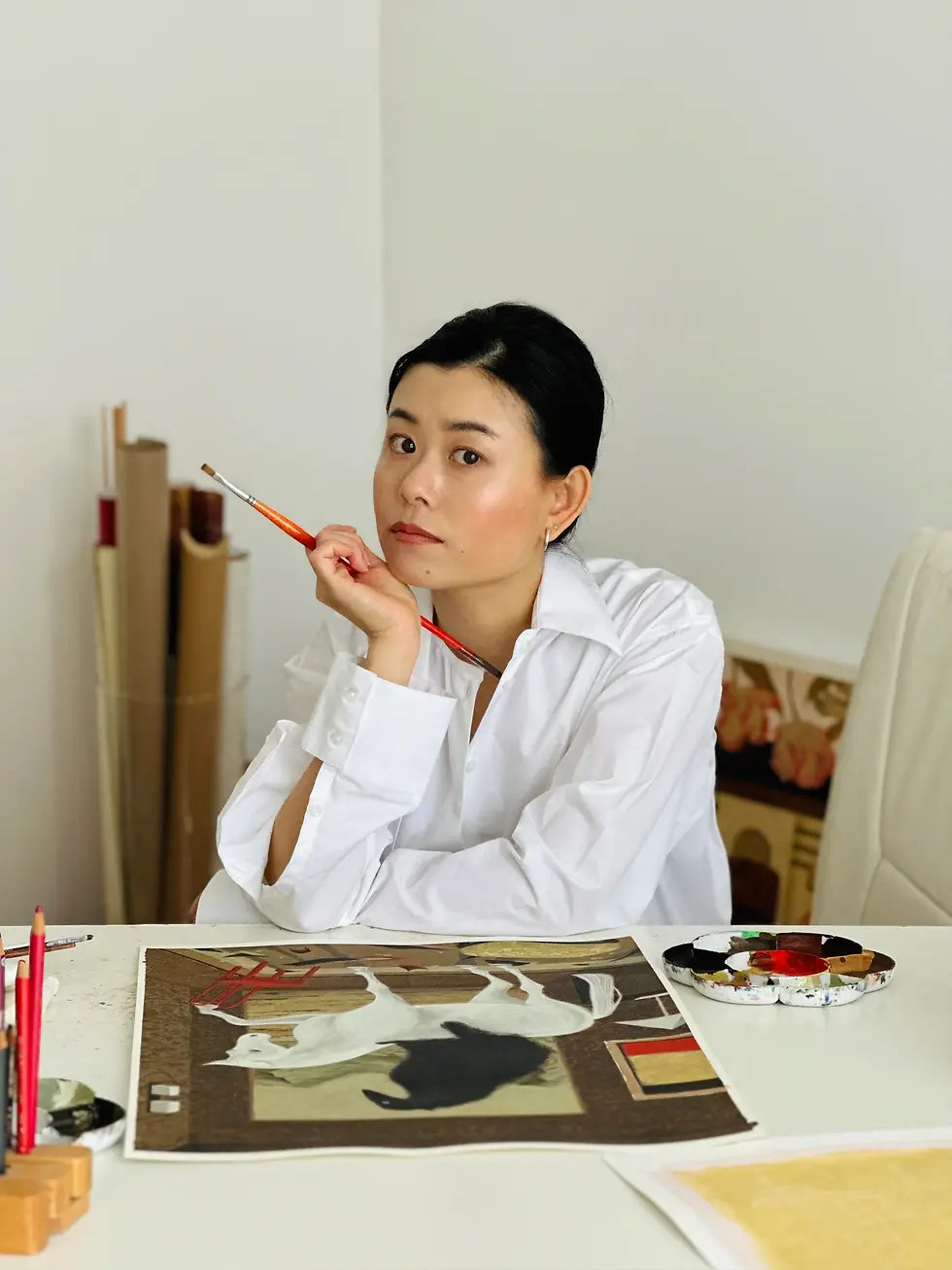
Tanvi Ranjan
Updated: Jan 30
Tanvi Ranjan is a textile artist based between Mumbai and Silvassa. She started in the knitwear industry, working with industrial machines and jacquard software, and later set up Mechaniya, a studio where she works closely with women on both digital knitting and hand techniques like embroidery and crochet. New works usually begin with a motif from Indian textile history, which she sketches, programs, and tests on the machine before developing it into a finished knitted surface. Her process is based on repetition, collaboration, and daily work in the studio.

Q: How did Mechaniya first take shape, and when did it become clear that it would grow into your main way of working?
A: Mechaniya first took shape at a moment when my practice and my circumstances aligned in an unexpectedly meaningful way. I had been working with jacquard knits since the start of my career, and was intrigued by how this technology could become a medium for storytelling; a place where pattern, memory, and emotion could live together within knitted code. After completing my MFA at Kingston University, I had worked and exhibited in the UK, but I was drawn to explore this further back home in the context of India’s heritage and history.
Around the same time, I met Namrata through her family’s long-standing textile business. She saw something in my work that resonated with her own sensibilities, and our conversations quickly revealed a shared desire to build a new kind of textile language, one that honoured tradition but wasn’t bound by it.
What began as an exchange of ideas soon grew into a collaborative vision. We realised that we were both drawn to the threshold space between the handcrafted and the machine-made, and to the belief that the machine, when approached with sensitivity, could be just as expressive a tool as the hand.
That thought became the seed of Mechaniya. It became clear that this would evolve into my primary way of working when I understood how naturally my artistic instincts aligned with the philosophy we were building. Mechaniya allowed me to bring together everything I cared about — language, codes, repetition, symbolism, women’s stories, and the emotional intelligence of textiles. It gave me the freedom to experiment with the possibilities of code, pattern logic, and technical knitting. It felt less like starting a new path and more like stepping deeper into the one I had been walking on for years.
That moment of recognition that this hybrid “mechaniya-made” space could hold personal expression and cultural inquiry made it clear that this wasn’t just a project. It was the foundation of my studio practice going forward.


Q: At Mechaniya, you work with both hand techniques and digital jacquard programming. How do you usually begin a new piece within this setup?
A: I start a collection of works with a motif or theme rooted in Indian heritage — something evocative, meaningful, often drawn from stories, traditional arts, or cultural memory. That initial idea triggers a period of visual and contextual research: we gather references, explore motifs, and sit with them until they begin revealing new possibilities.
From there, I make rough sketches and outlines, trying to visualise how the motif might live as a textile, preserving its spirit while imagining how it could transform through knitting.
Once the design direction feels resonant, we begin translating that vision for the knitting machines.
We choose from reclaimed yarns or factory-excess materials, and select a palette (restricting ourselves to a maximum of eight shades) based on what’s available and what the design calls for, while balancing practicality with intention.
Then comes the heart of the hybrid process: using specialized knitting software, we begin to build the design pixel by pixel, each pixel corresponding to a knitted loop created by the machine.
In this digital “canvas,” the artisans interpret each pixel with a colour, translating the original sketch into a data-driven design.
Finally, when the digital version feels right, we bring it into physical form: the design is programmed into our knitting machines and the knitting begins. Depending on the piece, we often translate these digital pixels into something tactile and textured using hand techniques like crochet or embroidery, thus adding human touch to the digital backbone.
In this way, every piece at Mechaniya starts from heritage and human impulse, moves through research and digital translation, and through a dialogue between technology and craft becomes a textile that carries both code and care.
Q: You describe a knitted jacquard as holding memory, labour, and repetition. Which of these ideas do you return to most as you work?
A: Of the three, I find myself returning most often to repetition. Repetition is where memory and labour quietly accumulate. In a knitted jacquard, every loop is the result of a repeated action, a coded instruction, a rhythm carried out thousands of times. It mirrors the way stories, motifs, and traditions survive — through being done again and again, not always consciously, but faithfully.
As I work, repetition becomes almost meditative; a digital handicraft where each pixel is carefully plotted. It slows me down and forces attention.
Within that repetition, I begin to sense labour — not just the physical effort involved, but the collective labour of artisans, machines, and systems working together. Memory then emerges naturally, embedded in the structure itself rather than applied as a narrative layer.
For me, repetition is not monotony; it is a method of holding time. It allows the textile to absorb traces of process, decision, and care.
By the end, the jacquard no longer feels like an image alone. It feels like a record of sustained making, where memory is woven in through repeated acts.


Q: Training underrepresented women is a core part of Mechaniya. How has this collaborative way of working influenced your practice?
A: Training and working with underrepresented women is not separate from my artistic practice at Mechaniya — it actively shapes it. Because our process is collaborative, ideas don’t flow in a single direction. While I may begin with a concept or motif, the piece evolves through continuous dialogue with the artisans, and often becomes richer because of it.
This collaborative way of working has taught me to slow down and listen, and to allow space for learning, questioning, and shared problem-solving. Because jacquard programming sits at the intersection of craft and technology, the process becomes a site of exchange: skills are passed on, but ideas also flow back to me, often reshaping the work in unexpected ways.
There have been many moments where the artisans have transformed an abstract idea into something more tangible and emotionally resonant. In one of our pieces, for instance, the blessings from Goddess Lakshmi were initially depicted through a symbolic hand gesture, the Varada Mudra, often used in images of boon-granting deities, with the hand facing outward and pointing down.
It was during discussion at the studio that the artisans suggested adding the visual element of coins flowing from the hand, turning an invisible blessing into something felt and seen. This authored detail added a sense of playfulness to the design, packed with personal stories. Similarly, when working on larger motifs, the women often take ownership of the details, debating which traditional patterns should fill smaller sections, or whether a particular area feels too flat or lifeless. More than once, someone has paused the process to say, “This needs to be redone.” Those decisions come from building visual intuition and familiarity with pattern, repetition, and rhythm.
Training women who have so far had limited access to technical or creative roles has also sharpened my sense of responsibility. The work is not only about the final textile, but about building confidence, authorship, and agency through making.
Over time, this has influenced my practice to become more intentional, more patient, and more rooted in process rather than outcome. At Mechaniya, collaboration isn’t an addition to the work — it is the work.
Q: In "Chaos in Padmalīlā", what were you most focused on as you transformed those motifs?
A: When we made "Chaos in Padmalīlā", my intention wasn’t just to remix imagery. It was to engage with the rhythm and structure of a sacred composition at its most elemental level. This work is part of a series called "Padmalīlā", which is inspired by the Pichwai paintings that have origins in Deccan India.
The lotus and its surrounding motifs create a devotional field that’s rich with meaning and presence.
With "Chaos in Padmalīlā", I literally cut that visual field into many squares, then jumbled them around like unresolved pieces of a puzzle. The work became a study of what happens when a canonized composition, one that is steeped in sacred order, is fragmented and reassembled. My focus was on preserving a sense of narrative tension even as the forms lose their original context: how can the language of lotus petals, temple arches, and sacred geometry still resonate when it’s broken apart and reassembled? The challenge was not to make the motifs chaotic for its own sake, but to allow the transforming grid to reveal new spatial rhythms, relations, and emergent forms that speak back to the original devotional source while also telling a contemporary story.
In essence, "Chaos in Padmalīlā" leads us to question — what stays alive when an image is deconstructed and what new life emerges? How does a devotional composition translate when its elements drift into new constellations? My attention was always on balancing fragmentation with continuity, letting the jumbled pieces suggest resonance rather than randomness.

Q: What part of Mechaniya’s direction are you most interested in exploring next?
A: The Padma (lotus) motif anchored our first collection, but it also opened a door. Mechaniya is moving gently outward from where it began. I’m curious about how a single motif can travel across cultures, gather new meanings, and still retain its essence. Right now, we’re working on a small capsule inspired by Japan, not as a literal translation, but as a conversation. I’m interested in what happens when the lotus is seen through a different cultural lens, when it pauses, adapts, or subtly transforms.
We’re also keen to expand our tactile language. We want to experiment with new textures, pushing what computerized knitting can do, and then interrupting it with hand techniques. I like the tension that arises when something precise meets something intuitive, when surfaces become layered, imperfect, and alive.
Collaboration feels like another natural direction. We’d love to work with makers across textiles, furniture, and clothing, to see how this digital craft can slip into objects of use, turning them into unexpected forms of utility art. These aren’t add-ons; they’re extensions of the same inquiry.
And at the heart of it all is our studio practice: continuing to grow alongside the women artisans we work with. Upskilling them in design software, but also the everyday technologies that support communication and confidence, as well as hard technologies that enable us to create. For me, this is not about scale, but about depth.
What interests me most about where Mechaniya can go next is expansion without dilution, allowing the language we’ve begun to speak to travel, gather new accents, and return changed.