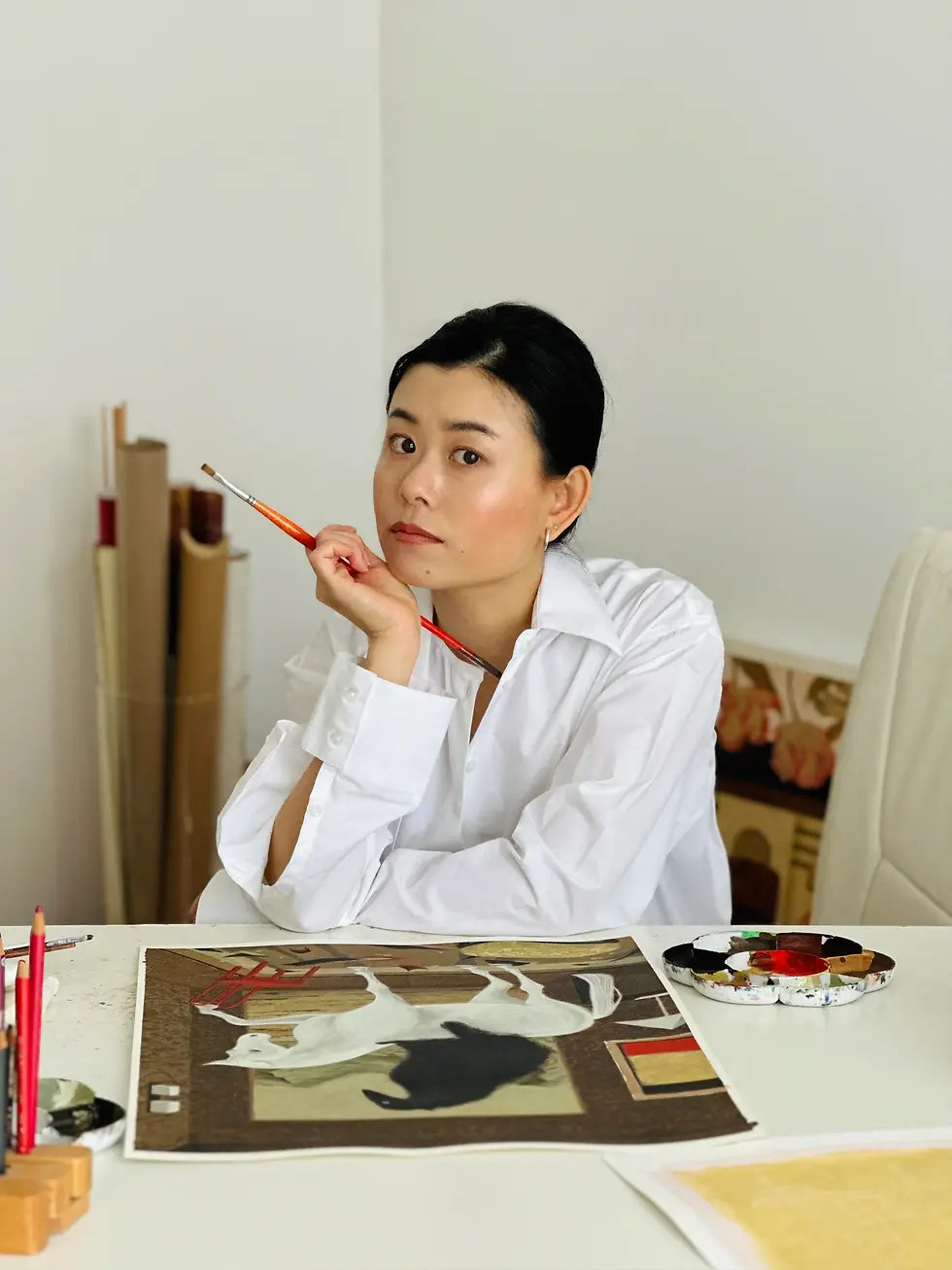
Stephanie Kim
Updated: Apr 29, 2025
Stephanie Ji Young Kim works with materials that absorb emotion. Ink, powdered color, rice paper. Each one chosen for its sensitivity, its ability to hold feeling. Her compositions often start in memory and build through quiet, intentional layering. Rooted in traditional Korean painting, her work moves between cultures, emotional states, and fragments of landscape. Nature appears often but always filtered through experience. Her titles suggest mood, but the real weight sits in the surface, where texture and memory meets.

Q: You work with rice paper, ink, and powdered color. What keeps you drawn to those traditional materials?
A: I majored in traditional Korean painting in college, so I’ve been working with ink and rice paper for a long time. Rice paper is incredibly sensitive to subtle changes in ink tone — it feels as if the paper and I are moving as one. It’s a very intimate and responsive material. Powdered color, a pigment used in traditional East Asian painting, also offers a unique vibrancy that’s different from Western materials. These mediums allow me to express emotions with a quiet, refined intensity that I find endlessly compelling.
Q: Nature shows up again and again in your work. What kind of landscapes stay with you?
A: I often reinterpret landscapes I’ve seen from memory. While some of my recent nature-based works weren’t included in this feature, they continue to be a central part of my practice. Natural scenes stay vividly in my mind.
I lived in Connecticut for a long time, and the fall foliage there left a deep impression on me — it’s something I still carry in my visual memory.

Q: In pieces like "Daydream" and "Separated", texture feels quiet but deliberate. How do you think about layering?
A: In "Daydream", I used thin layers of glue and ink to create a soft, overlapping effect. At the time, I was exploring the idea that even when people are in the same physical space — whether dreaming, thinking, or speaking with each other — their internal spaces can be entirely different. That contrast was the concept behind the layering.
Although it may look spontaneous, around 96% of my composition is intentional. "Separated" was more about emphasizing dissonance between coexisting spaces. I wanted to show how, even within the same environment, one person might carry strength while another feels completely stuck, like a stone. I built layers using bold textures, applying strong mediums beneath the rice paper, then added powdered pigments and ink to complete the piece.
Q: Memory seems to shape a lot of what you make. What tells you a piece is getting close to something true?
A: Memory is the core of who I am. Our memories and experiences shape our identities — without them, we lose a part of ourselves. When I’m working, there are moments when I feel completely unified with the rice paper and color. That’s when I believe I’m expressing something deeply truthful — bringing forth a part of myself in its purest form.

Q: Living between countries changes perspective. How has that shaped the way you see the natural world?
A: I believe what we see is always filtered through memory, thought, and experience. Having spent time in around 18 different countries, I’ve learned that even the same mountain can feel completely different depending on the lens of your experience. Living between cultures has expanded the way I perceive landscapes — it’s not just about the external form, but about how my memory shapes the experience of nature.
Q: Your titles often point to a feeling. Does emotion come first — or after the work takes shape?
A: Emotions are both shared and discovered. Sometimes I begin a work with a specific emotion or memory in mind. Other times, as I paint, unexpected feelings surface. That’s one of the reasons I love working with rice paper and ink — they capture even the subtlest emotional nuances and transmit my energy directly into the work. The emotion may come first, but the act of painting often leads me into deeper, sometimes forgotten emotional landscapes.