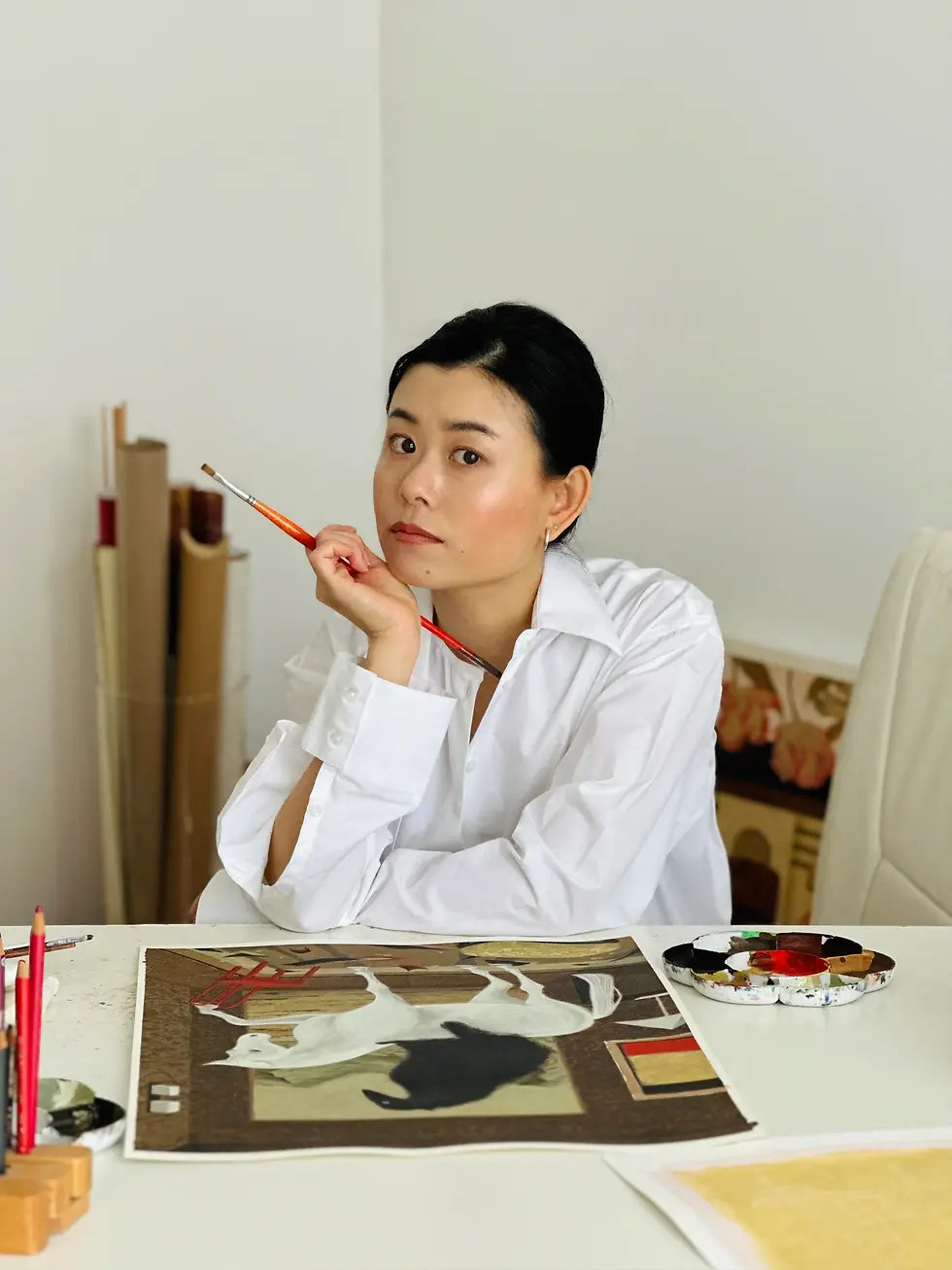
Romina Carrea
Romina Carrea’s work moves through small gestures and quiet tensions. Drawing from memory, archives, and her own body, she builds images that feel like traces—of presence, absence, or something in between. Photography, objects, and fragments of text come together in a language that resists spectacle. She leans into the subtle and the ephemeral, letting layers build slowly. The result is intimate, steady, and full of feeling, like something that speaks just under the surface.


Q: You describe your process as intuitive. What does that actually look like in practice?
A: It reveals itself in the initial impulse that draws me to choose one thing over another. I begin from an apparent chaos, uncovering clues, signs, epiphanies—flashes that call to me instinctively. At some point, connections start to emerge, like in those games of connecting the dots, and that's when I begin to pull the thread, and the underlying structure unfolds before me—one that was always there, waiting.
It's a moment of inner revelation, a deeper part of myself that, if I allow it to whisper to me, offers up an idea or concept. Then, with all those signs gathered, the narrative starts to build, and from a clearer awareness, I begin to organize and refine the puzzle.
It’s interesting how the process reveals itself and finds its form each time, depending on the project I’m working on. "How to turn this swamp into a garden", from which these images come, is an artist’s book that began with the color pink and the idea of the feminine lineage. Since storytelling is one of the most classical ways to transmit legacy, the project is conceived as a book—a pink book.
Q: What keeps you drawn to the space between the visible and the sensed?
A: Potential—the field of possibilities. I believe that between perception and the visible lies an infinite register. The air, that space that seems to both separate and connect us, holds all the information. I’m deeply interested in what we, like antennas, are able to pick up from there.
To put it in current terms, I think of it as a kind of organic artificial intelligence—a data field that contains what was, what is, and what could be... It’s there, available to anyone willing to receive it.
An expanded nervous system, where every shift resonates through the entire matrix.
In my process, that’s the place I draw from—first intuitively, and later, through matter—it becomes the essence of my work.
Q: Repetition shows up often in your work. What does returning to the same image allow?
A: Repetition is a question, a way of probing. I return to the same idea, the same image, hoping some element of it might reveal itself to me. I repeat as if, in that act, what the image hides might be sublimated—but it resists. And that resistance is exactly what draws me in.
Sometimes, the most revealing thing is the question itself, and all the spaces it leads us through.
Q: Fragility seems to shape how you build each piece. What does that offer you as an artist?
A: A space where fragility becomes strength, not limitation. To inhabit the most vulnerable place, to allow ourselves to be transformed by what threatens us.
That sensitivity can be understood as our most powerful tool—one that enables regeneration, adaptation, and new ways of perceiving. Not something that leaves us behind, but something that empowers the emergence of a new form: more capable, more real, more attuned to the present.
We’ve grown used to hiding our weak spots, but it is precisely in that space where we can be challenged, awakened, questioned, even transformed—and if we’re lucky, it’s where the alchemy begins. There’s nothing more alive… nothing more human.

Q: How do personal and inherited memories show up while you're working?
A: Memories, thoughts, and ideas coexist all at once, intertwining constantly. When I work with memory, it’s because it opens up another possibility—a rewriting of what has been. If I return to them, it’s because they’re still alive and still have more to reveal.
I trust in the capacity to rewrite our stories, and in that movement—seemingly from back to front and front to back—a space opens for reinterpretation, for giving new meaning to what we tell.
I find in artistic expression a possibility for redemption.

Q: When does a piece start to feel like it holds presence, not just form?
A: When it no longer echoes only within me, but when others begin to find in it revelations that go beyond my original intention—when it takes on meanings that exceed me. It becomes an autonomous entity, alive, revealing itself to new viewers. That’s when it starts to accumulate new layers of meaning and subtlety, transforming into something independent. From that moment on, it’s the piece itself that begins to question me.
The photograph "Here is my shadow" was one of the last pieces to join the project. Through it, I realized I was truly engaging in a dialogue with my legacy. It was taken by my great-aunt, with whom I share a striking parallel: we both take photographs, we both explore the concept of shadow, and our mothers share the same name. The photograph is also dated on the very day my mother was born—a kind of split of the same character across a different point in time, within the same family.