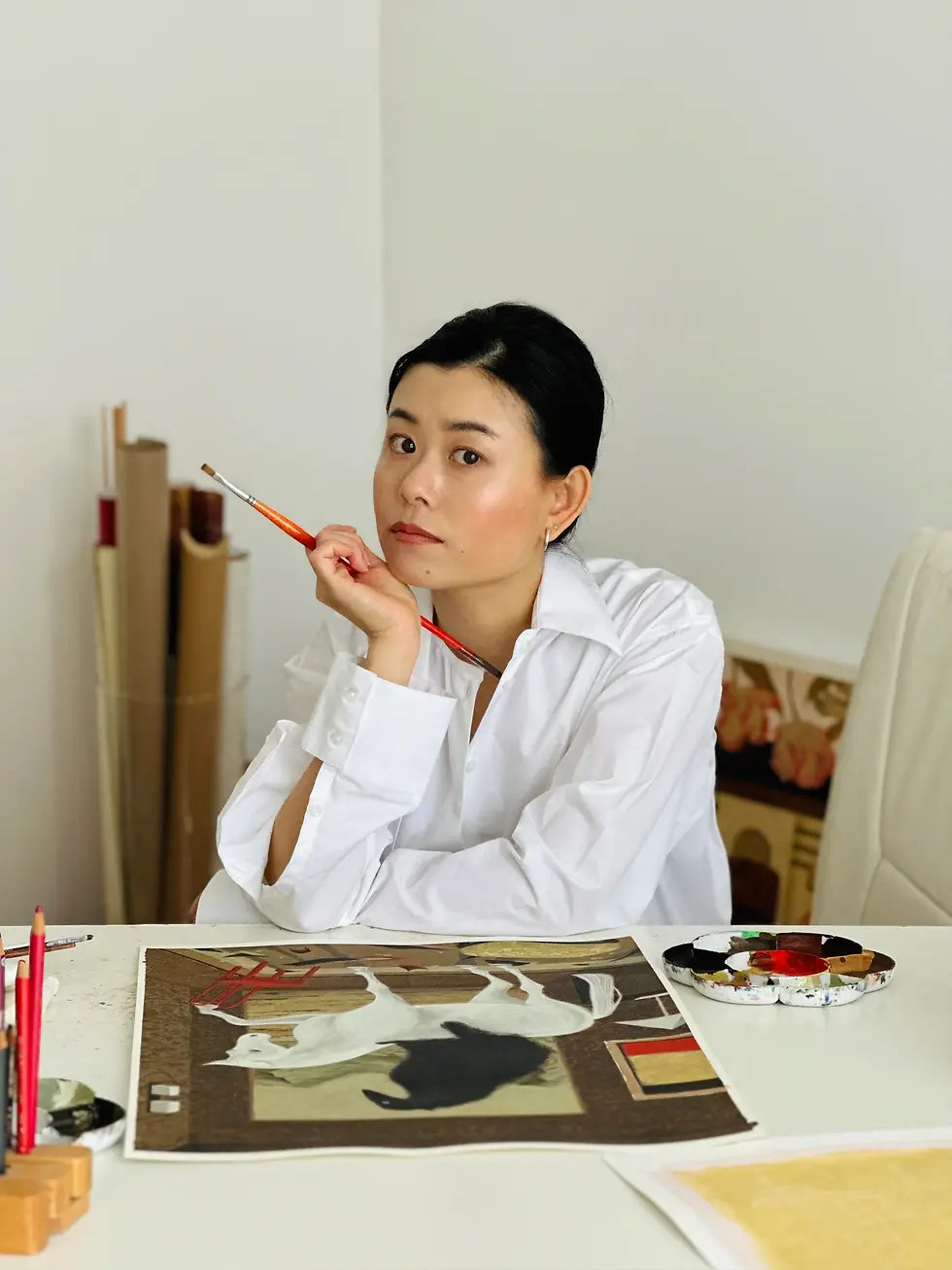
Olivia Jones
Olivia Jones builds her paintings like dream-spaces, drawn from half-remembered buildings, road trips, and fleeting impressions. Her background in architecture shows up in the strong lines and structured depth, but everything else feels fluid—like light hitting something just right, then slipping away. These are places you’ve never seen, but they feel familiar. Somewhere between design and daydream, her work invites you to step into the unknown and stay there for a while.

Q: What keeps you coming back to in-between spaces and abandoned structures?
A: I believe there are several reasons why I gravitate toward these spaces. On the surface, my background and interest in architecture naturally draw me to these types of structures, and my skill set allows me to design and visualize them. However, beneath this lies a deeper fascination with liminal spaces and derelict buildings. What captivates me is the sense of wonder they evoke as transitional spaces, acting as thresholds between the past and the future.

Q: How do you balance loose gestures with precise lines in your compositions?
A: Before beginning a new painting, I usually explore the type of composition I would like to execute.
I create a series of thumbnail sketches—sometimes on large A1 sheets in the studio, other times in a small sketchpad while on the move. These early studies are focused purely on the structure and the arrangement of form.
The initial work on the canvas is intuitive and expressive, characterized by gestural marks and recurring patterns that emerge naturally. It’s a process of letting go and responding in the moment, setting both the emotional and visual tone for what follows. As the underpainting develops, certain details begin to capture my attention. I find myself drawn to specific elements, working to incorporate them into the composition.
In the past, I would become quite attached to them—sometimes to the detriment of the painting. Over time, however, I’ve become more restrained, allowing the needs of the overall composition to take precedence. This balance between spontaneity and control, intuition and refinement, is central to how I work.
Q: Where does memory come in when you're building these imagined places?
A: Long road trips, train journeys, derelict buildings, and industrial sites have always sparked my imagination. These environments carry stories—layers of history, decay, and transformation—that resonate deeply with me.
However, at times, ideas arrive unannounced—as a sudden form or vivid pattern flashing through my mind, often charged with emotion. It’s a powerful, almost surreal moment, and I’ve learned to honour it and follow where it leads. While capturing the exact image from these visions is rarely possible, I’ve come to see that as a strength rather than a limitation. It allows the work to evolve, to take on a life of its own. These moments now serve as jumping-off points, and I respond by sketching as many variations as I can that capture the essence of the idea. Each piece becomes part of an ongoing conversation between memory, intuition, and material.

Q: How do you know when a painting is done—especially one that keeps evolving?
A: That’s a great question. My work is rooted in a search for balance between light and dark, stillness and movement, detail and space. I’m drawn to the way colours interact, and how negative space can enhance complexity. Much of this comes down to intuition. Some pieces flow easily; others might evolve over months or even years. I’ve learned to make peace with that feeling of uncertainty, and more often than not, those unfolding works end up being the most interesting.
Q: What are you guiding the viewer toward with your use of depth and perspective?
A: For the most part, I aim to guide the viewer into an immersive space that feels unfettered, weightless, and exhilarating. These internal spaces stand in strong contrast to their exteriors, which are often anchored by rigid horizon lines or solid blocks of colour. The transition invites a sense of release—as though stepping from a defined, grounded world into one of limitless possibility.
Q: Do you see your painted spaces more as escape or confrontation?
A: I see my paintings as places of escape rather than confrontation. That may say something about me, as I’ve always been a bit of a daydreamer, and someone who tends to avoid conflict. My creative process reflects that impulse, offering a refuge where the imagination is free to wander. Through these layered spaces, I hope others might find a moment of wonder or a place to retreat.