Marleigh Culver
Marleigh Culver is a Los Angeles painter, originally from Virginia. She works in abstraction, often paints plants, mixes all her colors by hand. She also works in design and art direction, and has been on Tappan Collective's roster since 2016.
We talked about the Ellsworth Kelly painting that got her into abstraction as a kid, the difference between her graphic and her intuitive work, how she picks colors, and what she wants to make next.

Q: How did you first become interested in abstract painting?
A: I first became interested in abstract painting when I was very young. My parents used to take us to museums, and I absolutely fell in love with Ellsworth Kelly’s work at a museum in Washington, D.C. I found the vibrating colors of the large pieces very alluring. It felt like I was seeing for the first time. I was also very interested in Matisse’s interiors because they felt so fun and messy. I think I was in elementary or middle school when I was drawn to that era of his work.

Q: When you start a new work, how do you build it between geometry and more fluid elements?
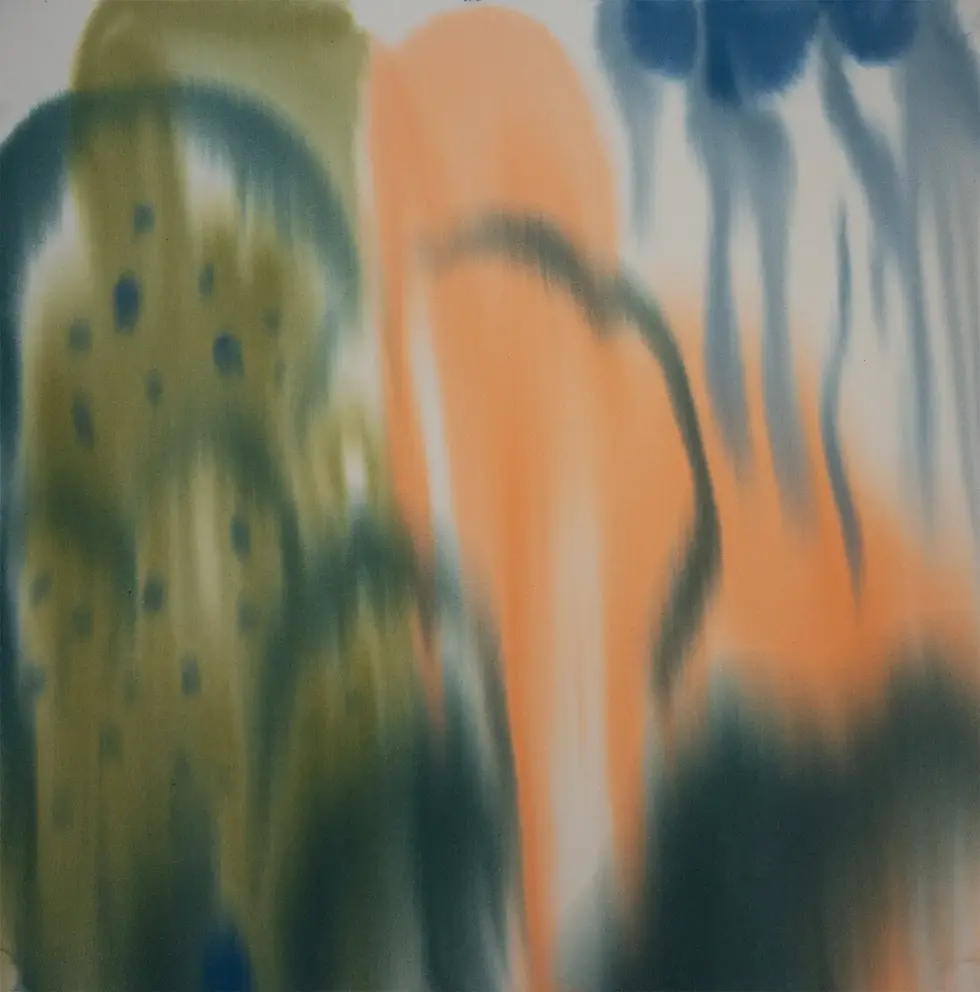
A: This is interesting because I usually make work that is either/or and haven’t combined them very often. For any of my pieces that feel flow or blurriness, that is all intuitive and of the moment, with no planning. The only thing instructing me is the colors of paint I mixed, and that sort of speaks to me in what colors to lay down in succession. For my graphic pieces, those are planned out on the computer via sketching. I like doing it that way because it’s very flexible and quick, and I can explore a lot of color options.
Sometimes I’ll just draw shapes on pieces of paper and see what feels right. But for the graphic work, I like being able to splatter and smack the brush down on the canvas to give it some attitude and imperfection. I think perfect lines for my work look too boring and simple, so I invite a little mess.
Q: How do you think about form while you’re painting?
A: It’s funny because I sort of hate that the canvas can’t just be infinite. I both love and loathe constraints and perimeters. So when thinking about a piece, it’s working with a shape, which most of the time is a rectangle, and then it depends on the day, but I’m more into horizontal, it feels like a hug, it’s welcoming.
Vertical is more severe, judgmental, high and mighty. When I make shapes in these orientations, it’s like a fight between lazing and standing guard. That’s why I wanted to start softening the shapes and make everything enmeshed. I like mystery, and I love for people to make their own meaning of my work. Form to me is always thanking nature through reflecting its being. I love curvature (the Kelly influence) and shapes of leaves and petals. I also like how round boulders can be, yet they are so strong. Softness with weight interests me.

Q: You work with strong color pairings. How do you choose colors for a piece?
A: It’s an intuitive process. I mix all my colors when painting, and I think I’ve definitely built my own palette over the years. Choosing color is answering to my gut feelings. At the start of painting, I take out a test strip of canvas and put a swatch of all the colors I have on hand, see what I need to add, and then I’ll pull 3–7 colors to work with that I think feel nice together. I just really love color.

Q: Your palettes can feel both soft and intense at the same time. How do you work with that contrast?
A: That’s so nice to hear! And funny as well, because I have always been told I am good at acting on the masculine and feminine sides in my work. I think there is a sensitivity there, and an understanding of rage and grief, so I like mixing colors that encapsulate all of that complex feeling of life.
Q: There's a strong sense of precision in your edges. How do you achieve that?
A: A careful hand, and if it’s a printed artwork, I can’t take too much credit since I’m working with vector shapes, and as a designer I love for the edges to be smooth. It bothers me when I look at digital work that hasn’t been cleaned up. In my paintings, I rarely do super clean edges or super geometric/graphic work because I like things to feel they have a little life to them. There are pieces where I have to be very gentle with shapes to make sure they look clean. Like I mentioned, a steady hand, and hopefully my dog isn’t barking and distracting me so I can reach a flow state.

Q: What does working as an abstract artist mean to you right now?
A: Abstractness is freedom to me, and it’s very important to create a space of openness for people to approach my work and respond naturally. Authority can be suffocating, so I like to make work that feels free and loose and with vitality.
Q: You also work in design and art direction. How does that background affect your creative process?
A: I’m pretty efficient. I juggle a lot of things, so the rules in design give me lots of energy to release when it comes to painting. It helps my planning process and is very helpful in presenting my ideas and work in a pleasant and digestible manner.

Q: What keeps you returning to plants in your work?
A: Because nature is not manmade, it’s incredible and very healing. I spend time a few days a week hiking and in my backyard, laying in the sunshine with the fragrance of jasmine blanketing me. I grew up with a grandma and nana who grew happy flowers and lovely food. Plants are life!
Q: What are you interested in exploring next as an artist?
A: Large works, mobiles, more dessert and art crossovers. I took an oil painting class from my friend John last month, and I’m curious to see how I can translate it into my own practice. I just want to keep making things that are beautiful and are touching to peoples’ souls.


