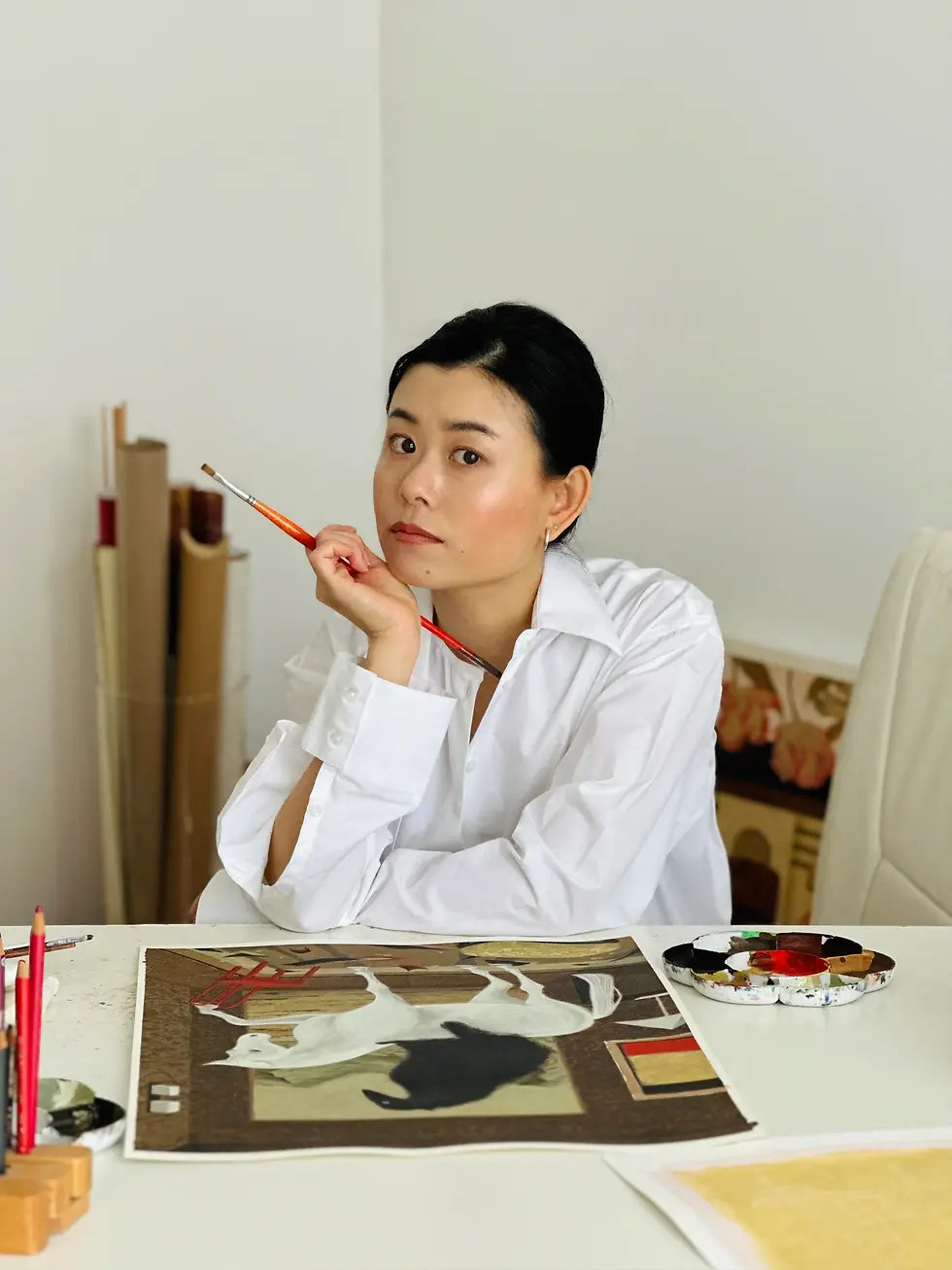
Lucy Baturina
Lucy Baturina’s work reflects on how emotions, memories, and physical states are connected. She works with painting, drawing, and installation to explore how certain moments leave traces. Her figures often seem paused in open space, as if caught in a thought or feeling. She’s interested in small gestures and quiet shifts, in the kind of presence that doesn’t need to explain itself. Her process is intuitive and open-ended, shaped by mood, materials, and time. Whether on canvas or in space, she follows what feels real, even if it stays unresolved.

Q: When did painting start to feel like a way to make sense of what's going on inside you?
A: I fell in love with painting and art from a young age, ever since I started attending professional art classes. While other kids went to school, I found myself drawn more to my art studio and my mentor, who became a guiding presence in my life. In the beginning, I was simply learning how to navigate the fundamental elements of art, but even then something deeper was happening. Painting quickly became more than a skill; it became a form of therapy and escape. At a very young age, I discovered that creating art gave me a way to process emotions I didn’t yet have words for. I often feel completely lost in the process of painting, as if time disappears. It’s in those moments that I connect most with myself. Over time, art has become not just something I do, but a way I understand and make sense of what’s going on inside me.
Q: You mention bending reality to match emotional truth—has that ever helped you see something more clearly in your own life?
A: Yes and no. For me, bending and transforming reality isn’t just a means of emotional expression, it’s also a form of escape from the rigid, academic art education I received in Russia before continuing my studies at Central Saint Martins. The art scene and educational approach here are very different from what I was used to. In Russia, there was a strong emphasis on tradition, discipline, and technical precision. Here, there's more freedom to experiment and break rules. So in my art, I’m constantly trying to find a balance between these two very distinct worlds. Distorting reality has become one of my subtle ways of breaking the rules, what would’ve been considered "naughty" or even unacceptable back in my academy days. It’s my way of pushing boundaries, blending discipline with personal freedom. By doing this, I’m not only creating my own visual language but also redefining what painting means to me, somewhere between structure and instinct, control and rebellion.
Q: In "Mental Illness," there's this mix of watching others and looking inward. Do you often catch glimpses of yourself in other people?
A: I wouldn’t say I catch myself in other people. The figures I paint are often individuals who happen to be around me during the time a work is being created. Through them I often project or echo my own emotional states and personal experiences. These figures become vessels, not literal self-portraits, but deeply personal ones. They carry pieces of my inner life, even when they bear someone else’s face.
For instance, the triptych "Sleepless Night" features three figures caught in the grip of nightmares, suspended in a state of unrest. None of them depict me directly, but they each embody aspects of my own experience with night terrors and the vulnerability that comes with fractured sleep. The painting is autobiographical not through likeness or self-portraiture, but through emotional resonance.
When it comes to the piece "Mental Illness", the intention was slightly different. That work wasn’t so much a reflection of a personal relationship or narrative, but an investigation into the idea of distortion, both physical and psychological. It was about exploring the fragmentation of self-perception and the quiet violence of internal disorder. At the time, I was in a period of intense introspection, and perhaps without realising it, I was engaged in a kind of self-inflicted probing, an attempt to make visible something that’s often hidden or denied.
In the end, even when the work isn’t consciously about me, my presence still leaks through gesture, form, or the emotional tension that sits beneath the surface. It’s less about depicting myself, and more about revealing what it feels like to be me, in certain moments.

Q: Does working with different materials bring out different moods or sides of you?
A: It absolutely does. Working with different materials doesn’t just bring out different moods, they uncover distinct facets of my identity and perception.
Each medium I use demands something different from me, and in return, it opens new ways to think, feel, and express. It keeps me alert and responsive. That constant sense of unpredictability keeps me engaged, driving me to keep experimenting and see how each medium brings a unique perspective to the work. I work with oil, acrylic, gouache, pastels, and graphite. Each one offers its own kind of language. Oil allows for depth and layering, slow and considered movement. Acrylic dries faster and pushes me to work with more immediacy. Gouache brings a delicate opacity and flatness that I find emotionally quiet, even intimate. Pastels and graphite feel raw and physical, there’s something about the immediacy of mark-making that makes the process more direct, even confrontational at times.
What I find most compelling is how each mark shifts in texture, in resistance, and in its level of control or spontaneity. That variation not only enhances the surface, but also adds emotional weight and complexity to the piece. The materials don’t just serve the work, they shape it, often in ways I don’t fully understand until the painting is finished.
Q: With "Red Lights," the figures feel connected but separate—did they grow out of the same idea, or come together later?
A: "Red Lights" initially began as a digital experiment, a triptych born out of playful, intuitive manipulation in Photoshop.
I was exploring unconventional compositions by layering multiple faces and features on top of one another, disrupting traditional ideas of portraiture and spatial logic. The process felt chaotic in a productive way, a kind of visual improvisation that allowed me to break apart and reassemble the human form in unexpected ways. At the heart of this work was an interest in distortion, not just visually, but psychologically. I was experimenting with pure, saturated colours and intentional disfigurement of the figure, challenging the boundaries between beauty and discomfort, identity and anonymity. The digital process became a sketchbook of sorts, guiding how I approached the physical painting with a clearer sense of mood and structure, yet leaving enough room for intuitive decisions on canvas. While the figures began as compositional tests, they eventually took on lives of their own, each embodying a different emotional charge, yet all emerging from the same fragmented emotional state. In the final triptych, there's a tension between their connection and their separation, a visual echo of inner conflict, isolation, and the push-pull of intimacy and detachment.

Q: Do dreams play an active role in your work, or do they just slip in without you planning it?
A: A significant part of my work is rooted in dreams and, more specifically, nightmares. They aren’t just passing experiences—for me, nightmares are a persistent part of my daily life, often lingering long after I wake. Painting them, or rather visualising them in new and abstracted ways, has become a vital form of processing and release. Rather than recreating the dreams exactly as they appear, I translate their emotional weight, the anxiety, distortion, and fragmentation into my compositions. Through colour, form, and texture I attempt to capture the mood of these subconscious episodes: the feeling of being trapped, observed, or dissolved. There’s a kind of therapeutic alchemy in turning these unsettling inner experiences into something external and visible. For me, painting these dream states is not just creative expression—it’s survival. It allows me to confront what haunts me, not through words or explanation, but through a visual language that feels more honest and instinctive. In a way, each piece becomes a soft confrontation, a moment of clarity carved from chaos.