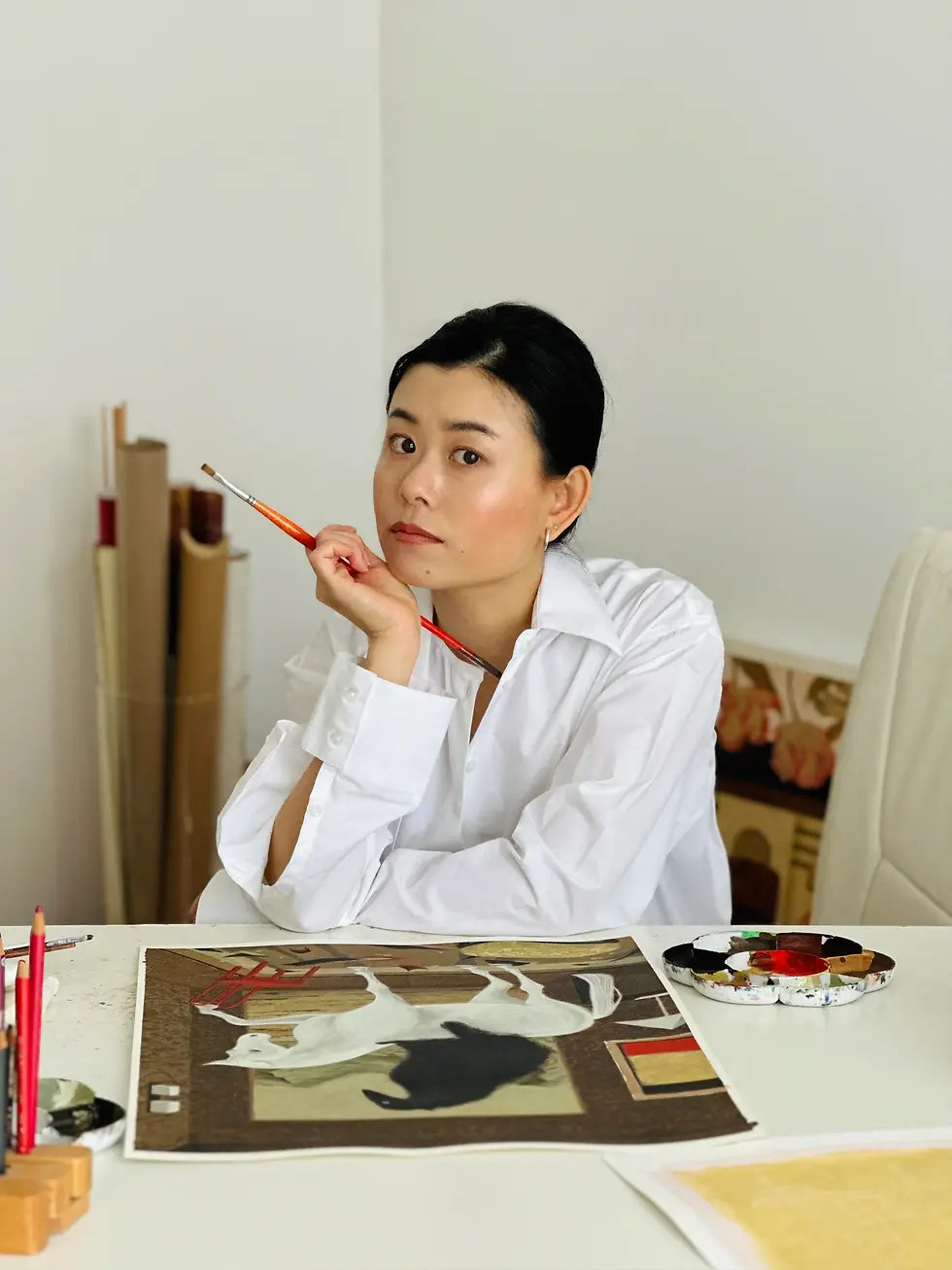
La Boom
La Boom is a duo: Eliza Mamonova and Almira Zakieva. They started the studio five years ago after they kept meeting on the same projects and realising they were already building one thing from different sides. They work across CGI, light and spatial design, making work for their own practice and developing concepts for other artists and events. Their references tend to come from outside the discipline, from whatever they are reading, watching, or bumping into. Their project Fluid Matters started from one question: can something intangible feel physical? It uses simulated liquid and light to build sensations that feel real but have no fixed form. They are based across Europe, currently between Barcelona, Belgrade and Paris.

Q: How did La Boom start? How did the two of you begin working together?
A: La Boom started five years ago as a natural continuation of something that was already happening. For a couple of years before that, we kept meeting on the same projects, each as an independent creative. At some point, it became clear our collaboration was the thing.
One of us came from stage direction and developing audiovisual concepts in events. The other came from CGI, design, and art direction. Different backgrounds, but the same instinct that the work gets richer when you look beyond it.
We were building the same thing from different sides. So we started La Boom.
From the beginning, the practice moved across formats naturally: CGI, space, light. Not as a strategy, but because that's where the ideas and projects went. Working across formats felt less like expansion and more like curiosity.
Q: You work as a duo, Art Director and Creative Director. How does the collaboration work between you?
A: In practice, it feels more like a shared creative mind than two separate roles.
Everything starts in conversation: messages, voice notes, calls. An idea takes shape gradually, through exchange rather than individual thinking.
A big part of the early process is defining a visual direction. Our references rarely come from CGI. We look at what's around us, what we're reading, watching, experiencing. Often the work is fed by everything outside the discipline.
Then comes the R&D process: understanding how textures, surfaces, and atmospheres actually behave. How light moves through a system. Even in CGI, we're chasing something that feels physically real. As the concept develops, one of us gravitates toward material and technical logic, the other toward narrative and rhythm. We both stay involved until the last frame to make sure the idea doesn't get lost along the way.

Q: You create your own projects but also develop concepts for other artists and events. How do those two sides relate for you?
A: There's no real separation. The approach is the same, only the context changes. Personal projects give complete freedom. Commercial ones come with a brief, but a brief is just a starting point. We still bring the same way of seeing, the same visual language, the same questions about how the work would make someone feel.
Part of what we do is also about shifting how CGI is perceived. Not as a production tool, but as a medium that carries meaning and shapes experience.
In the end, both directions shape each other. It's one continuous body of work.

Q: Fluid Matters works with light and liquid. What got you interested in those two elements?
A: Fluid Matters is probably the project that best reflects how we approach work in general. The starting point was a simple question: can something intangible feel physical?
Light and liquid don't hold a fixed form. They respond, shift, transform. We were interested in how they influence each other, and how the perception of a surface changes through motion. The process was largely about simulation: building fluid behavior, then watching how light moves through it. At some point, it stopped being about representing something and became about constructing a sensation.
Fluid Matters is about making the invisible feel present through movement, texture, transformation. It's a theme we keep returning to, in different materials, projects, and contexts.

Q: Every project at La Boom is carefully chosen. What makes you say yes to something?
A: A few things have to align. We need to find the task genuinely interesting and see real visual potential in the idea or product. And the client has to be open to a creative perspective, not just looking for someone to produce visuals.
The projects that work are the ones where both sides are invested in what comes out.
We're a boutique studio because creative and art direction aren't a phase for us. They run through the entire project. That requires a client who understands the value of that involvement, not just the deliverable.

Q: You're based between Barcelona and Belgrade. What's next for La Boom?
A: In reality, we're not tied to one place. We're based across Europe, and this year part of the team is in Paris. The practice has grown organically from local to international, following the work rather than any particular plan.
What's next is more fashion and beauty, more experimentation with formats, and more of the kind of work that keeps us curious, and more people who feel the same way, whether as collaborators or as an audience.
Come closer and see what we do ;) (our slogan)