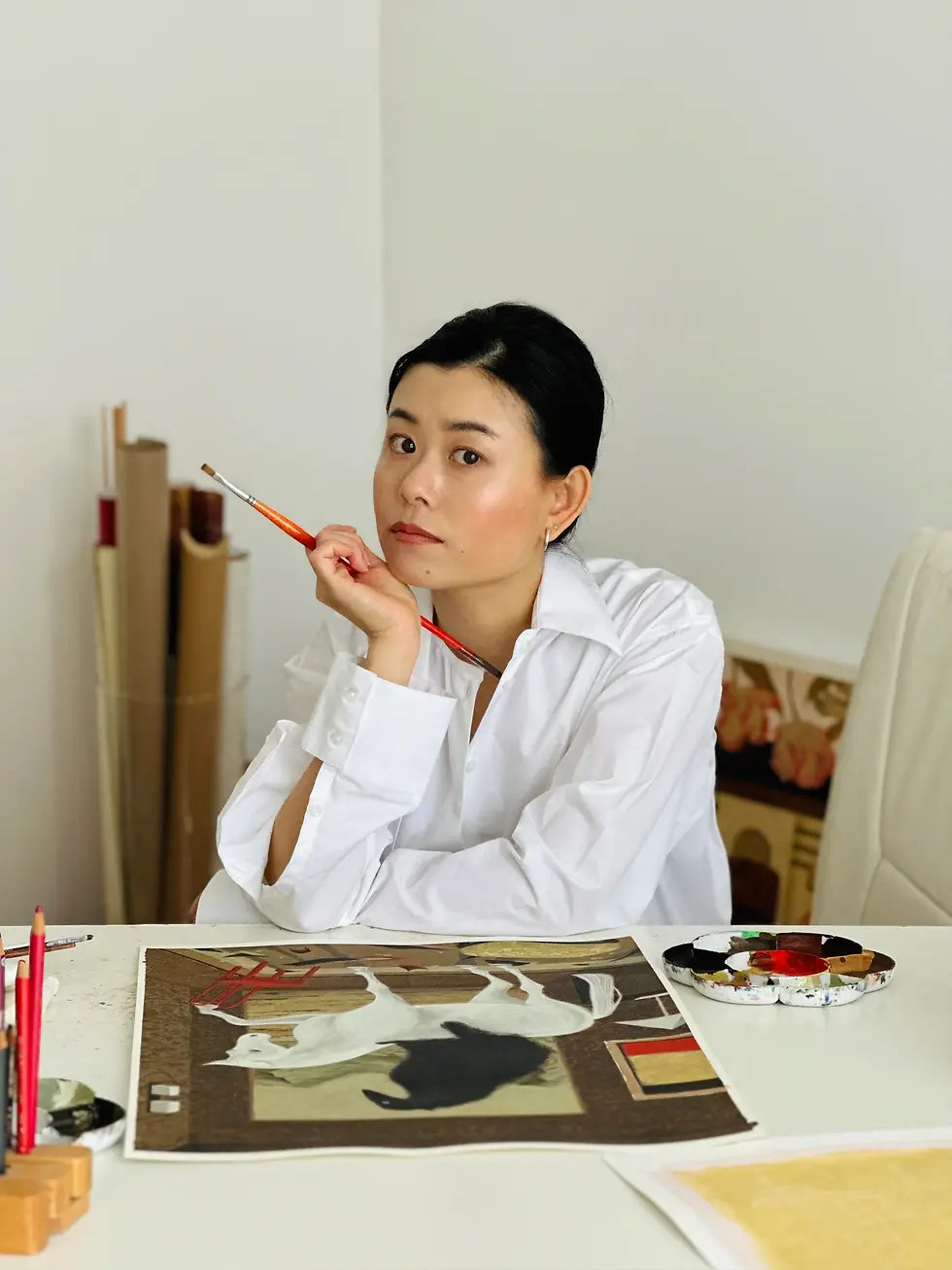
Janice Jensen
Janice Jensen is a German artist working with drawing, painting, and digital media. Much of her work starts outdoors, where she records movement and place through drawing. In her ongoing project “walkingwhiledrawing,” she uses a self-made device that marks a paper scroll as she walks. These drawings often return to her studio, where she develops them into digital or 3D works. Her process connects walking with making in a direct, physical way.

Q: What first made you want to turn walking into part of your art practice?
A: Most of my drawings and paintings are inspired by nature and landscapes, which I often experience while walking. Walking in itself is an important method for me to bring my thoughts in order and also to get new ideas. I think it is something about moving with my body through a space and looking at my environment, even if it is more or less unconscious, which calms me and helps me to be more intuitive and creative. My project “walkingwhiledrawing” began through searching for an artistic expression to represent my subjective perspective whilst navigating and walking through urban spaces and nature as a contrast to normative cartography. I wanted to explore the inherent feeling of movement through environments and how we might alternatively record how we individually perceive them.

Q: You built your own drawing machine for “walkingwhiledrawing.” What did that change in how you see the landscape?
A: When I walk and draw at the same time with my drawing machine, I have to be very attentive, as one of my rules is not to stop my walk and keep on drawing until the paper scroll is full.
I attempt to look at the landscape and almost draw without looking at the paper to keep a steady pace and not overthink the way I capture the environment. This way my drawings are rather gestural and become kind of symbols of specific landscape marks and references.
My view on landscape is altered in a way that I identify patterns that I might have seen in different environments before which allow my own transcriptive language of the landscape. A feeling of being very present and absorbed with what surrounds me is something that came from using this method of looking and drawing while walking.


Q: When you translate those walks into VR, do you still think of them as drawings?
A: Yes, I do. To create the VR landscape from my walks with the drawing machine, I first import my scanned analogue drawings in the virtual space to use them as a reference for my virtual drawings. Afterwards I use virtual drawing tools to draw all parts of my analogue drawing again and rearrange some lines in a spatial order to transform them into three-dimensional drawn objects. Drawing in VR gives the opportunity to re-perform my drawings through open gestural movements. In this way I consider the VR drawings as a further translation of the analogue drawing returning to its previous real-world dimensionality.
Q: Your works often sit between observation and imagination. Where do those two meet for you?
A: I am not really planning my works beforehand, it is mostly about how I feel and what interests me in that moment.
Aesthetically I am mostly inspired by nature’s organic patterns, like shapes of trees and plants, or specific landscape formations, for example big, round rocks that I observed on the coast in the Swedish archipelago of Björkö island or the shifting sand dunes in Nida, Lithuania. In my daily life, I often take photos of interesting light and shadow situations, color combinations, views through windows, cemeteries and ornaments in the streets. When painting and drawing, I use these images as an inspiration and combine them in an abstract composition, which does also bring up imaginative situations and things that I haven’t seen before.
So basically, my observations and imagination meet in a playful way while creating.

Q: How do collaboration and exchange with other artists shape what you make?
A: I have been working in different collaborative projects in the last years, being a member of a feminist collective that brings together artists and researchers to create and release our magazine publication. I am also part of an artist duo that is making spatial installations and performances. Sometimes these collaborations make me work on topics that I would not have chosen for myself.
Thinking together and experimenting with others brings up much more exciting ideas and makes things possible that I could not have done by myself. In residencies I often work site-specific and don’t plan too much in advance, talking to other artists is very important for me, even if the artists are working on different themes and disciplines. Being together in one spot and sharing a similar way of thinking is often causing very enlightening conversations which shape the way I create my work.


Q: When you start a piece without a fixed plan, what tells you it’s finished?
A: As it is the normal way I work, I already know that I will go through an initial process where I shape a piece more and more, which can also mean I spontaneously paint almost everything over and then start again.
I am mostly working in layers that begin to converge to the point of a finished work, which is for me a combination of dynamic strokes and shapes, a collection of colors that contrast each other in an interesting way and a composition which remains rather loose, then gradually becomes strictly planned. When I have the feeling these things are well depicted, however not too well evened out, that there is still some contradiction, I consider a piece finished.