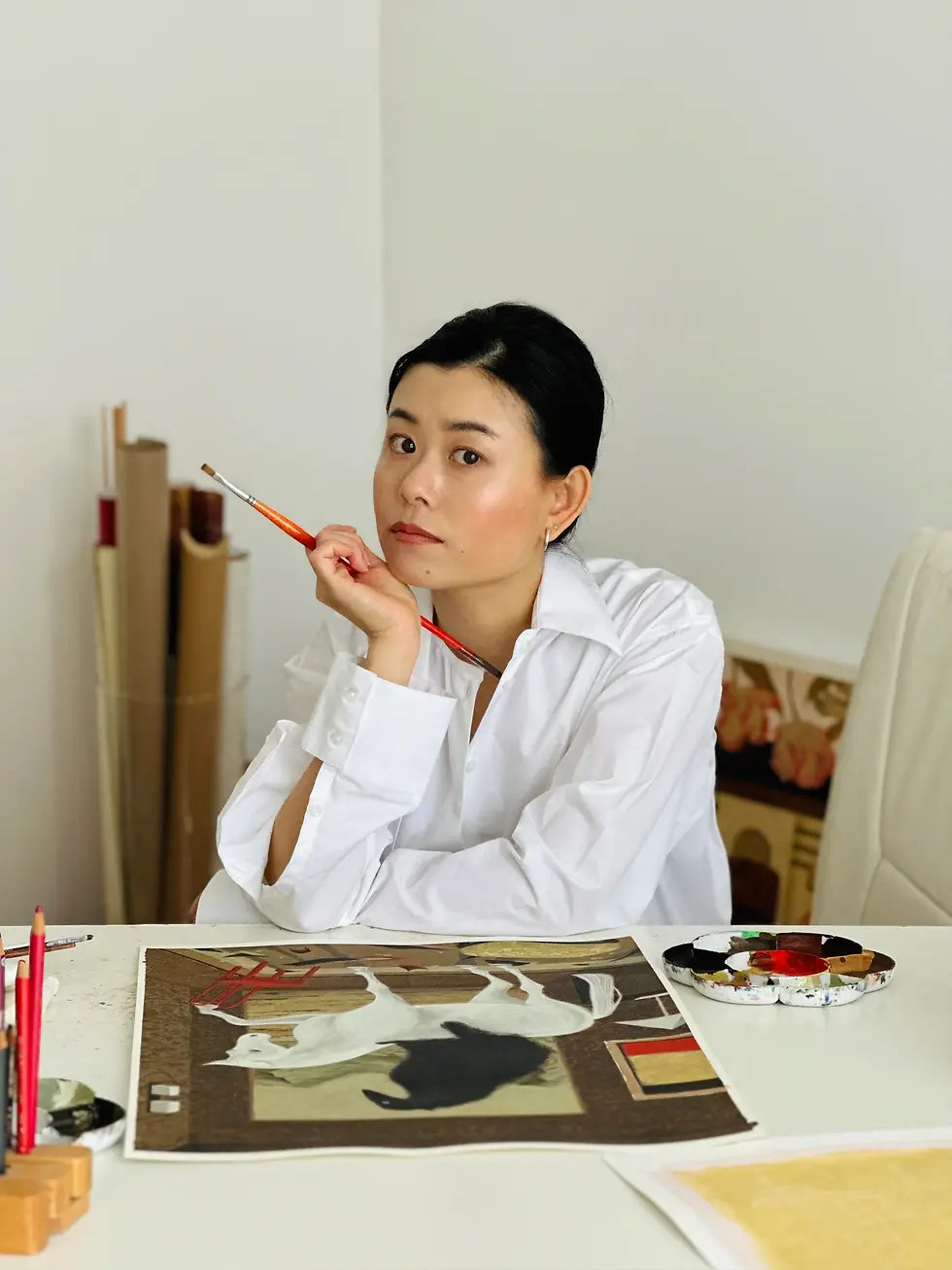
İlke Şahin
İlke Şahin is a Turkish artist living in London. She creates sculptures, installations, and films using metal, glass, and clay. Her background in architecture shapes how she constructs her work and approaches new ideas. Observation and patience play an important role in her process, as she works closely with materials and how they react. In works like “Beneath My Skin, Cells Under” and “Reach,” she uses touch and movement as part of making, leaving each piece room to change naturally. She often works in series, with each artwork building on the one before. Some of her works continue to change after completion, shaped by air, light, and space.


Q: You mention urticaria and skin reactions. How do those experiences feed into your process?
A: I’ve had various skin conditions since childhood. My mother used to say, “We have thin veins, sensitive skin and stomachs; that’s why nothing serious ever happens to us. These sensitivities warn us before a major illness and protect us.” I internalised that from an early age. Every time I got sick, or when a skin condition reached a serious stage, I felt empowered, as if my skin was protecting me, warning me.
As I grew older and distanced myself from my family culture, I realised that this way of perceiving fragility and sensitivity as a strength wasn’t very common. The sharp division between illness and health, one as something to be cured and the other as something to be preserved, has always felt strange to me.This perception of the body connects to patriarchal systems' binariness: life and death, health and illness, strength and vulnerability, all of which can also be examined through anthropocentric approaches. My work, however, emerges from a more holistic vision, empowered by the gap between being harmed and remaining unchanged. The act of scratching my skin when I’m stressed, tearing and wearing it out with my nails, can easily be seen as harm, a self-destructive gesture. But I perceive it as my body’s way of communicating, a mechanism of protection, a way of existing. My process is rooted in and structured on these psychological and dermatological experiences.
Q: What draws you to materials that rust, corrode, or change over time?
A: The connection I feel to metals is that both metal and skin, when scratched and wounded, undergo oxidation — a process through which a new, altered surface is formed. I like to name this new form as oxygenaties: entities that transform through exposure to oxygen; those who reveal a new surface through decay, healing, or rust.
The relationship that oxygen establishes with skin whenever it finds the slightest opportunity is not so different from its relationship with metal.
Oxidation that begins from the tiniest scratch is called a wound on the skin, and rust on the metal. That moment of surrender, when the material starts behaving beyond control and prediction, is what fascinates me most.
In other words, the myriad of ways in which the responsiveness of matter (such as skin as a whole system and metals) to external forces are a big inspiration in my approach to art. Each response/reaction that catches my attention pushes me to create different works and methodologies.


Q: When you work with materials that change on their own, where do you draw the line between control and accident?
A: I can never say that I have full control, but calling it an accident wouldn’t be accurate either. I name my medium as material performance and performance installation and I see my role as the artist as staging a scene, setting up a system where the materials themselves become performers and co-authors.
I decide on the type of metal, its position, how it follows gravity, where water will enter, how much vinegar will reach it, the same way a performance artist writes a script through their body. The rest I entrust to time, to the environment, to the materials themselves.
I think both of us, an artwork and me as co-authors, have the same amount of dominance on the control of the whole process. However, if I had to define a boundary between control and accident from my point of view as one of the authors, I would look at the installation process. More specifically, the process of adapting the work to a new space and when a new set of dynamics occur between spatiality and materiality. At that point, I lose control the most. My influence completely dissolves and I become a mere director. Sometimes I try to manipulate the process, to make sure all recipients can experience the same point on the timeline of the artwork that I am especially fascinated with, but I never succeed. The materials refuse to be tamed. Maybe that’s exactly why I choose them.

Q: When your works keep changing over time, what keeps you connected to them?
A: I’d say stubbornness and curiosity. I’m constantly wondering what happens in that silent wrestle between my intervention and the material’s own agency. Watching that struggle, knowing I’ll never live long enough to see its conclusion, only fuels my fascination.
Facing the vast temporality of the material accentuates different time perceptions, and the sense of scale becomes almost playful.
Q: “Beneath My Skin, Cells Under” feels raw and physical. What kind of moment were you chasing there?
A: I think that sense of rawness comes from not trying to perfect the surface, not hiding the traces of the layers, but instead allowing the material to reveal its own qualities, its own way of entering the world. The work begins with that intention and continues as I literally scratch the surface with my nails, integrating urticaria into the material process itself. “Beneath My Skin, Cells Under” was inspired by a sentence I wrote: “Concealed by each scab, fresh cells wait to decay with the sun.”
The word raw feels incredibly fitting here, both in its emotional and literal sense, so I’m glad the work was perceived in that way.
Q: “Reach” sits somewhere between contact and distance. What does that space mean to you?
A: In my MA Thesis from 2020 titled Haptic Art Object in the Context of Phenomenology of Perception, I look through the concept of haptic. While I was working on alternating the description of the term haptic, I focused on a type of perception and sense production that vaults the distance between the perceiver and an artwork without the existence of any tactile action.
The idea of researching the coexistence of the concept of haptics and the art object with a phenomenological approach in the focus of material perception and tactile perception/experience forms the basis of this study. Both theoretically and practically, tactility in the distance from touch interested and inspired me.