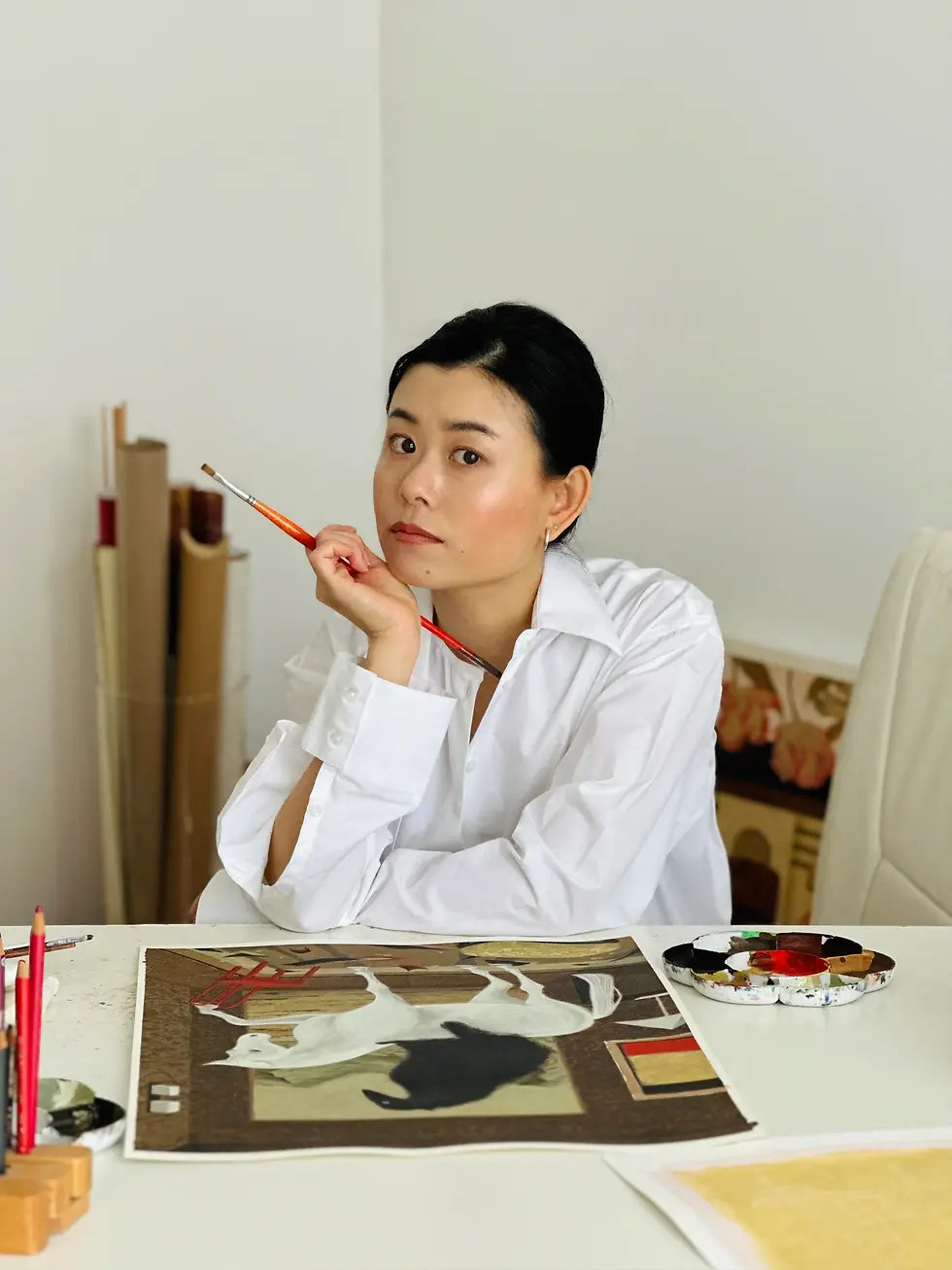
Ina Lee
Ina Lee’s work often begins with something small. A texture, a pattern, a shift in light. She follows those details across drawing, painting, and digital media, building forms that feel both precise and improvised. She works by testing, layering, adjusting.
Her pieces reflect how things change—visually, emotionally, over time. Some grow slowly, others take shape all at once. What stays consistent is the focus: how a mark, a shape, or a surface can hold movement, memory, and direction all at once.

Q: You describe your work as a visual record of self-growth. How do you know when something you’ve made reflects a fundamental shift in you?
A: My work is a visual record of self-growth, fostering connections across paintings and digital art. Each piece reflects an ongoing evolution—unfinished works push me forward, while completed ones reveal my progress. At times, paint flows effortlessly, aligning with my vision and reinforcing my sense of artistic liberation. This self-growth is evident in my thematic and stylistic connections, from evolving structures and natural formations to expanding colour palettes and complexity. My pieces document personal development, shaped by emotions, composition, and the meanings behind each creation. Similarly, my digital work reflects growth through experimentation. Once avoiding human references, I gradually embraced them, challenging myself while preserving my abstract style. Shifts in technique, colour, and exploration mark my progress, recorded in canvases and digital files alike. Every work—sketch, painting, or graphic—captures a shift within me. My process embodies reflection, revisiting, and reworking, manifesting self-growth in skill, vision, and mindset. This continuous evolution fuels my passion for creation and change.

Q: In pieces like "Bloom" and "Ebb and Flow", you balance fluid, organic movement with precise detail. How do you find that line between control and chaos?
A: The line between control and chaos in my work is often blurred, yet I’ve realized how much it influences my artistic process. While both elements contribute to dynamic and engaging pieces, their balance is essential. My high school teacher’s advice—“Know when to stop; sometimes too much is too much”—continues to shape my approach, helping me refine my instinct for restraint despite the natural chaos of my creative process.
In "Ebb and Flow", chaos took precedence. Created during a turbulent flight, my frustration with its lack of development and my struggle to push my skills forward fueled the piece. Its contrasting thick and thin lines, interwoven in small quantities, reflected my anxiety, the turbulence, and my initial aversion to the work itself. At first, I saw only disorder, but with time, I recognized its completion. This piece reaffirmed my need for balance—while chaos drives my process, reflection allows me to assert control over it.
Conversely, "Bloom" required precision from the beginning. As a pen-and-paper work layered with suminagashi print, control was critical—every dot shaped the composition, and a single misplaced mark could shift the entire focus. Unlike "Ebb and Flow", where chaos dictated my movements,
"Bloom" was structured, demanding a delicate balance between spontaneity and careful execution.
Navigating between control and chaos remains an evolving skill. I begin my pieces with fluid exploration, embracing instinct and movement, but my reflection process introduces structure, tempering the work. This interplay ensures that each piece captures the push and pull of creation—where chaos fuels expression, and control refines it.
Q: You’ve drawn inspiration from everything from candle smoke to the veins in your hands. What’s the last small thing you noticed that found its way into your art?
A: My most recent references in my work include mould, cells, and wet hair. It’s an unusual concentration for a piece, especially mould and cells. However, discovering bio art has been interesting as I focus on naturally forming patterns and formations. Typically, the idea of mould is that it’s ‘gross’ and something to avoid, yet I had never considered deliberately curating mould to be visually compelling. Cells, viewed through a microscopic lens and found across various media with circular formations, are incredibly eye-catching, which I refer to quite often. Over time, my work has evolved from references like smoke and petals to circular, rounder patterns. Usually, I choose anything I find visually compelling or that could push me further in my skills and visual patterns.
Q: The physical textures in "Interwoven: The Rhythm of Water and Light" bring sculptural energy to the canvas. What drew you toward working in three dimensions?
A: My main push towards this decision was due to my always two-dimensional work. It was always flat, and I wanted something to visualise a wave, so I had considered mesh, organza, silk, and fabrics in general. As I spent most of my time in the studio, I began fooling around with the hot glue gun and connecting circles with circles. This, to me, was genius. Hot glue was malleable; it was flexible enough to create the illusion of a wave, ultimately allowing me to turn two-dimensional art into something three-dimensional.
I wanted to work in a three-dimensional way to create something new. Values and contrast were only achieved with shadows and colours, and I wanted to explore something different and emulate shadows through a different factor.
The waves, the net created with the hot glue, allowed me to incorporate light into my work. It made shadows and helped emphasise them at the angle at which this piece was viewed. Water was referenced through the colours and underpainting bubbles. References to sea foam helped develop the painting, and the net referencing a wave helped create additional themes for the piece. The net also helped to create a reference to light, which was created through the projected shadows, a highlight of wanting to embed the idea of light into this piece.

Q: Your process often starts with intuition—freehand, open-ended, and unplanned. What does that kind of making give you that a structured approach doesn’t?
A: Freedom. Regardless of any plan or previous compositions, I never adhere to them. Usually, despite having a plan, it’s merely a rough idea of what I hope to see in my work. When I start creating pieces, I constantly contemplate my next step and continually develop ideas, meaning that plans are never stable. Even after finishing a piece, I often revisit it to improve and ‘better’ my pieces, further developing them to be up to my standards. Sometimes, structured approaches constrain my creativity, and I don’t feel compelled to follow them, as I am inconsistent. I typically gather ideas and refer to references as guidance, allowing me to create freely. Music, movies, and shows I may be watching extensively influence my work as I decide about the moment rather than through plans and genuine contemplation.
A structured approach often feels confining to me. I sometimes sense that I am bound to a rigidly planned composition, frequently leading to creative blocks. My work is primarily characterised by freehand expression, as it grants me the liberty to convey my emotions directly. I value fluidity and flow in my artistic process; therefore, adhering to strict rules and guidelines significantly impacts my craft. I’ve realised that abstraction resonates with me the most, as it provides the freedom I seek while working with the constraints of realism.
Q: You work across paper, canvas, and digital—how do you decide which medium a particular idea needs?
A: It comes across naturally when I feel inclined. I started working on it and will continue to develop it. However, sometimes I feel the urge to work within a particular medium at random moments unless there are projects due to an assignment or specific requirements, which is usually the only time I must choose. Another example occurs when contemplating a particular theme, referencing, and planning where I would develop and decide on the medium to use. If I want to employ fine lines, I typically gravitate towards graphics. If I wish to create a colour piece and experiment, I prefer to work with canvas. Most of the time, mediums come to light, and I decide based on my plans, thoughts, and feelings. If there is a particular aesthetic I want to portray, I outline it digitally and on paper to determine which medium would best serve that purpose. My choice of mediums mainly depends on what I desire, feel compelled to use, or what is available.