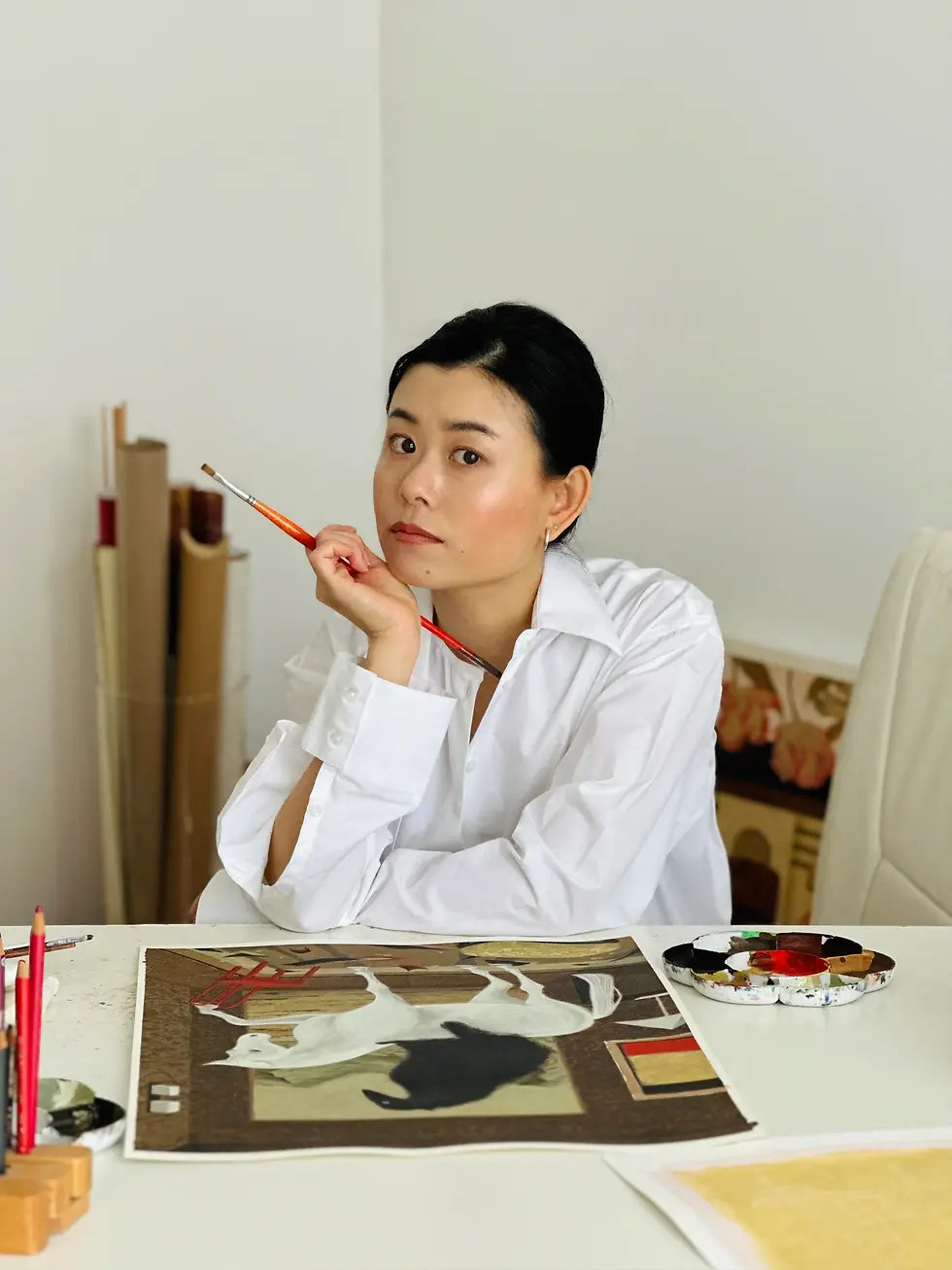
Filipa Figueiredo
Updated: May 30, 2025
Filipa Figueiredo builds her paintings slowly, using natural pigments she prepares by hand—often from minerals, rocks and shells she collects while traveling. The process is quiet and steady, almost like a form of listening. Working mostly with Japanese ink and color on engraving paper, she lets each layer find its place through rhythm and repetition. Her compositions feel open and reflective, shaped by memory more than image. The work invites stillness but holds something intense underneath. Whether shown in Portugal, South Korea, or South America, her pieces carry the same calm force.

Q: You learned to make natural pigments over a decade ago. What made you return to them after all that time?
A: I learned to make natural pigments in 2009 in India. It has always been a topic that interested me. As a child, I remember trying to extract colors from flowers and plants to paint on paper. When I returned from India, I continued to paint with my acrylic paints and Japanese ink, which was what I used at that time. In 2019, when I moved to a new studio, I discovered a remnant of a natural pigment that I had made in Puri, India, from a rock from the Dhaudia River. I decided to develop a series of paintings with this pigment. After this experience, I only use natural pigments—and sometimes Japanese ink—in the realization of my painting series.
Q: How do you decide where to gather your materials? Is it planned or more spontaneous?
A: When you talk about materials, are you referring to natural pigments? Regarding these, I travel to certain places specifically to find the types of natural pigments that work in paper painting. These pigments have to be from natural minerals, meaning that they come from rocks or shells. Great places to find them are, for example, Morocco, South Africa, India, Sri Lanka, and the south of France. For me, it's a wonderful reason to travel! In Portugal, a lot of natural pigments are produced, but more from plants, which are excellent for use in fabrics.
Q: Silence seems to be a recurring theme in your work. What kind of silence are you looking for when you paint?
A: This stay in India in 2009 changed a lot about the way I see things and the world. I used to go out a lot—I was always surrounded by many people and doing various things.
When I returned, I lost the desire for many things and began to seek solitude and to need to be in silence more. The name of this first series created with the pigment from the rock of the Dhaudia River is called "Stay Still." I think it represents what I needed, and continue to need since then. Please note, I am not a calm or still person—quite the opposite! All my artistic work until then had already addressed the issue of the distancing of man from nature, the excess noise, both visual and audible.

Q: Your pieces often hold this balance between atmosphere and texture. What makes that mix work for you?
A: I call them landscape atmospheres. Many people consider my work abstract, but it is not.They are all images that emerge in my mind—or even on paper—of imagined landscapes. The sense of atmosphere is caused by the dilution of the pigments and the texture by the agglomeration of them. If the pigments are really good, they gain ‘life’ and move to where they want, creating fantastic situations! I like to watch the evolution of the painting drying because they seem to have their own wills and desires, following certain directions and mixing with certain other pigments.
Q: You’ve shown work in so many different places recently. Does the location ever change how a piece feels once it’s up?
A: I never felt that the location changed the way of seeing a particular painting. What I feel—and what I have increasingly taken into account when I go to show my work—is that the place preferably has natural light. Natural pigments stand out a lot with natural light. If the place has little natural light, it should have specific lighting so that the people who are going to see the exhibition can have a real perception of the work.


Q: Is there a certain rhythm or habit you rely on when starting a new series, or does each one begin differently?
A: Normally, the series starts with the image that forms in my mind. When I begin the first painting, the others naturally emerge.
Music is a very important factor in the creation of my paintings—I always listen to music while I paint. Musicians like Hiroshi Yoshimura and Enno Velthuys, who in my view also explore the concept of soundscapes, are part of my constant playlist. But I listen to many other things, depending on what I need at the moment.
I have had two situations where I was specifically asked to work on a theme, and I must confess, it was difficult for me. At the beginning of this process, I felt blocked and lost. But after the images began to appear, I found the process quite interesting. Stepping out of my comfort zone is sometimes a good thing! Now, little by little, I am accepting challenges of this nature, developing my landscapes based on a specific place or theme. I think I will develop a project in this context either this year or next year.