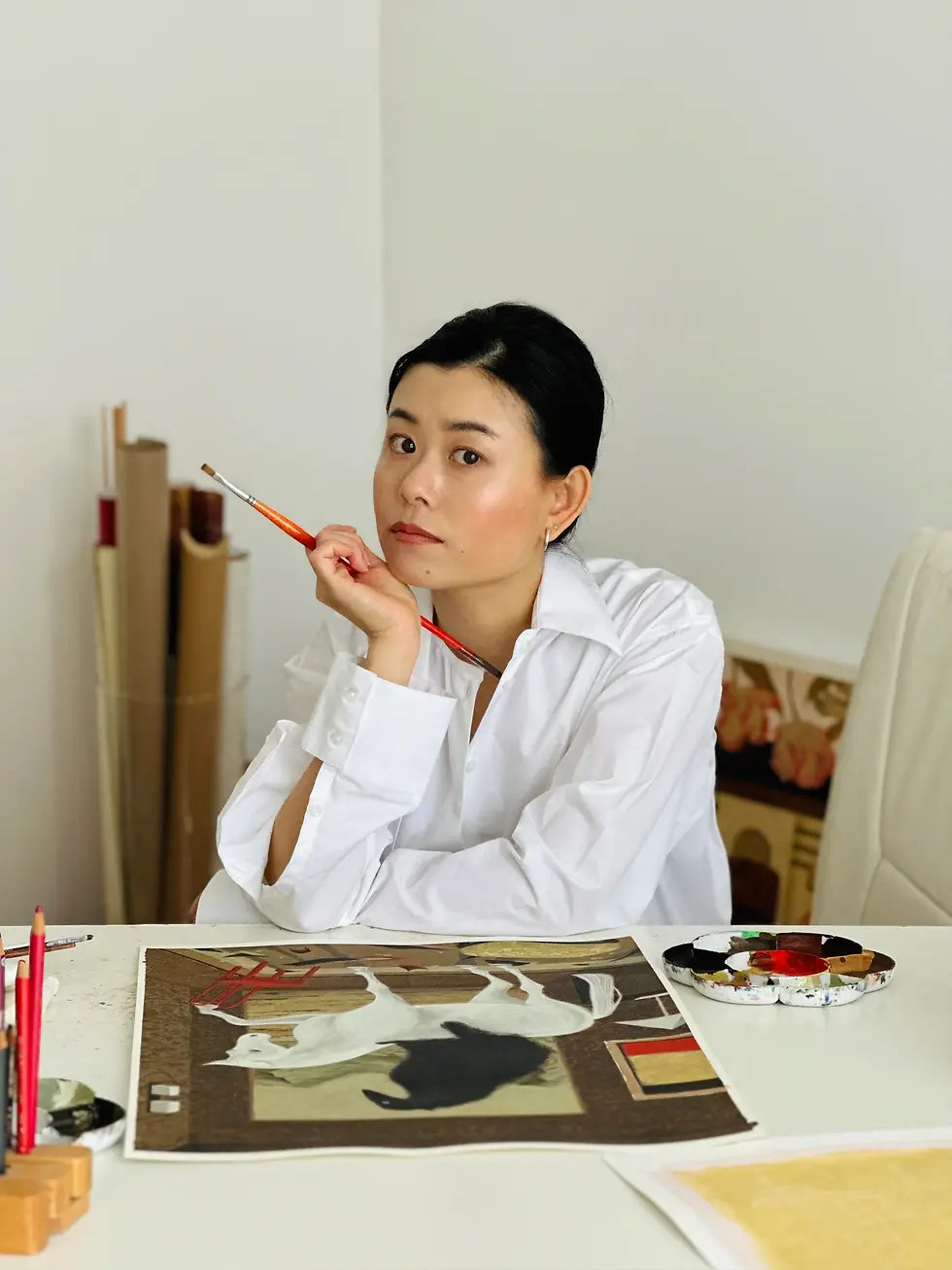
Aurora Mititelu
Aurora Mititelu is a Romanian artist based in Los Angeles whose work investigates how digital images shape perception, power, and identity. Her practice spans computer-generated imagery, AI, sculpture, and writing, often drawing on personal experience to explore the cultural codes embedded in visual technologies. Raised in post-communist Romania, she grew up absorbing American digital culture, an influence that continues to echo through her work. Projects like “Abel & I” and “Meta-Mahala” connect synthetic media with personal memory, gender roles, and Eastern European environments, using hybrid tools to rethink what intimacy, agency, and presence can mean in a world shaped by machines.

Q: What stuck with you most from growing up between post-communist Romania and American digital culture?
A: I grew up in a specific post-socialist moment in Romania, when people were still figuring out Western capitalism. The ’90s and early 2000s in Romania were a time of disillusionment with local culture, of economic hardship for my family and many others around us. And then there was this hope, that there was something better in the West. Then the computer came in, then the internet, and all of it was American-centric. I loved it. It felt like hope. It opened up the world. I watched Nelly Furtado’s music videos landing in a helicopter on a high-rise in New York City and heard Hannah Montana sing about Los Angeles. Then we had Facebook and Instagram and iPhones, and it was all coming out of California, with all its symbols, images, and culture attached to it.
I recently heard Jon Rafman (an artist also working with media art and the internet) say something along the lines of, “We all thought life was going to become more like MTV, but it didn’t,” and I haven’t heard something resonate that strongly with me in a long time. I think this speaks so strongly to how my generation’s — and probably his too — psyche was shaped by this.
At some point, I realized I had no idea, culturally, what was going on eastward from Romania, but I knew everything about New York, even though geographically it was on the other side of the world. What you saw and knew and heard wasn’t geographically bound at all.
Of course, this wasn’t something I could have articulated then, but I later came to understand the political power images have in shaping your subjectivity through the aspirational image and constructed dreams. I mean, that’s what LA is so good at. Or it used to be.
Funny enough, while I grew up watching American movies in Romania, once I got to Los Angeles I started watching Romanian New Wave cinema and seeing my own symbols represented. I almost had a sort of aspiration towards that grit — a reversed desire to be somewhere else. I also started to understand how there’s this romanticized version of Europe for America, how they long for something that doesn’t exist here.
Q: When did you start seeing computer images as something more than just visuals?
A: I think it started in recent years, when I began noticing a shift: images that are constructed, made, fabricated, starting to overlap with those we understand as “taken,” sampled from the real world, like photography. That separation began to collapse. This is what I mean when I talk about “hybrid computer images.”
I started thinking more deeply about this while working in Berlin as an art director and CGI artist. I was actively participating in the creation of computer-generated images that increasingly mimicked realism and were feeding into the Western imaginary. It was there that I began interrogating what kinds of images I was making, and more importantly, who they were ultimately serving. I also started to understand image-making at a more granular level, to see how every decision carries implications, and to ask whose choices those really are — whether in CGI, photography, or something in between.
Around the time of the pandemic, we also saw the rise of virtual influencers and avatars like Lil Miquela, and all the talk about the metaverse. That moment now feels past, like something we’ve moved beyond, but I think it marked a fundamental shift. The appearance of those avatars crossed a boundary.
The social contract quietly shifted to allow CGI constructions to feel real — to be part of the social real.
That shift has only deepened with the rise of AI-generated images. Even if we try to draw a line, the convergence is already underway. So I don’t see computer images as just visuals anymore. They’re agents within a much larger system.

Q: Abel shows up in a few of your works — does he still feel personal, or has he taken on a life of his own?
A: He has definitely taken on a life of his own by now. I think he has also allowed me to think through this persona in ways that opened up certain social areas and ideas I didn’t find accessible before.
Even at the level of ideation or theory, thinking through Abel gives me access to a different subject position.
I first created him for "Meta-Mahala", and after the exhibition was over, I kept the textile hanging in my studio. I spent a lot of time with him. That time helped me make sense of some of the more intuitive choices I had made, like the decision to switch gender. Why did I have the impulse to represent myself as a man?
That question led to deeper reflections on autonomy and power, and eventually to the next work, "Abel & I", where I focused more directly on gender dynamics in Romanian and Eastern European culture. Abel became a way to examine the kind of masculine authority that structures both public and private life, especially in more traditional societies. There’s something about embodying that position synthetically that allowed me to reclaim and rework it.
Over time, he did begin to feel like more than just a mirror or alter ego. Other people started to respond to him with curiosity and enthusiasm, and I began to see him as a character that could move across formats (sculptural, interactive, cinematic) without being fixed to one narrative arc or medium.
A bit like the CGI influencers I referenced earlier, whose personas exist across platforms and formats — not confined to a single medium. In a way, Abel also started to resemble the kinds of hybrid images I’m interested in — images that are sampled from the real but ultimately constructed, images that reshape how we experience subjectivity and self.
Q: With "Meta-Mahala", was there a moment that made you want to connect digital tools with something so local and familiar?
A: That summer I was in Europe, going between places I used to live in — in Bucharest and Berlin. Being in Bucharest gave me an embodied intuition of what I was making and what kind of spatial and material feeling I was looking for, even if what I was thinking about was digital media.
I did a lot of research there. I took pictures in the city, especially in more working-class areas that looked more like what I remembered growing up.
Later, when I was visiting Berlin, I sat down at a table outside a café at the entrance to Tempelhofer Feld, took out a little sketchbook, and drew the installation I was going to make.
And I just stuck with it. I couldn’t yet explain how everything made sense together, but I was somehow comfortable with that.
I think "Meta-Mahala" does not have a fixed interpretation. Its meaning emerges through the material and sculptural combination of its elements. The combination of the digital image and the physical structure became a way for me to reflect on how images translate into the physical world — almost to speak of their weight and gravity, of their existence within what we intuitively call “reality,” as we continue to treat the digital as somehow not real.
Using generative tools to render a space so specific to Eastern Europe felt important. It wasn’t about nostalgia, but about insisting that these environments deserve to exist inside digital media’s contemporary visual language too.

Q: In "Edit / Save / Replace", memory keeps shifting. Is that how it feels for you too when you look back?
A: Yes, I think so. The work definitely came about at a time when I was struggling with my own sense of identity through memory. It was just a few months after I moved to LA, so maybe that shift triggered it.
Being between places, having split lives, and starting over multiple times leaves you with a fragmented understanding of your past. Sometimes it’s hard to parse what was real, what’s been enhanced or romanticized, and what you’ve simply forgotten.
It makes you very aware of how your mind processes memory — how it contributes to constructing it through selection, how it makes sense of events, and how that structure can later be reshaped. Memory is fluid and shifting, not a static thing. I was reading a lot about memory at the time, and later I took classes on perception and cognition — on how your mind actively constructs your perception of the world and of yourself. That’s definitely a theme that keeps coming back into my work.
Q: When you start a new piece, do you begin with an idea — or more of a feeling you want to follow?
A: As hard as it was, I learned to let go of having a fixed conceptual or meaning framework when I start new work. I think my more successful pieces have come from following a strong sense of intuition — just knowing that something about it feels important and that I have to make it.
That wasn’t easy for me to learn. I naturally have more of a producer’s mind. I want to plan ahead, know why I’m doing something, and figure out how to optimize the process.
But I’ve found that the work becomes more interesting when it becomes a form of research. Often, it’s a kind of investigation into how I function — something that can hopefully translate to others as well. And I found that it did.
It became easier to let go of the need for full clarity in the artwork once I also started writing. Writing gives me the space to be precise and structured. Art-making lets me be more fluid, poetic, and sometimes even funny in the way I engage with the elements of the work — whether that’s software, materials, topics, or symbols.
That’s not to mystify the process of making art, but it did help me embrace ambiguity and allow for a bit more openness in how things come together.