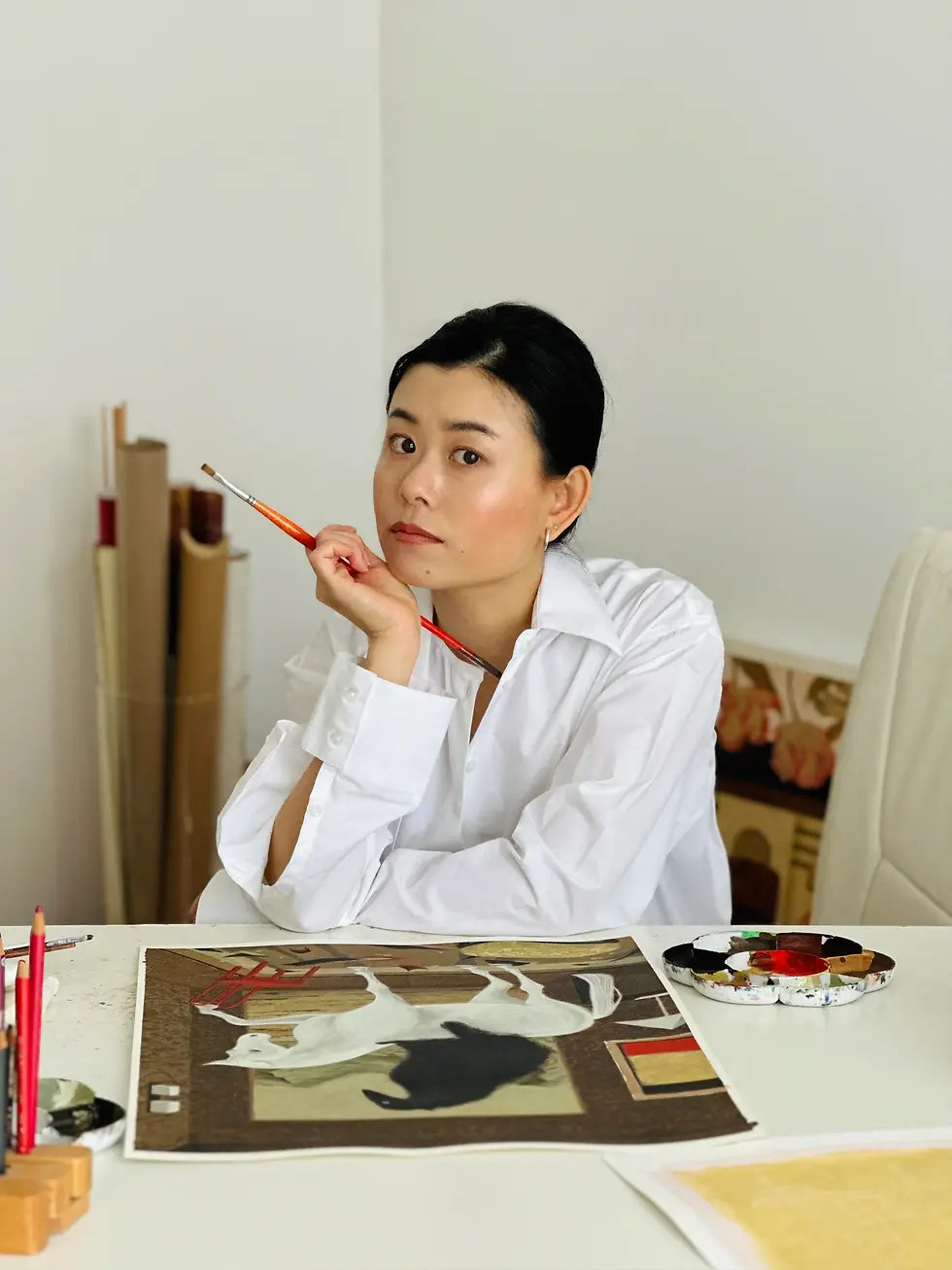
Annick Létourneau
Originally from Montreal, Annick Létourneau turned to art after working in law and communications. Over time, she found that pastel was a medium that felt natural to her. It let her mix freedom with precision. Her abstract drawings are filled with light, rhythm, and spontaneity. Létourneau creates each piece intuitively, layering color and texture. Her work has been shown in places such as Zurich, Dubai, and New York.

Q: You started in law before turning fully to art. Do you feel that shift still echoes in how you approach your work?
A: Law feels as distant from art to me as a bird is from a sewing machine, despite many Montréal law firms and lawyers being avid art enthusiasts and collectors. Here's why.
The legal field I was in was strictly bound by civil and procedural codes, meaning I operated within a rigid framework. In contrast, my artistic journey is all about freedom. I chose to embrace abstraction and soft pastels. I often defy conventions, for example, by selecting a shape or colour that clashes rather than complements, by experimenting with pastels to create new and organic textures, and by using tools not typically employed by pastel artists. Essentially, I thrive on exploring and creating the unexpected.
Q: You often talk about light as a kind of guide. What does it reveal for you beyond colour and texture?
A: I'm captivated by light, which infuses most of my drawings with vibrant colours—various shades of red, green, blue—as if light itself illuminates and influences their tones.
Light is also a metaphor that brightens my entire life. I've chosen to be a positive person, believing that everything works out for the best and that the best prevails. I'm not naive; it's an attitude and a way of seeing life daily, making it more beautiful and gentle for those around me and myself. I feel more inspired, interested, and curious. My works are undoubtedly more colourful, detailed, and inspiring because I've let the light in.
This light within me has taught me not only that all hopes are possible but also, and more importantly, to let go of what I can't control. To trust life, to accept what it brings—not that it's always easy!—and to do my best. To look forward as well. It makes my life simpler, my happiness easier, and my artworks more intriguing. When the first stroke of pastel on paper is so rich and fascinating that I abandon my initial intentions, I never regret it.
I sometimes try to step back, but my intuition leads me to follow this new direction four times out of five.
Light, in life and on paper, can only be beneficial. That's my experience speaking, and my drawings reflect it well.

Q: Working with pastel seems to demand both control and spontaneity. Where do you find that balance?
A: Creating with soft pastels requires a deep understanding and mastery of the medium. Personally, I've chosen to approach it differently, allowing spontaneity into my creative process and using pastels in unconventional ways.
This approach developed gradually as I explored pastels and what I aimed to express on paper. Experience and openness to spontaneity have enabled me to discover and incorporate unique, raw, even organic textures into my work, so intrinsic to pastels. These textures originate from the initial strokes on paper, which I refine and enhance delicately, slowly, with precision and patience, to preserve their essence.
In my view, this spontaneity finds balance in the mastery needed for the creation and finishing of each figure, regardless of its texture; also in the complementarity of the many forms and details that compose and characterize my works.

Q: Abstraction gives space for freedom and interpretation. Do you ever miss the structure of figuration?
A: When I began drawing seriously nearly 14 years ago, I instinctively gravitated towards figurative art using graphite. The human body was my first subject of interest. I focused on drawing body parts, concentrating solely on their forms—never the entire body—and playing with shadows and light.
I quickly transitioned to abstraction and soft pastels, likely to free myself from the many demands of figurative art and to create more freely. I wanted to create something that speaks to me and reflects who I am.
That said, the fact that my works are composed of such dense forms and varied textures, requiring time, precision, and meticulousness, suggests that a certain structure inherently exists in my compositions—probably to ensure a sense of balance, at least visually, once the piece is completed.
Q: Your process mixes intuition with technical precision. What usually triggers the first move on paper?
A: The very beginning of a piece used to be very intuitive, but over time, I've grown to favour certain shapes and silhouettes for a period before transitioning to new ones. Now, I start with some sketching on a paper pad to find a direction and a variety of figures that appeal to me. Then, I move to my main sheet of paper to draw a few diffuse and sometimes temporary lines that guide me at the start.
During the drawing process, I can and have changed the direction or shapes of some figures to ensure a stronger message or better harmony with the colours and textures already created.
My art is definitely a balanced blend of intuitive and thoughtful creativity.

Q: You mention being moved by beauty everywhere — from Rome’s alleys to Quebec’s autumn. How do those places stay present in your studio?
A: I would love to walk in the forest every day and at the same time capture the charm of Rome in my studio, but instead, I find beautiful light, decor to my taste, and a spacious area where I don't feel cramped, with all my drawing materials within reach.
I wanted to create in a studio with large windows where light would enter abundantly and freely. Essential to my mood and my art, it brightens my days and allows me to create each figure in my works with the necessary precision and detail.
Beyond the physical organization of the space, my studio has become a special place where the passage of time has little hold on me. With a rested mind but a head full of images—among others of landscapes, cities, and museums visited over the years—I set to work each time. These travels, like all my life experiences, undoubtedly influence my compositions and interpretations of same, consciously or not.