Nian
Nian is a painter based in Florence. She paints women, naked and twisted into tight poses. She trained at the Academy of Fine Arts, spent a few years doing abstraction, then moved to the figure. She usually starts from a sensation, and in recent work from visions that come to her in half-sleep.
We talked about how the body became her subject, why her figures push and press into each other, and a new series where lovers show up inside the drawers of old furniture.

Q: How did your painting become a method for working on the human figure?
A: I've always been fascinated by the body, especially the female one. While studying painting at the Academy of Fine Arts, I experimented for a few years with an informal practice, using drippings and layering to generate abstract, almost ghostly and ethereal images.
At a certain point, however, I felt the need to bring the body to the foreground and as my main subject. At first, they were figures of dressed little girls. I was interested in a lighter dimension, linked to play, clothing, and a spontaneous relationship with nature. Over time, these figures grew, and I began to strip them away, until I recognized myself in a naked, contorted body, searching for its own form to exist in the world, to adhere to or resist certain patterns.
For me, the human figure has become a tool for investigating painting. Through the contortions of the body, I began to explore the possibilities of the surface, listening to curves and tensions as if they were indications for color and gesture.

Q: You said you don't start from a pre-established image: where do you start, then?
A: I usually start from a sensation. Sometimes from a network of signs, other times from a curved line that guides me and suggests the construction of the body. This has been central in recent years.
In my more recent works, however, I often start from images that emerge in a state of half-sleep. They are like flashes, rapid visions that I try to capture and translate onto the canvas. They fascinate me for their surreal component; right now, for example, I'm working on couples of lovers who inhabit the drawers of old furniture.
I feel the starting point is constantly evolving, but I try to maintain an instinctive component, something that remains open and continues to guide me through the process.
Q: When does this figure begin to appear?
A: The figure begins to appear when, within the lines and curves, I recognize a clue: an elbow, the hollow of a calf, the roundness of a face. It's as if the body were slowly emerging from the paint.
In other cases, however, it already appears as an image, especially when it arises from a state of half-sleep. In both cases, the challenge is the same: retaining that initial intuition, listening to it, and letting it evolve, without forcing it. It's a process closely tied to listening.

Q: In some works, the figures come very close, almost hugging each other. What attracts you to this?
A: Besides embracing, the figures sometimes pass through each other, pierce each other. After several years of working on the single figure, I felt the need to introduce the encounter.
What interests me is its ambivalence. The encounter can be an embrace, but also something that invades and transcends personal boundaries. It can take the form of desire, or that of a vice. I'm drawn to this tension between opposites. Desire and repulsion, closeness and loss of self. The idea of wanting to get under the other's skin and, at the same time, the fear that this entails.

Q: In works like "The Siege," the figures almost merge. What were you trying to express in that painting?
A: "The Siege" is one of the works I feel closest to, and probably one of the most intense. In that work, I took to the extreme precisely the tension I was talking about: the boundary between desire and violation.
It's a painting I only began to understand once it was finished, and in part it also unsettled me. There's passion within, but also a form of aggression; there's a gesture that can be interpreted as a gift or an imposition. What interests me is that these readings can coexist. It seems to me that the scene maintains a very subtle and ambiguous balance, in which the dynamics are constantly shifting: those who act and those who suffer, those who offer and those who receive. This simultaneity of meanings is something I often seek in my work, but I believe this is the best example of it.
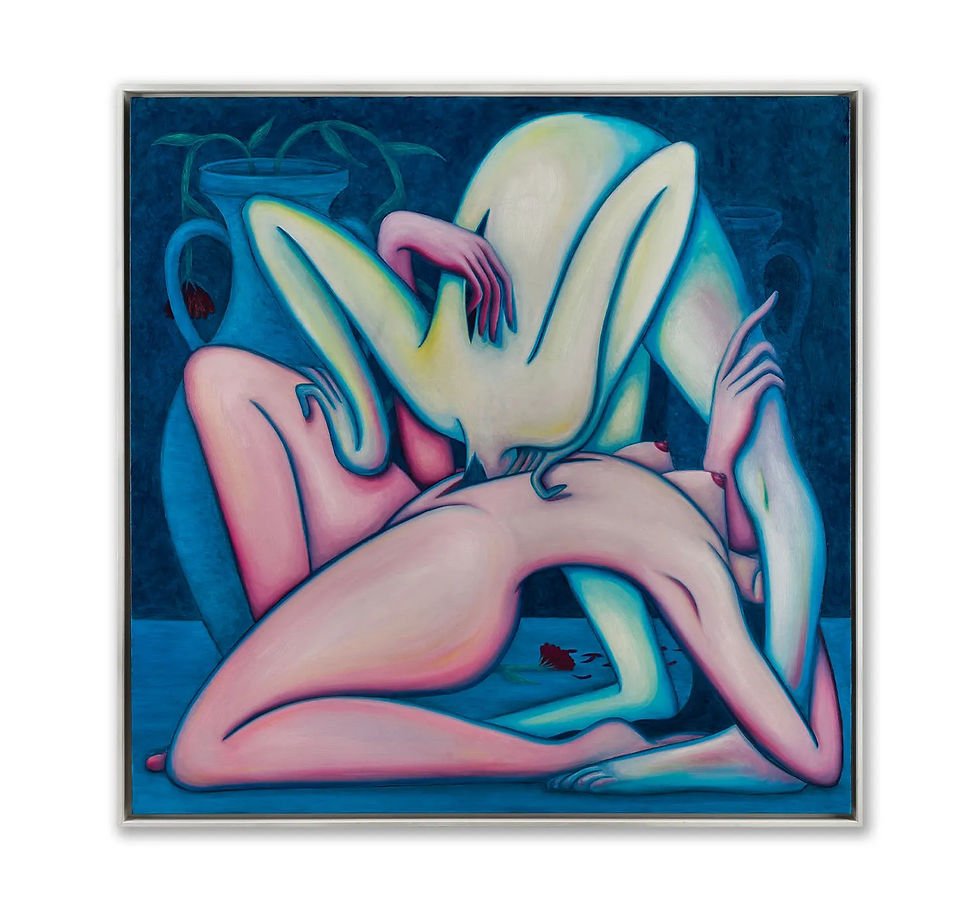
Q: In your works, the image can be simultaneously intimate and complex. How do you approach this aspect while painting?
A: During my work, I try to leave room for what emerges, as if in an open dialogue with my inner self. When I witness the images taking shape, I act as both observer and guide.
I believe this approach naturally brings out internal tensions. Intimacy, by its nature, is never simple or linear; it brings with it layers and contrasts. Even the time it takes to complete is affected: some works remain unfinished for a long time, while others are created very quickly, almost voraciously.

Q: In your paintings, space never appears neutral. How do you approach the space around the figure while painting?
A: In recent works, space has taken on an increasingly symbolic meaning. Environments and objects function as emotional extensions of the figure, almost as if they were interior rooms. I'm not interested in a descriptive space, but rather a space that actively participates in the construction of the image in an evocative way.
The restriction or "box" that society has placed on women is what my figures try to emerge from. I want my figures to take up as much space as possible, but there never seems to be enough of it.
Q: What are you exploring in your work right now?
A: I'm currently working on the relationship between the body and the space that contains it. I'm interested in observing how the body relates to environments and objects, and how these can become a projection of its interiority.
I feel that these spaces function as emotional places, in which everyday, routine elements take on a more ambiguous and symbolic dimension. It's a way to delve even deeper into the dialogue between intimate experience and image.


