Ulrike Martha Zimmermann
Ulrike Martha Zimmermann is a Berlin-based artist who makes images out of single vertical threads. She trained under Karl Rödel at the Kunstschule Mannheim, and though she knows weaving, knitting, and embroidery, she uses none of them. Each piece is designed digitally, then built by hand. Her colors come from up to seventy shades that mix only in the viewer's eye, so the surface changes with the light and where you stand. Her installation Did you realize I'm human? comes from the story of her uncle, killed as a child in the Nazi "euthanasia" program, and continues through 2027.

Q: You trained under Karl Rödel in Mannheim. How did you end up working with thread?
A: My time at the Kunstschule Mannheim and my studies with Karl Rödel had a lasting influence on me. He believed that exploring many different techniques was essential to finding one's own artistic expression. The training included, among other disciplines, portrait, figure, and still life drawing, painting, printmaking, and lettering. I have always been drawn to textile materials. A few years ago, I began to work intensively with thread. I design my objects digitally and then translate them into vertical thread surfaces with color gradients. What fascinates me is that a surface with painterly qualities can emerge from thin sewing thread – that an image can be created entirely from vertical threads. The limitations of this technique and the minimalism that results from them are an essential part of my work.
Q: A piece begins as a digital design and ends as thread worked by hand. What happens in that translation?
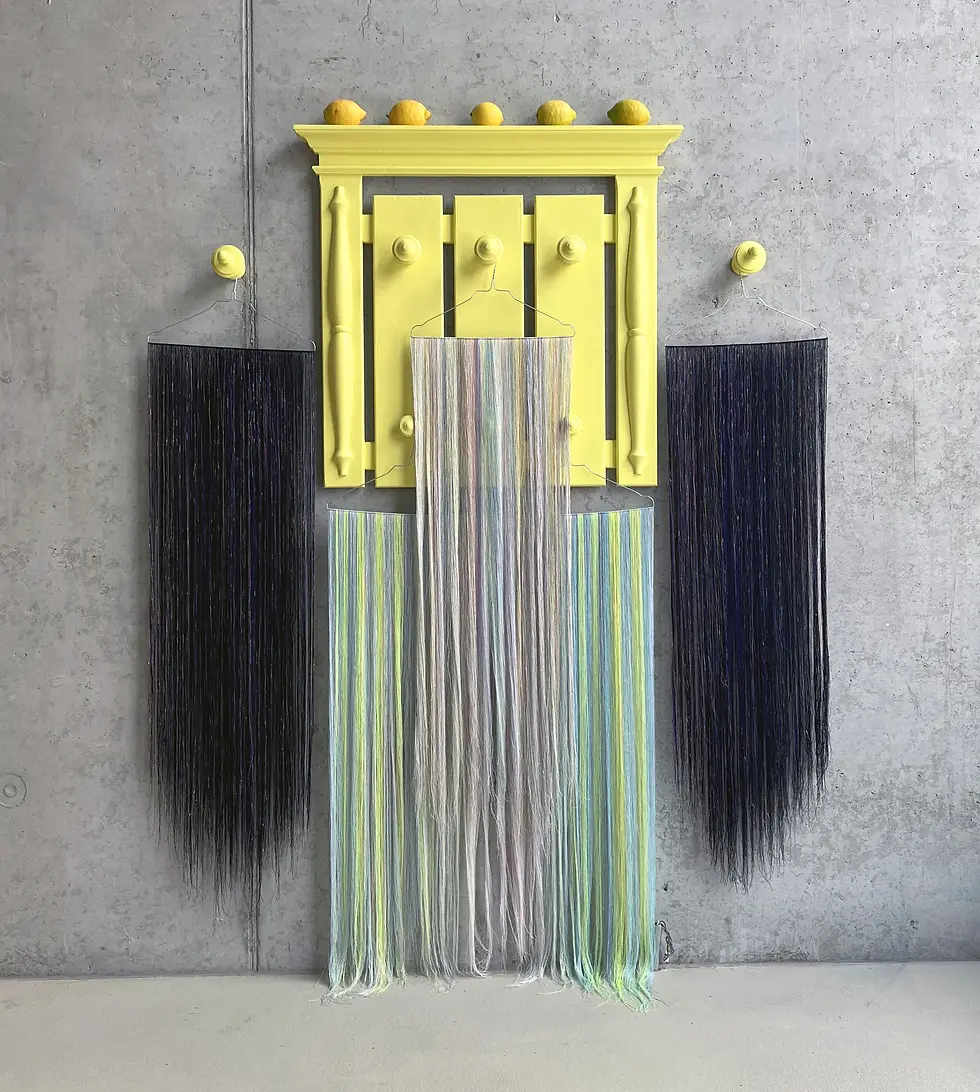
A: The transition from a digital design to a physical artwork is at the core of my practice. In the digital design, I develop the composition, forms, and color gradients while already considering the possibilities and limitations of thread as a medium. During the process of realization, the immaterial idea becomes a tangible image-object. Each individual thread is placed by hand and has its own three-dimensional presence – like a very thin cylinder. This creates intense fields of color and subtle nuances of shadow, produced through the interaction of light and material. The time-consuming process is an essential part of the work itself. Through the reduction to individual vertical threads, a unique form of spatial painting emerges.
Q: You've trained in weaving, knitting, and embroidery, yet set them all aside. Why just the single vertical thread?
A: I have always been interested in textile traditions and their diverse techniques. At the same time, I realized that many of these techniques are historically associated with function, craftsmanship, and feminine attributions. In my artistic practice, I was searching for a form that could move beyond these associations and connect more closely with image, painting, object, and sculpture. While textile techniques are often based on the joining of individual elements – through weaving, knitting, or embroidery – I am interested in the single thread as an independent visual element. This reduction to a single material and a single visual unit gives the technique its radical and minimalist quality. The thread is not understood as a decorative textile element, but as a line – comparable to a brushstroke. In this way, an individual visual language emerges, in which color, light, space, and perception are interconnected.

Q: How did you arrive at building color from up to seventy shades that blend in the viewer's eye?
A: The effect and composition of color have always fascinated me – in painting as well, the exploration of color is central. Through working with threads, I discovered a particular form of color mixing: similar to the Pointillists, the individual colors do not blend on the surface itself, but only in the eye and perception of the viewer. By using many different shades, I create intense, luminous fields of color that can develop a vibrating quality depending on the light and the viewer's position. The viewer becomes actively involved in the construction and perception of the image. This technique has expanded my understanding of color. Since each individual thread remains visible, the process is revealed – I cannot simply paint over it, but instead continue to develop the color effect by adding or removing individual threads.
Q: The piece looks different depending on the light and where you stand. Was that the point from the start?
A: Yes, this variability has been an essential part of my work from the beginning. I am interested in the particular color effect of the individual thread as a long, cylindrical form that reveals its intensity when it remains fully visible. The structure of the thread also plays an important role: during the unwinding process, the thread can remain smooth or become slightly curled. Some yarns also contain their own color gradients, which enhance the interplay of light and shadow. Through the continuous change of different yarns, a complex color surface emerges that shifts with the light and the viewer's position. This gives the works a physical and living presence. At the same time, the technique is intentionally fragile. Even a movement of air can alter the surface. This vulnerability connects, for me, with the fragility of organic bodies.

Q: Your installation "Did you realize I'm human?" runs through 2027. Where is that project taking you?
A: "Did you realize I'm human?" emerged from my engagement with the story of my uncle Walter Baumann, who, as a child, became a victim of the Nazi "euthanasia" program in 1943. During my research, I discovered that after his murder, his brain was used for scientific research. This led me to the Max Planck Society's research project on the history of Nazi brain research and unethical scientific practices, where I was able to exchange ideas with the historian Philipp Rauh and my work became part of this context. In the installation, I combine personal history and visual form: a wooden toy horse, carved by my grandfather especially for his son Walter, stands for a childhood that was taken away. Opposite it is a face constructed from six layers of thread, whose fragile structure reveals the vulnerability of human identity. The project has expanded my artistic practice by bringing memory, history, and material into closer dialogue. In 2026, my uncle's story will become part of a publication on victims of the Nazi "euthanasia" program and unethical research. The accompanying program includes a book launch at the Topography of Terror in Berlin, a panel discussion at the NS Documentation Centre Munich, and a presentation of the installation in a memorial space at the Max Planck Society. Additional events and exhibitions are planned for 2027.


