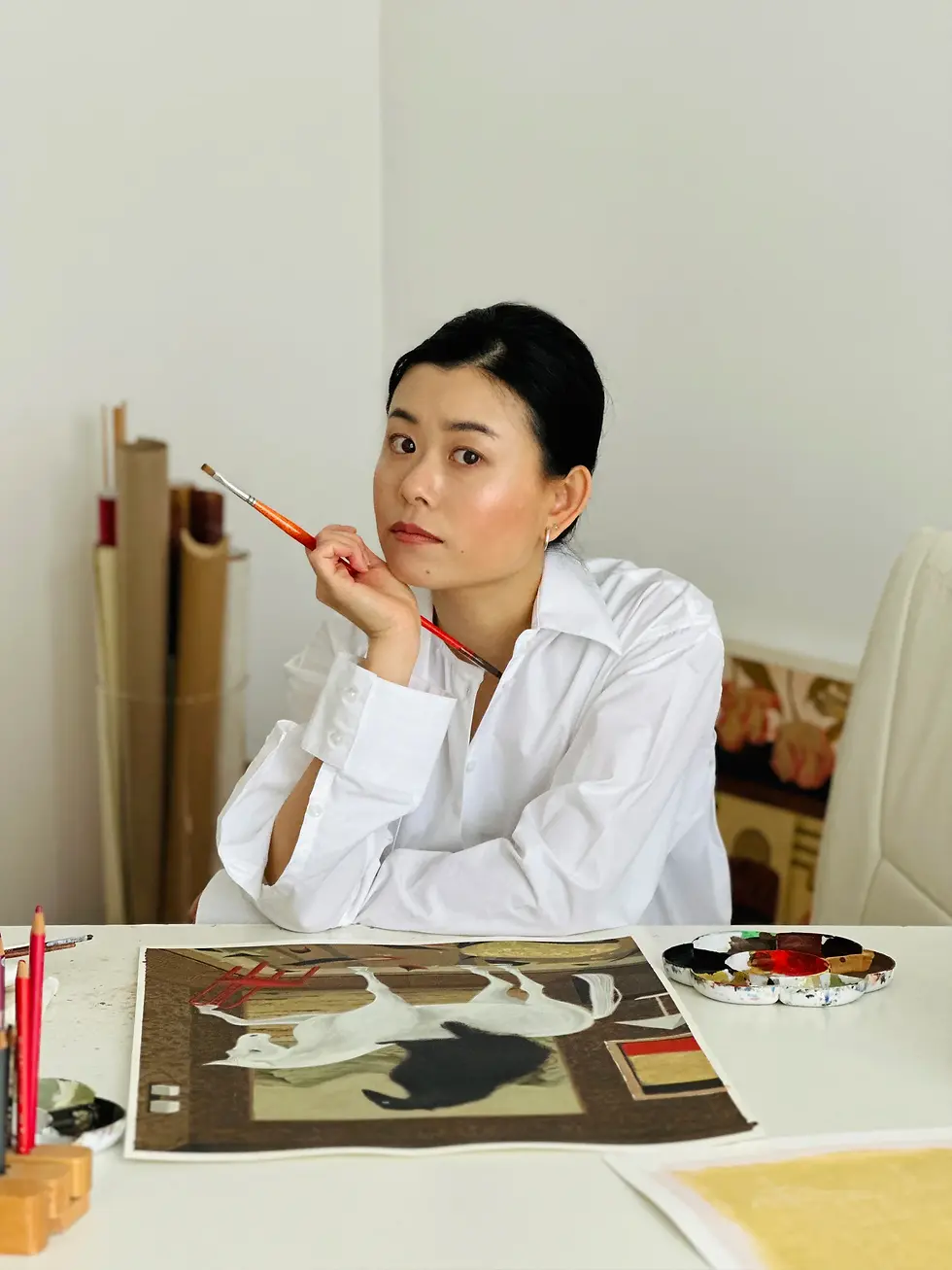
Tanya Golodynska
Tanya Golodynska is a Ukrainian painter who studied at the Kharkiv State Academy of Design and Arts. She tried illustration, watercolor and acrylic before flowers became her subject, and today she paints them in oil, many times larger than life. At one point she noticed an ashy blue somewhere, started seeing it everywhere and eventually brought it into her paintings. Her series Vyshyvanka rebuilds Ukrainian embroidery patterns from thousands of metallic pieces. This year her painting Infinity was chosen for the Chianciano Biennale in Italy. Now she wants to slow down and spend longer on each work.

Q: You trained at the Kharkiv Academy. How did flowers become your subject?
A: My academic education gave me a fundamental understanding of composition, colour theory, and spatial thinking. Flowers became my subject much later.
Before finding my way into floral oil painting, I went through a period of exploration. I created illustrations and worked with watercolour and acrylic. I experimented with different subjects and techniques, but throughout this long process of searching and reviewing references, my eye kept returning to plants and flowers. Flowers resonate with my inner world — with my pursuit of aesthetics and beauty, sensuality, and emotional expression.
My practice is a search for new compositional and aesthetic solutions through which I aim to convey in painting what is difficult to express in words. Flowers captivate me not only through their beauty. I see in them a combination of qualities that at first appear contradictory — fragility and endurance, delicacy and strength, transience and the continuity of life. These are the qualities I seek to explore through painting, removing floral forms from their familiar context and giving them a scale and presence that invite the viewer to pause and look more closely.
Q: You paint flowers at a scale far beyond life size. What happens to one that big?
A: Scale plays a central role in my artistic practice. By enlarging flowers far beyond their natural proportions, I transform them from decorative motifs into monumental subjects in their own right. A petal that might otherwise go unnoticed in everyday life becomes an entire landscape of light, colour, texture, and movement. The spiralling rhythms of the petals create complex visual structures, while subtle transitions of colour and transparency reveal the flower's inner architecture.
Large-scale floral paintings become gateways to states of quiet introspection and emotional depth. Rather than functioning as simple botanical studies, the flowers expand into meditative fields where presence, breath, and inner energy unfold. The generous scale allows each petal to feel monumental, while the handling of oil paint remains exquisitely delicate.

Q: Your colours are soft, creams and blush pinks against deep blues. Where does that come from?
A: The colour palette is usually determined intuitively and emotionally. At the same time, what draws my attention within the world of flowers has changed over time.
There was a period when I was particularly fascinated by the structure of leaves and petals, the complexity of their forms, the magical spirals of buds, and the way natural forms can create an almost fairytale-like rhythm. Later, my attention shifted towards the compositional interaction of several flowers — how they coexist within a single space, and how their forms, scales, and directions of movement interact.
Over time, the space surrounding the flower itself also became an important element. For example, at one point I became fascinated by a particular ashy-blue shade. I simply noticed this colour somewhere in my surroundings, and then began to see it and look for it everywhere. Gradually, I felt the need to translate this sensation into painting.
The dark blue background also began as an experiment. But in the process of working, I discovered an exceptionally expressive combination of this deep, almost bottomless blue with cream or pink petals.

Q: In Vyshyvanka the embroidery patterns are rebuilt from thousands of metallic pieces. How did that start?
A: Vyshyvanka is a project that is very close to my heart. I turned to Ukrainian ornaments, but I did not want simply to reproduce them. It is important for me to reinterpret familiar motifs through my own visual language and to show how tradition can resonate in a contemporary way.
I use ornament patterns that have been passed down to us as a legacy from previous generations. What once existed in the cultural memory of generations can today occupy a worthy place in contemporary space and continue to convey the meanings embedded within it.
The paintings literally interact with light — the metallic elements reflect it, so the ornament constantly changes depending on the lighting and the angle from which you look at it. For me, this is symbolic. I want this light to be not only a property of the material, but also my image of Ukraine — a country that, despite everything, continues to live, develop, and radiate its own light.
Q: Making something beautiful, you've said, is an act of resilience. What does that mean to you?
A: For me, creating something beautiful is an act of resilience, not because beauty can erase the complexity of reality. On the contrary, it is precisely an awareness of this reality that makes creativity particularly important to me.
Resilience is the ability to continue seeing value in life, to notice beauty, to create it, and to share it even when there is a great deal of instability, loss, and uncertainty around us. When I work on a painting, it is as if I regain the ability to focus on what can be created, rather than only on what is happening around me.
The nature of a flower is delicate, yet at the same time it possesses an extraordinary vitality: it blooms, changes, and moves through its natural cycle. Its fragility does not exclude strength — on the contrary, they can exist simultaneously.

Q: Infinity was selected for the Chianciano Biennale this year. What's ahead for you?
A: It is a great honour for me to be part of such a large-scale cultural project and to represent Ukrainian art there. It might seem that I have built up good momentum and simply need to continue moving in the same direction. But in fact, I feel the opposite desire — to slow down.
After approximately five years of active work, I find myself at a point of rethinking my artistic practice. I no longer want to increase the number of works I produce, but rather to deepen each one further. I can absolutely imagine that in the future this might mean creating only a few paintings a year, if that is the amount of time a work needs to express what I want to say.
My choice is quality over quantity. Depth and uniqueness over repetition. It is important for me to create works that require time — both from the artist and from the viewer.