Emma Fineman
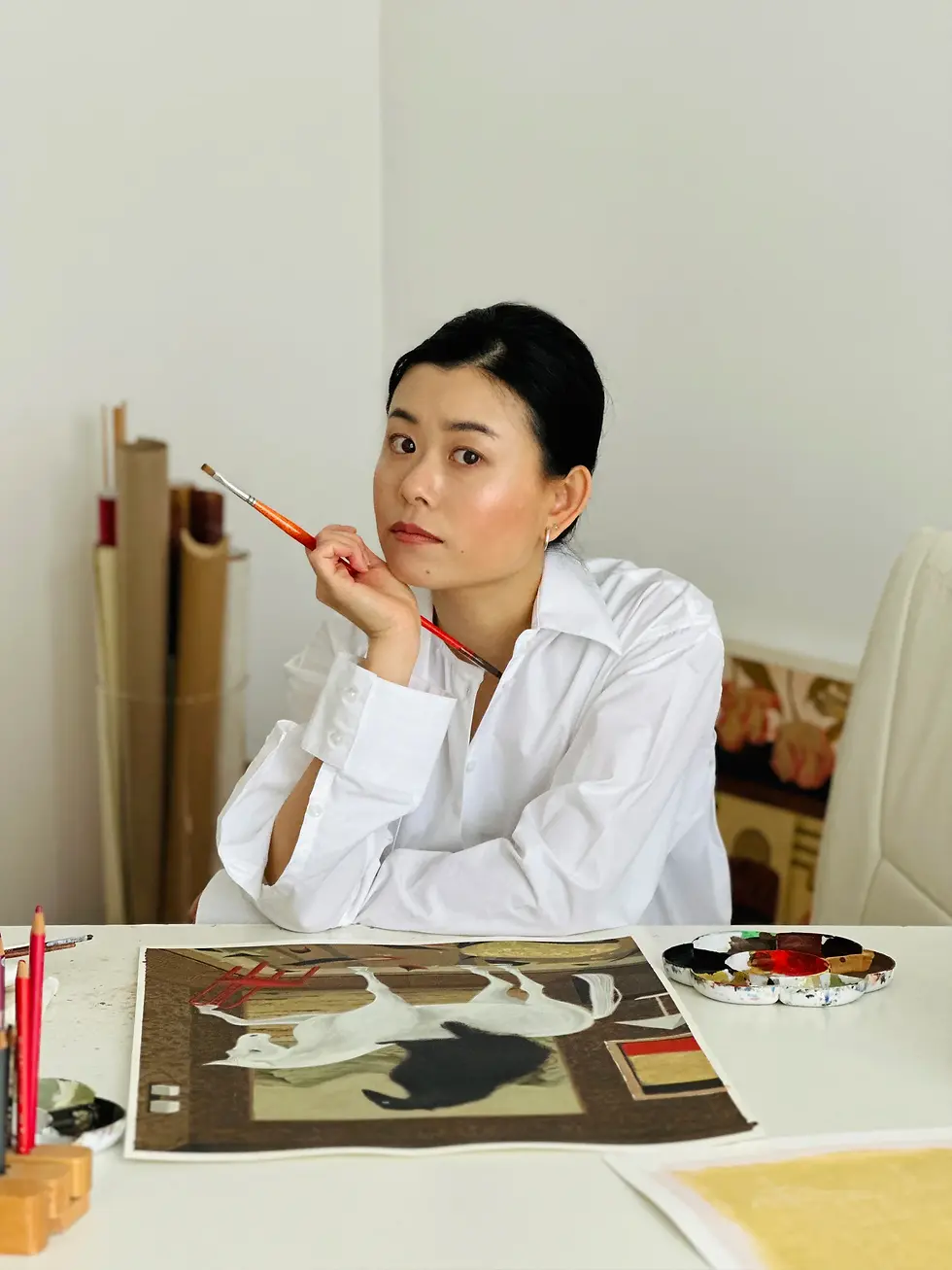
Emma Fineman was working at the Porthmeor Studios in St Ives, in a studio once used by Patrick Heron, Ben Nicholson and Lubaina Himid, when she noticed their paint on the floor. She started thinking about the studio as a place of ritual, and that was the beginning of The Genesis Project. It is her first major institutional show and opens at Grace Cathedral in San Francisco in January 2027. Fineman was born in Berkeley, studied painting at MICA and the Royal College of Art, and lives in London. Her paintings, drawings and bronzes use stories from Jewish folklore and art history to question what we inherit about gender, sexuality and belief.

Q: You studied painting in Baltimore and came to London for the RCA. How did you get here?
A: I decided to come to London for graduate school because I was really interested in receiving an education outside of the US, and after visiting some peers who had also studied at MICA and decided to get their master's in the UK, I felt there was a lot I could gain from being in a more international program that had a real intentionality on teaching theory and philosophy.
Q: Your work comes out of questioning and curiosity. How does that turn into a painting?
A: The process of painting is full of constant questions. What might happen if I push the materiality in x way? Who are these figures and how do I know them? These are the basic ones, however, there are more broad questions about identity, sexuality, desire, and social construct that I am also very interested in reckoning with in my work. Why are the stories we inherit told this way? Who does that benefit?
Can they be told differently? What perspectives are being lost here and can I allow myself to be the author of their recasting? Queerness is at the very root of all of this. Queerness allows for an openness to a possibility that sits outside of what we know and that becomes a space of innovation, of play, and that certainly can manifest in the world of painting.


Q: What makes you reach for Jewish folklore and art historical allegory?
A: I am interested in the ways that my ethnicity as a Jew has shaped my methodology. There is a tradition of questioning and storytelling within the Jewish context that I feel very much influences my approach to painting. As we are a people that have existed in a migratory state for most of our existence, story and retelling what happened is engrained in our culture. It is how we keep our traditions alive in some way. Allegory operates much the same way, especially as it was a tool to share stories when reading wasn't permitted for the majority. What fascinates me is where some of the mythical practices and understandings in the Jewish religion begin to blur with other religions. Where you see the same sacred geometry of the Muslim faith or repeated signs and symbols that also reveal themselves in Chinese mythology, Indian miniature paintings, or even Pagan traditions.

Q: Your paintings are full of ghost-like figures and repeated symbols. Where do they come from?
A: I paint figures until a soul is present. I was in Jaipur reading about Krishna and devotional altars. They talked about the idea that each altar is a meeting point where the god that is depicted can arrive to meet the person who is there to pray. Like a threshold. I am creating a context for these beings to make themselves known and I feel it when they are and when they aren't. When they aren't, it's an illustration of the person, with none of its energy. That energy is very important to me.
The symbols come from that collective space; through that, I develop my own adaptive lexicon. I played with Lambda, the symbol for queer liberation that came from the Greek letter; I moved that letter into an eye form, flipped it vertically so it became a yoni. Each evocation creates different connotations rooted in my own language.

Q: You've done residencies from Iceland to Istanbul to St Ives. What does a residency do for the work?
A: It is an important part of the research. Each place has its own energy, history, and context that I am responding to in the work. For instance, I am about to do residencies at Dragon Hill in Mougins, France where I will be directly looking at the modernist liturgical vestments that Henri Matisse made for the Chapelle du Rosaire de Vence as research for the regalia I am making for a show at Grace Cathedral. Interestingly, that project began during my time working in studio five in St Ives at the Porthmeor studios. While there, I was thinking of the studio as a place of ritual after looking down at the floorboards and seeing paint splatter from Patrick Heron, Ben Nicholson, and Lubaina Himid, who have all made work/rituals in that same space.

Q: The Genesis Project opens at Grace Cathedral in San Francisco in 2027. What are you planning for it?
A: This is my first major institutional show featuring three nights of performance (January 21–23, 2027) at Grace Cathedral during San Francisco Art Week. I will be making a site-specific installation during my residency at The Headlands Center for the Arts that responds to the current murals in the cathedral. This installation will be activated by a phenomenal group of performers, musicians, and collaborators from the Bay Area and beyond to reimagine some of the myths we've inherited from the Book of Genesis. This work is rooted in interdisciplinary dialogue where the performance invites audience members to question the origin stories we've inherited, so that together we might co-create a more collaborative, free, and queer world.