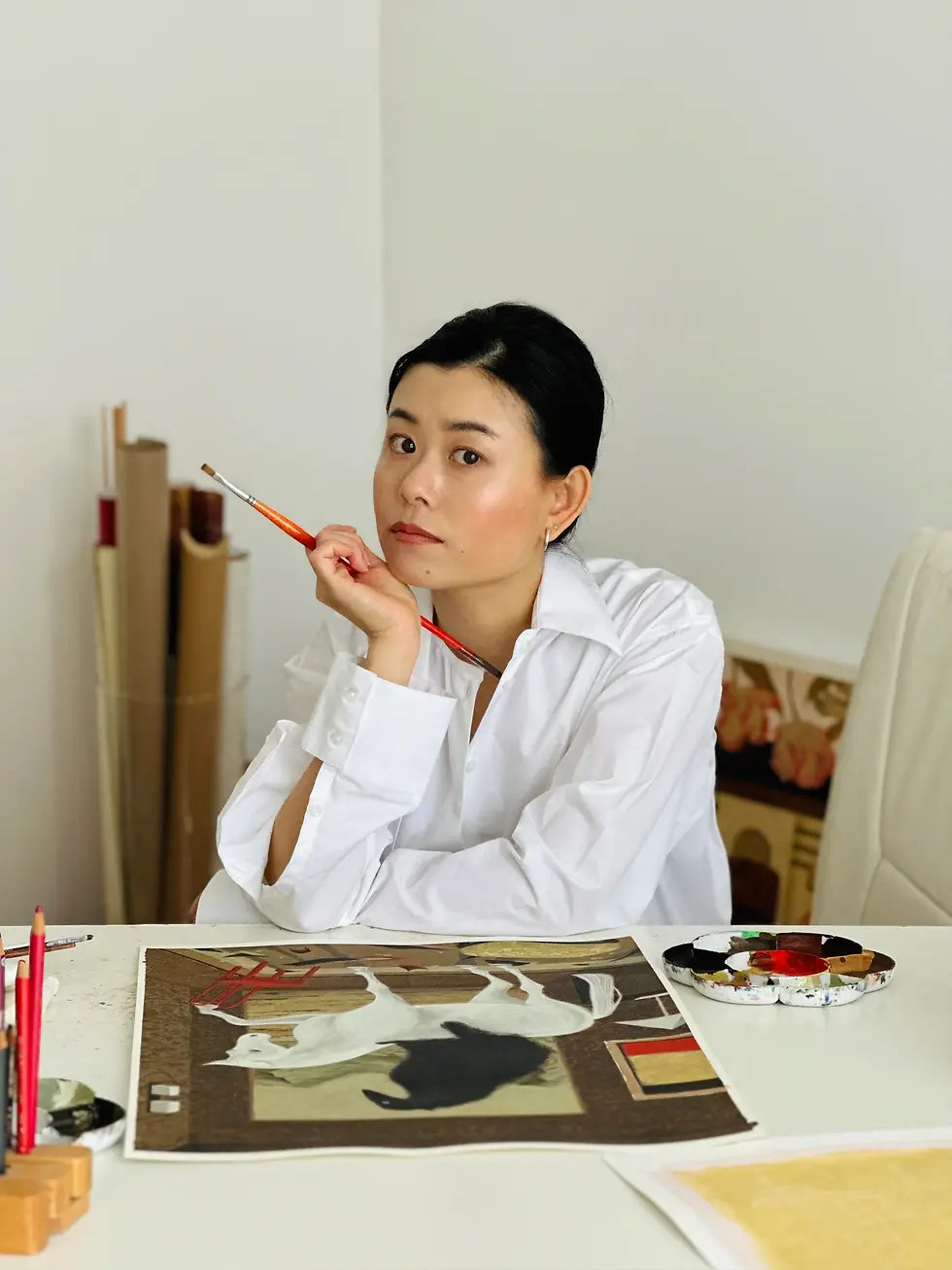
Oanh Luong
Oanh Luong is a photographer and graphic designer based in Philadelphia. She got her BFA from Temple University's Tyler School of Art and Architecture. Photography came first, starting in high school when she was shooting film to help her brother with his clothing brand, staging basement photoshoots with friends. She works with both film and digital, and her portraits tend to be soft, blurred, glowing. Before she picks up a camera she makes mood boards, sketches and collages. Her senior thesis, Who Are You When No One Is Watching?, is about what identity looks like when nobody is performing for anyone.

Q: First of all, tell us a little about yourself. You come from a design and illustration background, so how did photography enter the picture?
A: I'm a Philadelphia-based graphic designer and photographer with a BFA in Graphic and Interactive Design from Temple University's Tyler School of Art & Architecture. Photography actually came first for me. I started in high school, experimenting with video and eventually shooting on film during COVID to help my brother with his clothing brand. What began as a favor quickly turned into a passion, leading me to stage basement photoshoots with friends.
When I got to college, I was undecided and unsure how photography could become a career. Discovering graphic design gave me a way to merge image-making with concept and craft.
Now, my practice is rooted in process, experimentation, and visual storytelling. While design is my primary focus, photography still remains a second language. It's something I return to for its ability to capture presence, mood, and emotion with intention.

Q: Before you shoot, you create mood boards, sketches, and collages. How much of the final image is already there in that stage?
A: I'd say about 60% of the final image is already formed during the mood board and sketching stage. That phase is where I map out the core elements: location, styling, color palette, lighting, and composition. This way, I'm walking into the shoot with a clear visual direction. I often have a strong sense of the image in my head before the camera even comes out.
That said, I leave room for flexibility. Some of the most compelling moments come from unexpected, in-the-moment decisions. I like to think of them as "happy accidents." Those shifts can reshape or elevate the original idea. Post-production then becomes the final step where everything is refined and brought fully into focus, aligning the planned vision with what was discovered during the shoot.


Q: You work with both film and digital. Do they do different things for you?
A: For me, film and digital photography serve different creative purposes. Film feels raw and intentional. There's something special about slowing down and not seeing the image right away. That delay builds anticipation and forces me to be more thoughtful with each shot. It also taught me discipline early on, especially realizing how costly each frame can be.
Digital, on the other hand, offers freedom and flexibility. I can shoot without limits, experiment more, and refine ideas in real time. It also opens up a wide range of possibilities in post-production, where I can shape the final image to match different moods or styles.
Q: Softness, motion blur, glow keep showing up in your portraits. Are you after something specific with that, or is it more instinctive?
A: I'm drawn to images that feel more like moments than documentation. I'm not always chasing something literal—it's often instinctive—but those elements help me shape a mood and suggest a narrative rather than define it outright. I like when a portrait feels slightly untethered, where there's space for ambiguity and emotion to exist at the same time.
A lot of it comes from my interest in cinematic imagery, where atmosphere can carry just as much weight as the subject. The blur or glow can imply movement, memory, or even a sense of distance, allowing the viewer to step in and interpret the image in their own way. I'm less interested in sharp perfection and more focused on creating something that feels lived-in, where the story isn't fixed but open-ended.

Q: You've mentioned crafting and collecting as influences. What does that mean in practice?
A: Crafting and collecting are central to how I think and make. They remind me that experimentation is essential, and that there's always another way to tell a story. I grew up collaging and cutting scraps, rearranging them, and building something new. That hands-on process still shapes my approach today.
I'm drawn to working physically because it slows me down and creates space for trial, error, and discovery. I like when mistakes become part of the process, because they often lead to more interesting outcomes than what I originally planned.
Collecting plays a similar role. I tend to hold onto pieces that stand out to me. Whether it's typography, color, imagery, or even discarded materials, I hold onto it—because over time, these fragments continue to spark new ideas. They become a personal archive of references that I can return to when I feel stuck or want to push my work further.

Q: Are you working on a particular project or series right now?
A: I'm currently working on my senior thesis, Who Are You When No One Is Watching?, a project that brings together my interests in photography and design. It explores identity in a culture shaped by constant visibility, self-curation, and external validation, asking who we are without an audience. The work turns inward, focusing on the tension between our public personas and our more private, unfiltered selves. By removing the gaze of others, it creates space for honesty, vulnerability, and self-acceptance.
This project has been a turning point in my practice. When I first entered design, I struggled to find a consistent voice or visual language that worked with my photography style. Through this process, I've been able to explore that more fully, combining image-making with concept in a way that feels intentional and personal. It's allowed me to not only define my style, but also better understand my creative approach.