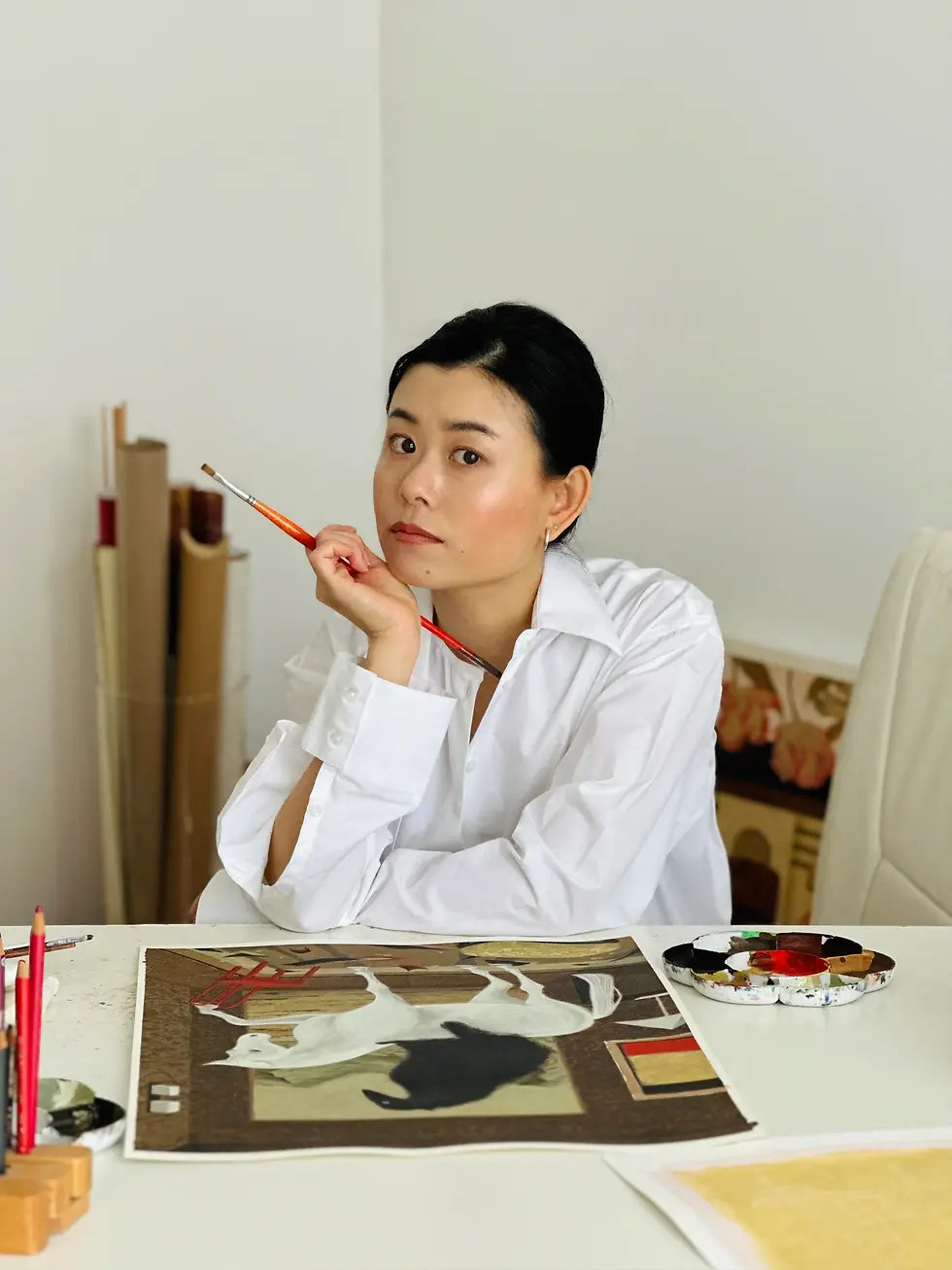
Nicole Young
Nicole Young is a visual artist based in Vancouver. She started adding fabric to her paintings as a student in LA because she could not afford paint, and the material stuck. She makes her own pigments and dyes from things like onion skins, avocado pits and pomegranate, and sews repurposed canvas and thrifted textiles into her work. Nothing gets thrown out in her studio. For her 2024 solo I Was There, I Forget The Rest, she cut up older paintings and sewed them into new ones. She is represented by Jennifer Kostuik Gallery in Vancouver, Tacit Collective in Toronto, and AT Art & Interiors in Los Angeles.

Q: Tell us a bit about yourself. You make your own pigments, dye, and sew. How did that practice begin?
A: My work has always been focused on material exploration, the ways they react and sometimes detract from one another. I started using textiles in my paintings out of necessity when I was a broke art student living in LA. I discovered that I could cover a canvas with a .50 cent piece of fabric instead of paying for paint, so I started making work combining a little bit of paint with a lot of fabric. I had also been working in the fashion industry, so adding textiles to my process was a natural step for me.
Then as I became more involved with environmental activism, I started researching ways to make my practice more sustainable. This led me to sewing leftover canvas scraps together to save waste, using natural dyes on fabric to create colour, and a new style of mark making through the limitations of my materials.


Q: You make your pigments and dyes from natural materials. What does that gathering process look like?
A: When I first got into natural dyeing I did more wild foraging of materials, going to areas with walnut and oak trees and collecting the fallen shells and acorns.
I have collected flowers that are past their prime from florists to repurpose into dyes, and people give me random things to try to make dye out of. I love to learn, and it has been an engaging process of trial and error.
Over time, I've pared down to certain colours that I go back to again and again because I have easier access to them. I love to cook, so onion skin, avocado pits, and pomegranate skin dyes make frequent appearances in my work. I haven't been dyeing as much recently because I currently have a large stockpile of textiles to go through, and my aim is to utilize what I already have before seeking out new materials.
Q: Nothing gets wasted in your studio, every scrap of canvas, fabric, paper goes into future work. How does that rule shape what you make?
A: It has expanded my practice in ways I never expected, and has added opportunities for me to play and experiment. I keep wood panels on hand at my studio and I periodically glue leftover textiles and thread to them, allowing the composition to build up slowly over time. Similarly, I have a large sewn textile piece in progress that I have been adding scrap fabric to for years. I'm not sure if it will ever be a finished piece, or just continue evolving. I keep a few containers of really tiny pieces of fabric and thread that may eventually become stuffing for future textile sculptures, an idea I've been playing with but haven't fully explored yet. The work that I am making for exhibitions and commissions is more structured, and the work that I make using the leftovers gives me a little more room to play and try new ideas.

Q: Your last solo was called I Was There, I Forget The Rest. That's a great title. What was that show about?
A: That exhibition examined how memory shifts based on the way our feelings change over time, and whether or not anyone can be an accurate narrator, even of their own lives. It was the first exhibition of my work in which I took previously completed artworks, cut them up and sewed them into new work.
The earlier works were part of a series I made based on a trip I took to Iceland in 2016, and the pieces combined past work with new work to show how those ideas and experiences had been reframed as time went on.
The title of the exhibition was inspired by a quote, "We were together—I forget the rest," which has been misattributed to Walt Whitman. I thought the misattribution and changes the quote has gone through lent itself well to the idea of memory not being as accurate as we want to believe.
Q: You work with thrifted textiles and say fabric is closely tied to memory. Do you ever know the history of a piece of fabric, or is it more about what it suggests?
A: I often do get to know the history of a piece of fabric. Since I've been doing this for so long I get gifted textiles from friends, family and community members, and I am also gifted with the story of the fabric. One of my favourite pieces uses fabric from an old shirt that belonged to my brother; it was a blue checkered dress shirt that reminds me of all of the men in my family.
The pieces that I get from thrift stores I select either because I'm looking for a specific colour, or because it suggests something significant. I like to think about the lifespan of a fabric, and find fabrics that have shapes cut out of them and have obviously been used to make something else. Where I can, I try to keep those shapes in the fabric as a nod to its former life.

Q: You've recently been picked up by galleries in Toronto, Vancouver, and LA. What's on the horizon?
A: I've just signed on with a gallery in Seattle as well, so I really need to get in the studio and make some new work! Right now I'm pushing my compositions in a new direction; as my sewing skills improve
I can complicate the work more and more. I have also recently been selected as the Lover's Tempo Full Circle Artist for 2026. Lover's Tempo is a jewelry brand based in Vancouver, and their Full Circle Artist
Program involves giving damaged and donated jewelry to an artist to recycle into an artwork or series of works. The program aligns well with my values as an artist, and it will be an opportunity to work with materials in a completely different way. My piece will likely involve weaving textile scraps and jewelry together, though that could change depending on what kind of jewelry I receive from the program.