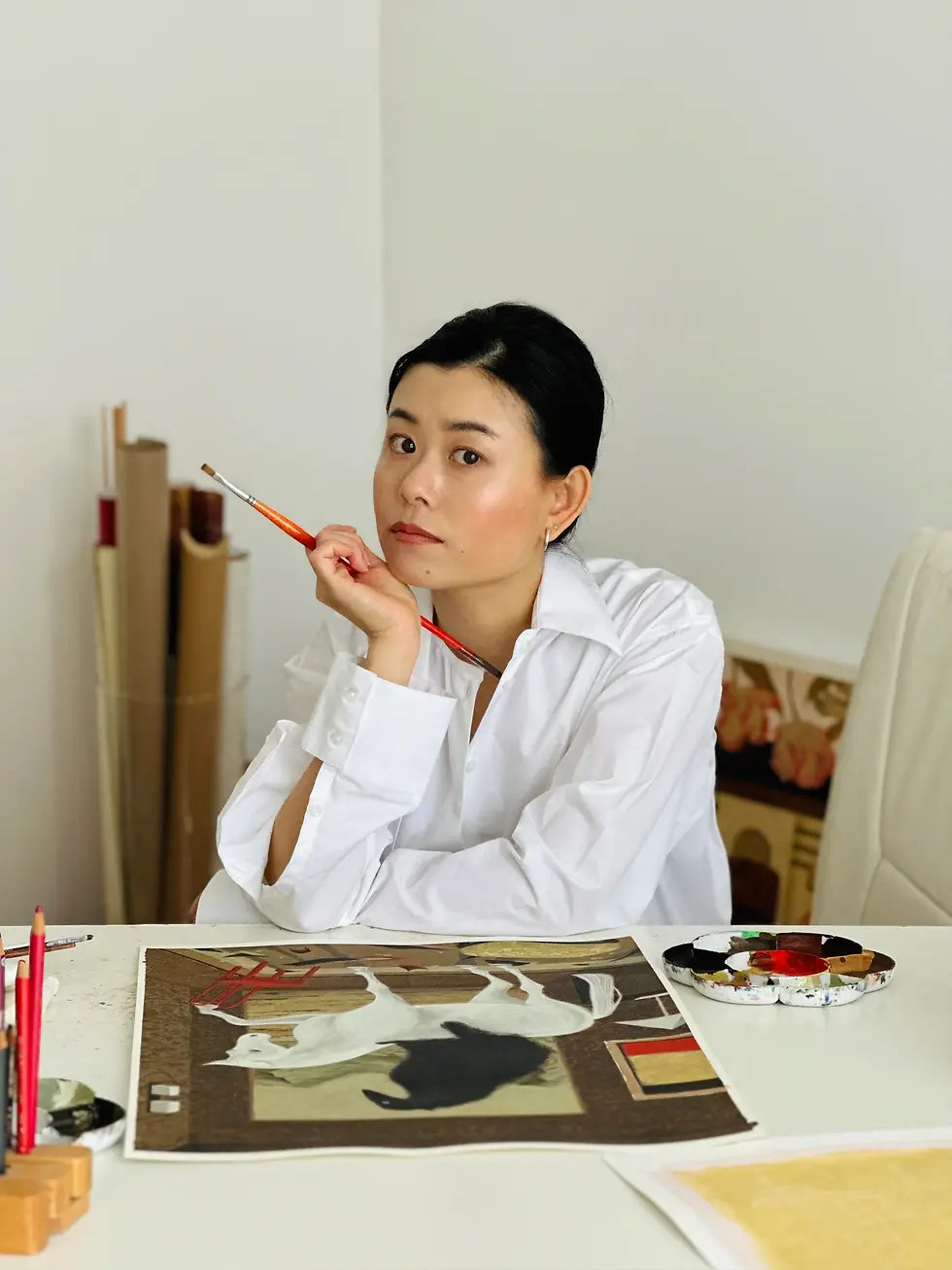
Mosa Zhao
Mosaz (Zijun Zhao) works mainly with drawing, using fine lines and detailed patterns to explore ideas around memory, transformation, and spirituality. Her works often include symbols from different cultures and personal stories, blending them into complex and intimate scenes. Insects, rituals, and quiet moments of change appear often in her images. For Mosaz, drawing is a way to slow down and reflect. She has shown her work in Milan, Venice, South Korea, and Japan, and it has been featured in several international exhibitions and publications.

Q: In your drawings, the line feels almost sacred. What draws you to this level of detail and repetition?
A: Lines have always been at the core of how I see and build images. Over time, they’ve become more than just marks on a surface—they carry fragments of memory, moments of attention, and traces of thought. During a long period of introspection and personal transition,
I found myself returning to the act of drawing as a quiet, steady rhythm. This sensitivity to line continued to evolve as my work was shown in international contexts such as the CICA Museum in South Korea and the Fukuoka Asian Art Museum in Japan. Exhibiting in such diverse cultural environments made me more aware of how a single line can carry weight across visual traditions. Line work, for me, is not only a visual tool but a way of listening—to memory, to emotion, and to what lies beneath the visible.

Q: You describe your visual world as flowing and chaotic at once. Does drawing help you make sense of that inner chaos, or does it let you live inside it more fully?
A: That inner chaos often stems from a sense of detachment rooted in dreams—a kind of simulated experience of the world after death. My visual world is, in many ways, a rehearsal for the unknown. These images are reflections of how I think about death.
In Chinese culture, we often speak of a “joyful funeral,” but to me, it doesn’t have to mean a peaceful death at the end of a long life. It could also mean having the agency to choose when your life ends, and imagining that the world you enter afterward is one shaped by your own longing. Because it is unknown, it allows you to construct a sense of safety within it. That’s where drawing comes in—not to control the chaos, but to live more fully inside that imagined realm.
Q: In “A Joyful Funeral 1”, the moth becomes a symbol of return and then destruction. How did that cycle come to represent your view on death?
A: This series is also the most representative of my body of work. The visual narrative moves from the bottom right to the top left: beginning with a small figure in mourning, seen only beside a tree stump, and rising to the large Tree of Life represented by three divine heads. Behind the tree lies the ocean, symbolizing the birth of new life. The narrative continues with the deceased’s tears and their transformation into a moth—a symbol in Chinese culture of the dead returning to visit loved ones. However, this moth is eventually eaten by a bird. Many older people in China say that people will become giant butterflies or moths to visit their relatives after death. However, I think death is just a random point in the infinite cycle, neither the beginning nor the end, so there is nothing to worry about. Therefore, the death described as "喜" (joy) is not as good as turning into a bird and eating the concerns.

Q: “Maternity” combines the human and the insect in a way that feels both tender and unsettling. What made you see insects as sacred?
A: I collect insect specimens and study their anatomy, not out of scientific curiosity, but because they mirror something primal and raw in us.
Q: You often bring personal emotion into traditional imagery. How do you navigate between cultural memory and your own inner world?
A: I grew up surrounded by traditional symbols, but I reinterpret them through lived experience. Cultural memory isn’t static—it breathes, morphs.
Serving as a juror or exhibiting internationally, such as in the China-Italy Contemporary Art Yearbook, allowed me to witness how artists from vastly different cultures transform their inherited forms. My own work lives in that in-between space.
Q: Your works suggest both pain and beauty within transformation. Is there a particular moment or experience that shaped this perspective for you?
A: I slowed down my art-making for two years and immersed myself in reading philosophy, natural history, and entomology. That period reshaped my perception. I came to understand that transformation isn’t linear—it’s recursive, full of decay and renewal. There wasn’t a single defining moment—there were many. For a while, my life was difficult. I found myself overanalyzing everything—myself, the people around me, the environment I lived in. Drawing eventually became a way to stay close to that discomfort without being consumed by it. The beauty I search for now lives in what is fragile, conflicted, and still able to endure.