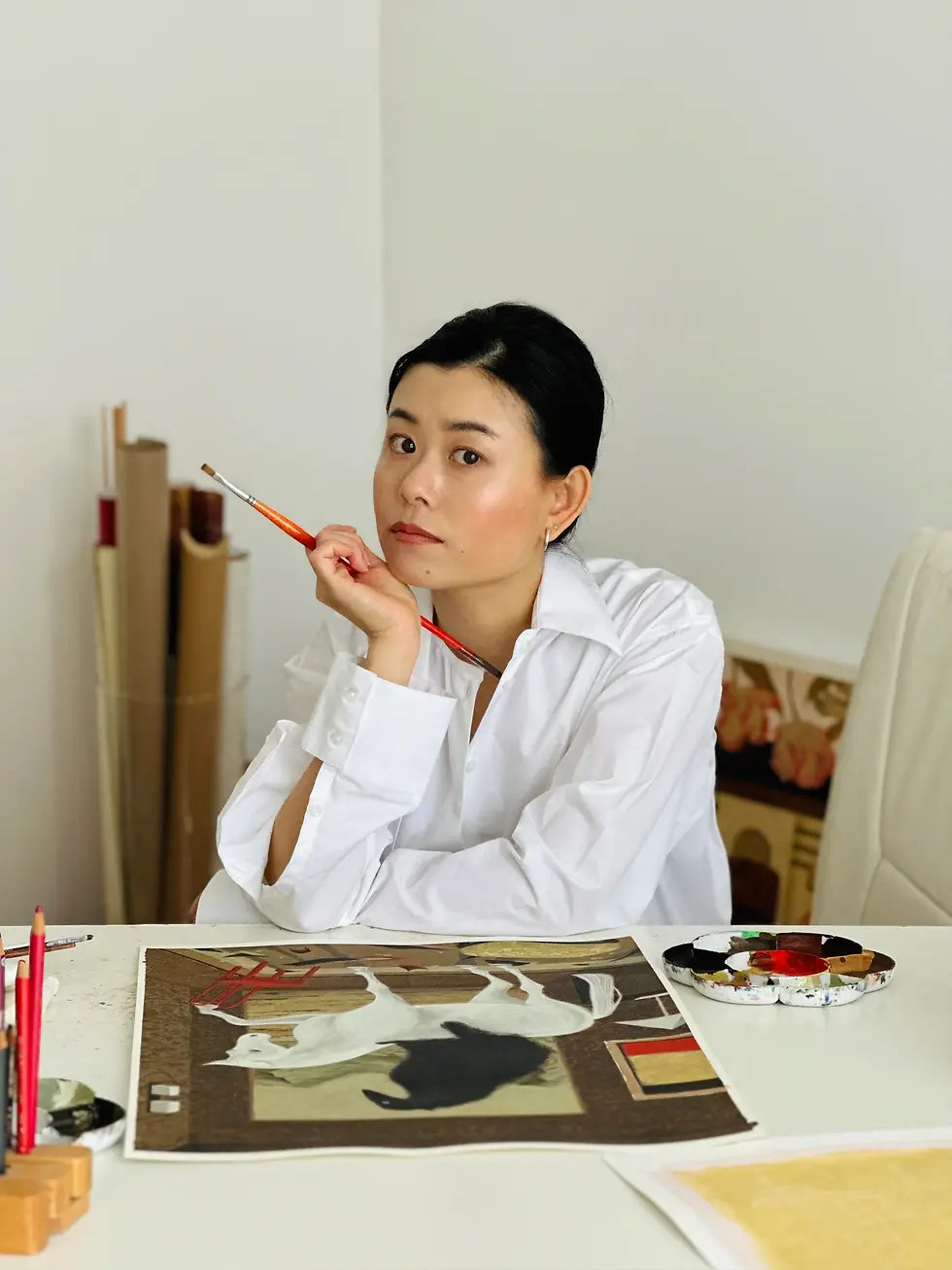
Mirabel Wigon
Mirabel Wigon is a painter based in Northern California. She teaches drawing and painting at California State University. Her subject used to be environmental degradation, but she wanted to move away from the cynicism and turned to plants. She scans botanical specimens with photogrammetry, breaks them apart digitally, then paints from the fragments. The flowers in her work are invasive species and weeds, plants that are already tangled up with humans. She borrows from sci-fi and fantasy to paint them, building what she calls mythopoesis. This summer she heads to New York for the Two Coats of Paint residency.

Q: First of all, tell us a bit about yourself. How did plants end up at the centre of everything you make?
A: I have been a practicing and exhibiting artist for about a decade. Over the years, the subject matter of my work has shifted but has consistently been about how the exterior world shapes me and provokes my imagination. For a while I was focused on environmental degradation, but I really wanted to shift away from cynicism to a more positive message.
In recent years, I've become increasingly interested in plants. To disrupt a solely anthropocentric position, I aim to decenter the human subject and make space for the non-human to be of equal importance.
Plants, specifically the flowering plants in my work, represent absolute otherness and inspire speculation about their nature. I borrow visual language from sci-fi and fantasy since I think it best communicates my dreams for positive entanglements. I think of flowers as agents of change; they literally signal transition and actively demand collaboration from pollinators and cultivators.


Q: You scan botanical specimens with photogrammetry, break them apart digitally, then paint. What does that do to the image?
A: Reflecting on mediated information and the translation of information between media has long been part of my practice. I am interested in the ways that mediation reinforces passivity and separation from active engagement. I make paintings that reflect on this complicated relationship with mediation and respond by rejecting passivity and embracing engagement with the world. I explored mediation by photographing my physical models, so the transition to using photogrammetry seemed natural.
Photogrammetry is a process that takes multiple images of different perspectives of an object to create a model in digital space. The scans themselves are imperfect and fragmented and are further distorted through painterly interventions. The goal is not about mimicking the world but using different processes to create a layered experience. In my current work, the results are enlarged flower forms that reflect multiple perspectives and allude to stages of development. The blooms beckon and engulf the viewer.

Q: You call this work mythopoesis. What kind of myths are you building?
A: Historically, romantic landscape painting positioned the viewer to be in awe of natural forces. Later depictions of industrial and manipulated landscapes reinforced awe in the face of technological progress.
These are stories of human passivity in the face of either nature or culture. Similarly, in present cultural consciousness, people are positioned as passive consumers rather than embodied participants. Rather than perpetuate this, I'm interested in creating a mythic, active painting space that engrosses the viewer.
The plants I record are invasive botanicals and weeds. They are similar in that they are both cultivated and intrinsically tied to humans. To reinforce these active entanglements,
I use crisscrossing orbital pathways to allude to cyclical rhythms and slower, more active ways of being in the world. The painting is a vision which rejects the passive observer for an invitation to experience this entanglement.
Q: There's a phrase in your writing, "becoming with." What do you mean by that?
A: Recently, I read this transformative text by Donna Haraway, Staying with the Trouble: Making Kin in the Cthulucene. In it she discusses "becoming-with" as essentially co-evolving and world-building with companion species. This backs up her ideas of sympoiesis, or "making-with," which is a call for cross-species and interdisciplinary actions to make a more livable world. Using this idea as a departure point, I look to flowers of invasive botanicals and weeds as companion species for humans. There is a sense of wonderment and possibility when learning from and looking closely at our relationship with other species. I am thinking a lot about my practice of gardening and painting as being analogous ways of cultivation.
Both create the conditions to observe the complex and messy relationship between people and plants. The fractured and layered surfaces of the paintings demonstrate a reflection on the entangled cohabitation between two companion species.

Q: You teach drawing and painting at Stanislaus. Does being in the classroom change anything for you in the studio?
A: Absolutely! If I'm reading, thinking, or painting about something, I want to share it, and the first way is with students.
Teaching is also reciprocal; you learn from others while they learn from you.
It helps to both clarify and transform your values. I think the classroom is a space to generate an ongoing dialogue about current events and to process new ways of thinking about the social, political, and cultural climate of our times.
I also wanted to familiarize myself with the possibilities of the maker space on our campus, so I took a workshop and learned strategies for the classroom. My students and I were learning and experimenting in real time together with technologies and materials that fall outside of a typical painting practice.
Lastly, I teach because it's a way of giving back or paying it forward by sharing what I've learned to help guide students.
Q: You have one recent and one upcoming residency, one in your region this April and the other in New York this summer. What are you bringing into that time?
A: The first residency, Social Studies, is run by an artist couple in a rural community located an hour north of where I live in the Central Valley. What's exciting is that the Sacramento and San Joaquin Rivers converge in the delta near where I live, before flowing out of the San Francisco Bay area.
All along this migratory flyway there are wetlands which provide shelter for waterfowl. I had the opportunity to explore the river, look at migratory birds, read, and reflect on strategies employed in my painting. I think this is a needed time away from the studio to unabashedly play without feeling the pressure of looming deadlines. For the Two Coats of Paint residency in New York, I'm bringing some finished/slightly finished work to hopefully engage in dialogue about them with other artists, specifically painters. I plan to use that time to ideate and reflect on my project.