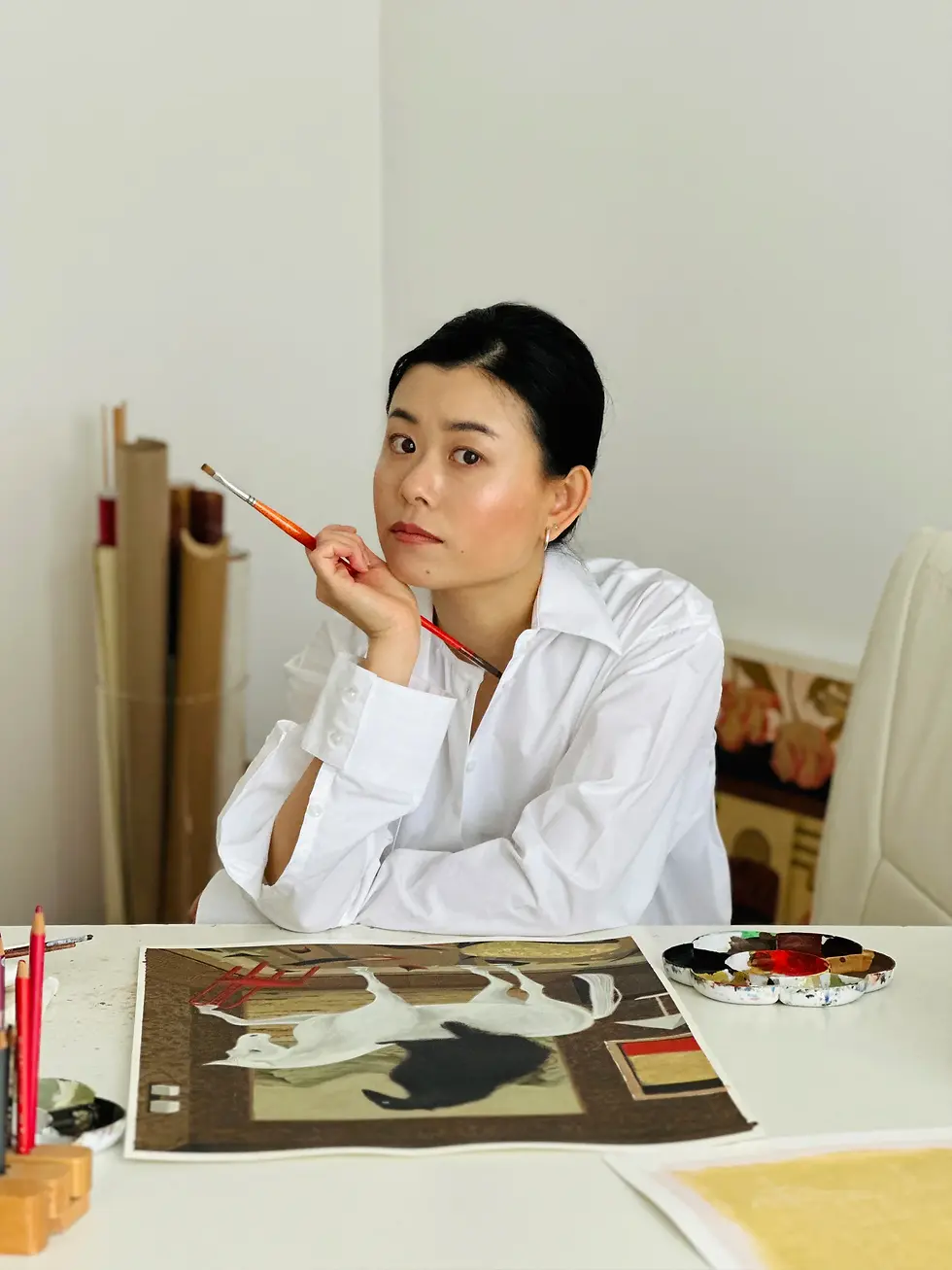
Mary West
Mary West is a painter who has lived and worked in London her whole life. Her father ran his architecture office from the front room of the family home. Later, a secondary school teacher gave her the confidence to go to art school, and she went on to study painting at the Slade. West's early pieces were carefully planned, but motherhood made her mark-making more urgent and intuitive. Today she paints landscapes from scenes on her walks, without sketches. Her current series is about London's lost rivers, which she sees as "the veins of the city."

Q: Tell us a bit about yourself. When did painting become your life?
A: My home and studio are based in London, I've actually lived my whole life in London. My paintings hover somewhere between abstraction and figuration. Landscape and nature are at the heart of all of my work. Imagined and remembered scenes emerge, providing a form of escapism. Painting has always been a part of my life. My Dad was an architect, with his office based in the front room of our family home. Growing up there was always a sense that making and drawing was just something you did. I also had a brilliant art teacher at secondary school. He allowed me the freedom to experiment and championed finding our own identity in art. It was his belief and guidance that I should go to art school that gave me the confidence to pursue it.

Q: You work in the studio but also en plein air. Do you get different things from those two ways of working?
A: Most of my paintings are made in the studio. I spend a lot of time walking and looking, absorbing scenes that accompany me back to the studio. Painting en plein air is a completely different experience, a way of capturing the energy of a place. Paintings come home with me blurred by rain or with bits of grass stuck to the canvas. All of my paintings are made by building layers in oils. I wash colours on, almost like a watercolour, allowing the paint to find its own way. If I try to control the paint too much the painting loses its power.
Q: You find comfort in the cycles of the natural world. Is that what keeps you painting landscape?
A: I'm constantly drawn to the ever-changing elements of nature and landscape. I find comfort in nature's ancient rhythms, the changing of seasons and the persistence of light after darkness. In a world that is increasingly hard to make sense of, nature offers a sense of hope and renewal. Painting, like nature, is knowable and yet unknowable.

Q: Your mark-making is impulsive; the unknown result is thrilling. Has that always been the case?
A: I paint intuitively, building layers and responding to the marks that are left behind. I always feel that the paintings start to paint themselves. I never plan the paintings; I'm not interested in doing preparatory sketches. It's the element of surprise that excites me. I never know how the final piece will look. This hasn't always been the case. My earlier paintings were much more figurative and carefully planned. After having children, the way I painted changed. My mark-making became more urgent; it was as if I surrendered to the paint.
Q: Awash at Twilight Contemporary was a recent solo. What was behind that title?
A: 'Awash' at Twilight Contemporary was an exploration of the shifting states of water, as something that is tender while simultaneously furious. 'Awash' became a space to consider psychological and ecological conditions, with a tangible balance between turbulence and calm in the paintings. I drew on Roni Horn's 'Some Thames' series and Robert Macfarlane's reflections in 'Is a River Alive?', where water is personified, an entity that demands even greater care, understanding and respect.

Q: Your palette is very specific, pink against green, burnt sienna into Prussian blue. How does colour arrive?
A: Colour is key to all of my paintings and is drawn from nature itself. My palette subconsciously changes with the seasons and my surroundings. I generally begin with a dark layer on the canvas, a mix of Prussian blue and burnt umber. I then start a process of reintroducing light, carving out spaces through which to enter the painting.
Q: Landscape has been painted for centuries. What can it still say in 2026?
A: Our relationship with landscape and nature is at a more critical point than ever in 2026. As we face rapidly intensifying climate change and a super El Niño which is on course to be the strongest on record, landscape painting acts as a reminder that we need to protect and honour nature.
With forest fires ravaging ancient woodland, rivers drying up and weather patterns becoming more and more unpredictable, painting the landscape is an essential reminder that we need to defend it.

Q: You've been showing at Galerie Grecourt in Biarritz alongside your London galleries. Has painting for a French audience changed anything?
A: I think you have to be true to yourself and not paint with the audience in mind. If you believe in your work, then the chances are it will resonate with someone whatever their nationality.
Our relationship to nature is universal and as this is the overarching theme in all of my work I hope it speaks to a global audience.
Q: What are you working on right now?
A: I'm currently working on a series of paintings exploring London's lost rivers. These are historical natural watercourses that now flow entirely or partially underground as a result of centuries of urban growth. I see them as the veins of the city, nurturing an ecosystem secretly beneath our feet. I'm drawn to the inherent sense of mystery and deep sense of history.