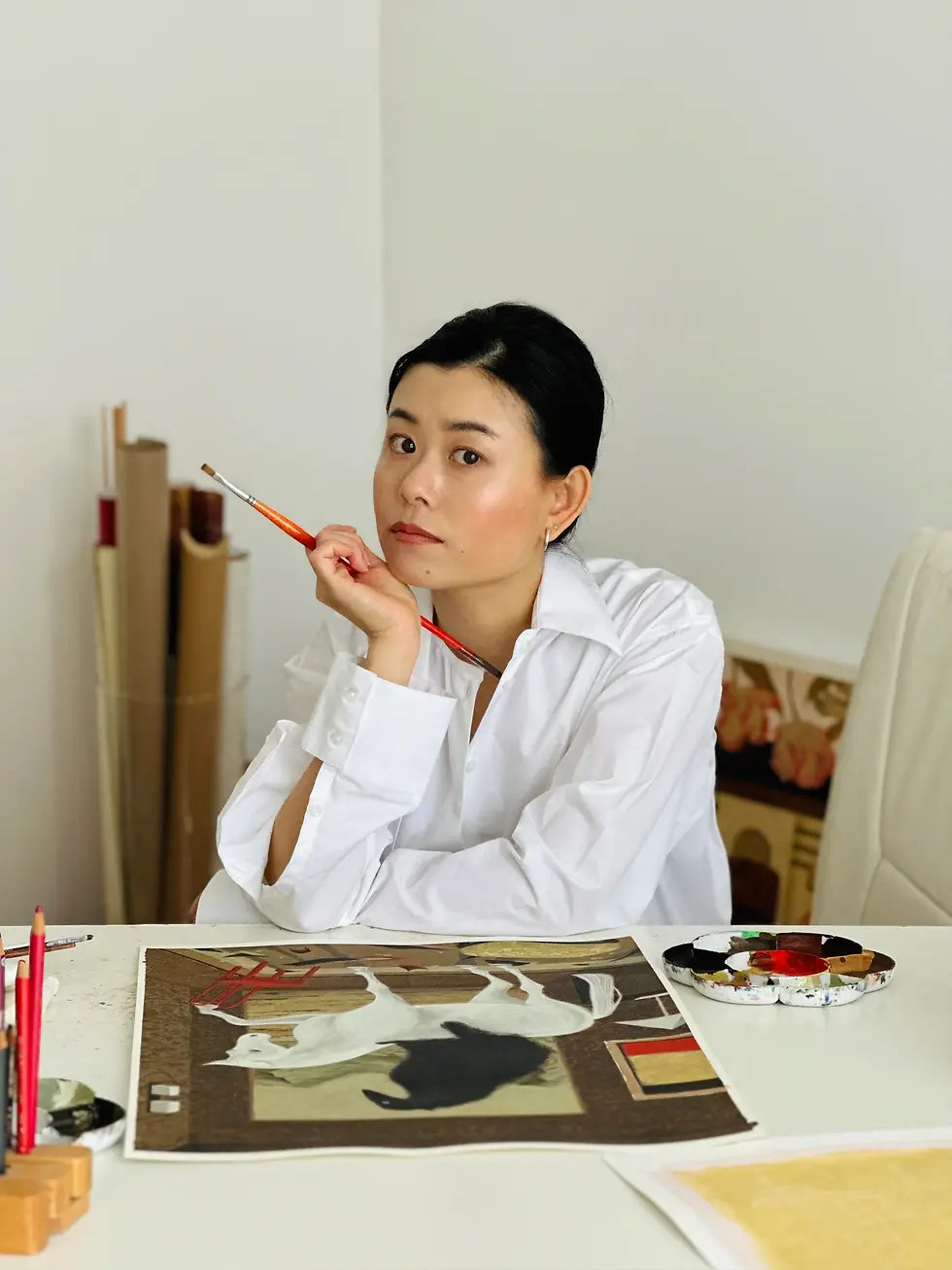
Lauren Beth Łojek-Williams
Lauren Beth Łojek-Williams is a self-taught painter, poet and DJ based in Sydney. She works in acrylic and ink on canvas, often rotating it while she paints to see what shows up. She started writing poems while travelling because she could not get to the studio, and now the poems come before the paintings. She sticks them on the wall and works from there. She also DJs, solo and as one half of Kissin Cuzzins, which she says is the out-of-your-head, in-your-body counterbalance to all the introspection.

Q: You're a painter, a poet, and a DJ. How do those three things live together?
A: I started writing poems when I was travelling and couldn’t take my thoughts and feelings to the studio right away. I found out it was a great way to release them and still preserve them so they don’t get lost in the moment and can make it back to the studio. And DJing gives that out-of-your-head, in-your-body counterbalance that I need after all that introspection and thinking.

Q: Your poems and paintings come in pairs. How does a poem turn into a painting?
A: In my paintings, nothing is ever a literal depiction. The poems are a time capsule of what’s happening in that moment; it’s a photo of something that can’t be photographed.
I have a quote from an article about a Degas sculpture of a woman on my studio wall that says the figure is “looking for something she can sense but cannot see.” That’s the whole idea. The poems capture something I can sense but not see, and then I write it on a sticky note, stick it on the wall, and see what it becomes.
Q: You rotate the canvas while you paint and let figures emerge from the abstract layers. How much of that is trust and how much is control?
A: I trust the process. Rotating the canvas throughout the painting lets me find things I didn’t know were there. I might have an idea going in, but it’s just a starting point.
I’ve moved away from planning a structure and doing that. I just want to paint and see what the painting will do. Making room for surprise is very important to me.

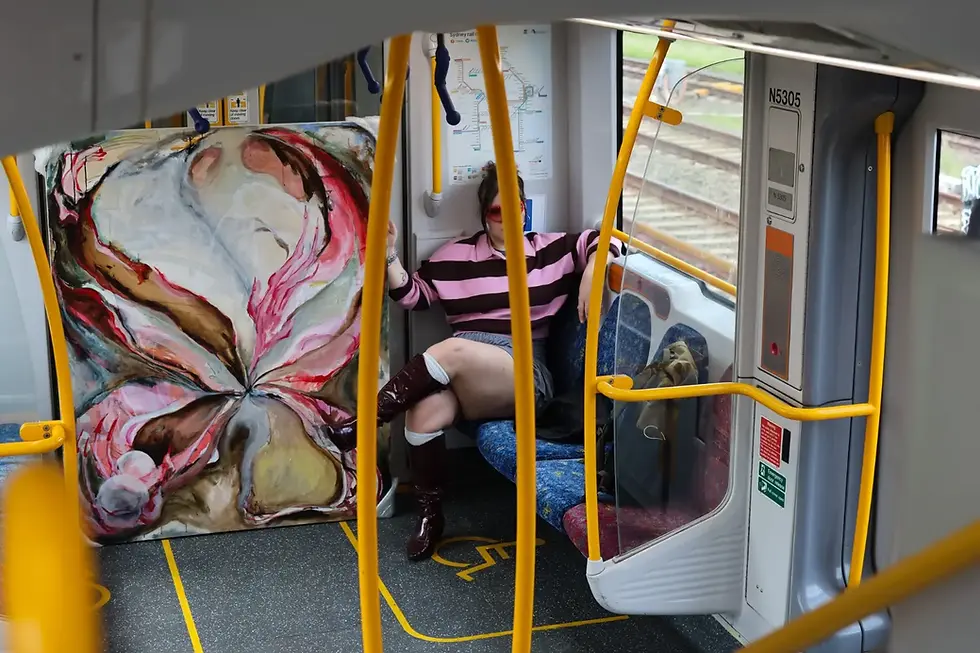
Q: The Delivery is a photo series of you physically carrying a large painting across Sydney by foot and train to submit for the Sulman Prize. What made you document that?
A: I love painting on big canvases that are unfortunately difficult and uncomfortable to move around. I used to have my big canvases delivered to my home, and they didn’t fit in my car, so I’d have to carry them on the 30-minute walk to get them to my studio. I got a lot of stares from people on the street and in cars; it would scuff up the bottom corners of the canvas when I’d accidentally drag it on the ground, and it stayed with me what a performance that is—even unintentionally, with an empty canvas, even when I didn’t want it to be.
With The Delivery, I wanted to use the quiet, generally annoying, and inconvenient task of carrying a large painting as a reflection of the persistent, awkward, and constantly exposing nature of being an artist.

Q: Woman of Experience is about turning 30, shedding the weight of youth. Where did that piece begin?
A: From about the age of 27, I was constantly hearing how I was “nearly 30,” something I’ve never experienced about turning any other age before. It was clearly so significant to people and made me feel like I was about to expire. I realised how prized being young and naïve is for women, that life experience isn’t held up as the reward it is, and that one day, after the big birthday, you escape from the echoes of “nearly 30” that linger through your late 20s and into the quiet abyss of “early 30s.” The road stretches out before you again, and after fighting through the painful, larval, teething stages of your younger life, you are rewarded with the knowledge and confidence of someone who has already weathered some of the storms that will come to you.
Q: You're self-taught. What does that mean for how you learn and grow as an artist now?
A: I used to feel a little behind because I never went to art school. I didn’t know at what point I could call myself an artist, or a painter. How many paintings until you’re a painter?
Then one day my friend, who did go to art school, pointed out that I painted because I wanted to and felt the need to—not because I was told to, or had an assignment—and what’s more an artist than that?
That really shifted my perspective. I’ll go and do a short course, or a day lesson on how to write an artist CV. I try to plug the holes I know I need to fill, but mostly I keep my focus on the poem, painting, or DJ set in front of me, and on how I can have the most fun discovering and executing my vision for that.