Lasse Thorst
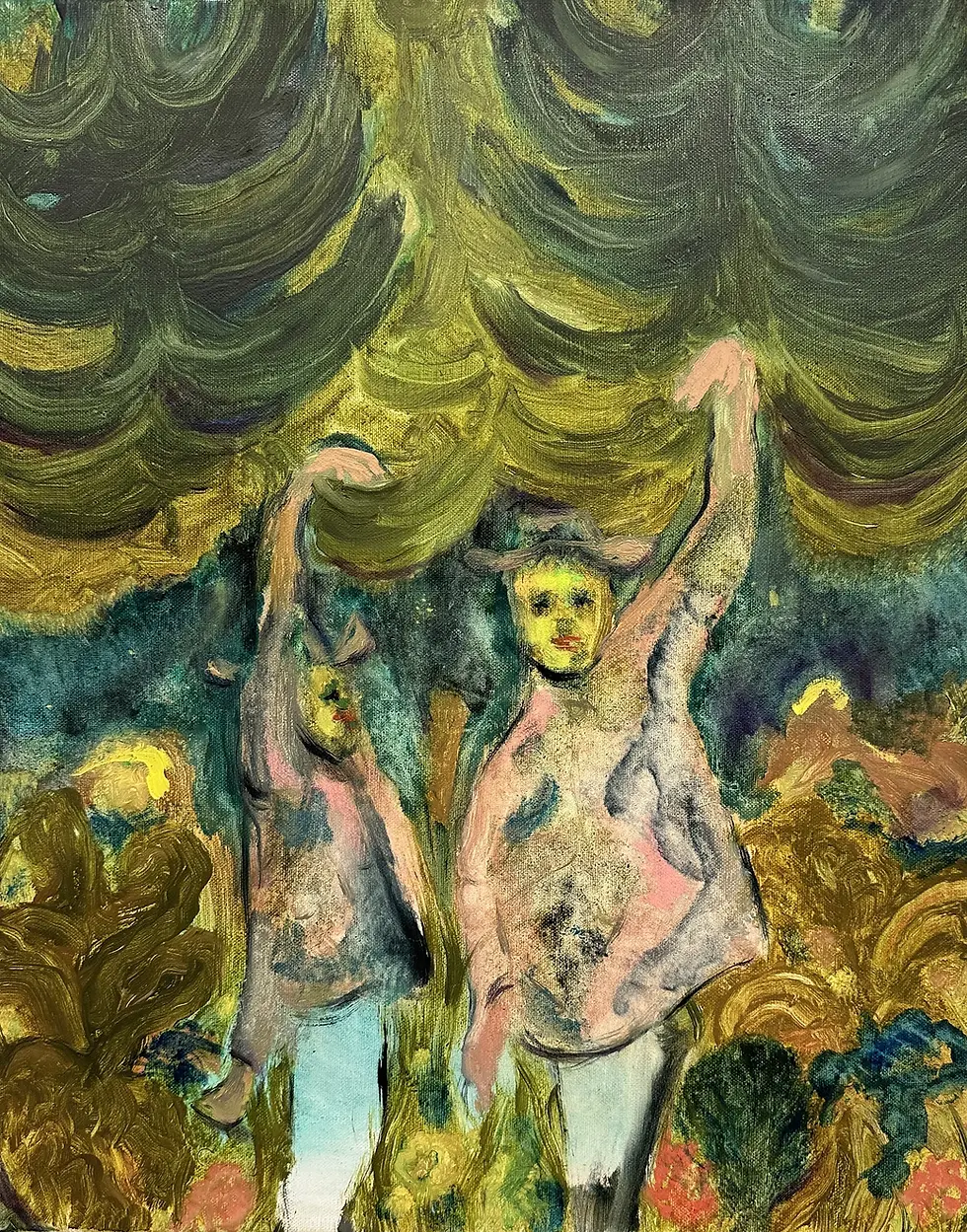
Lasse Thorst is a Danish painter of myths and dreamy landscapes. He spent years as a musician and songwriter before a trip to Vietnam in 2018 got him painting again, where he took up traditional Vietnamese lacquer painting, coating and sanding each layer of paint. He works without sketches, with archetypal figures like the clown, the magician, and the artist, placed in strange surroundings. His first institutional solo, Drømmevandrer (Dream Walker), opens in August at the Frederikshavn Museum of Modern Art.

Q: You spent years as a musician and songwriter before you started painting in 2018. What did that trip to Vietnam change for you?
A: Painting was not new to me, but I hadn't been painting for ten years before my trip to Vietnam. I guess I woke up and started visualizing again, seeing things painted. The thing was that I got introduced to lacquer paintings, an old Vietnamese tradition, where each layer of paint gets lacquered and sanded. This was what I needed at the time, a new perspective, a new medium and a different approach. It just went fast after this.
Q: You paint without sketches. How does a piece start?
A: Well, I come from a musical background, so I'm very much into improvisation and I know that I need to connect with what I'm doing, so that I can have the best conversation with myself. I just found that every time I try to sketch I sort of ruin the magic of not knowing the story I'm telling myself. I have ideas and perhaps details and colors figured out, but I believe that the more I focus the more interesting it will become – first of all to myself. In that sense I work more like an abstract painter doing sessions and that suits my workflow. I easily become restless, and oil usually requires patience, but I love the fact that I cannot figure it out – neither the motive nor how the oil reacts.
Q: What makes you reach for archetypes like the clown, the magician, the artist?
A: I guess I define myself as a romantic painter trying to tell new stories with old characters. I mean I'm very much into mythologies and folklore and I try to stay true to this belief and I find that I love how these characters seem to have so many expressions and meanings. Perhaps archetypes is what binds us together?

Q: You put your characters in landscapes that are unfamiliar to them. What does that open up?
A: The landscape is sacred to me. It's like a new dimension. A liminal zone between dreaming and real life, so it's much more than a setting, it's sort of everything and I find that it's essential for my storytelling and my characters add to this coz their appearance raises questions and makes them kind of like extras in some sense.
Q: Your first institutional solo, Drømmevandrer, opens this year at Frederikshavn. How did that come about?
A: My solo Dream walker (Drømmevandrer) opens this year, August 2026 at Frederikshavn Museum of Modern Art.
I got invited to do this show last year and it's been such a pleasure to dive into this theme. The show is a dialogue with Danish landscape painter, Karl Bovin (1907–1985), where I try to reinterpret the classical landscape painting into sort of this new dreamy, wild landscape not shaped by human culture. So it becomes a liminal zone.

Q: How do you see your art going from here?
A: Right now I'm focusing on upcoming art fairs (Enter, Chart) in Copenhagen this summer. After my museum exhibition I have an upcoming solo with Annika Nuttall Gallery in Århus, Denmark and new group exhibitions next year. I hope to be able to apply for some more residencies and work more abroad and still be able to develop my language. I find that residencies tend to open up for what's next in line. It's like doing concerts instead of practicing alone. It's a way of looking at your own work with a new perspective.


