Cindy Phenix
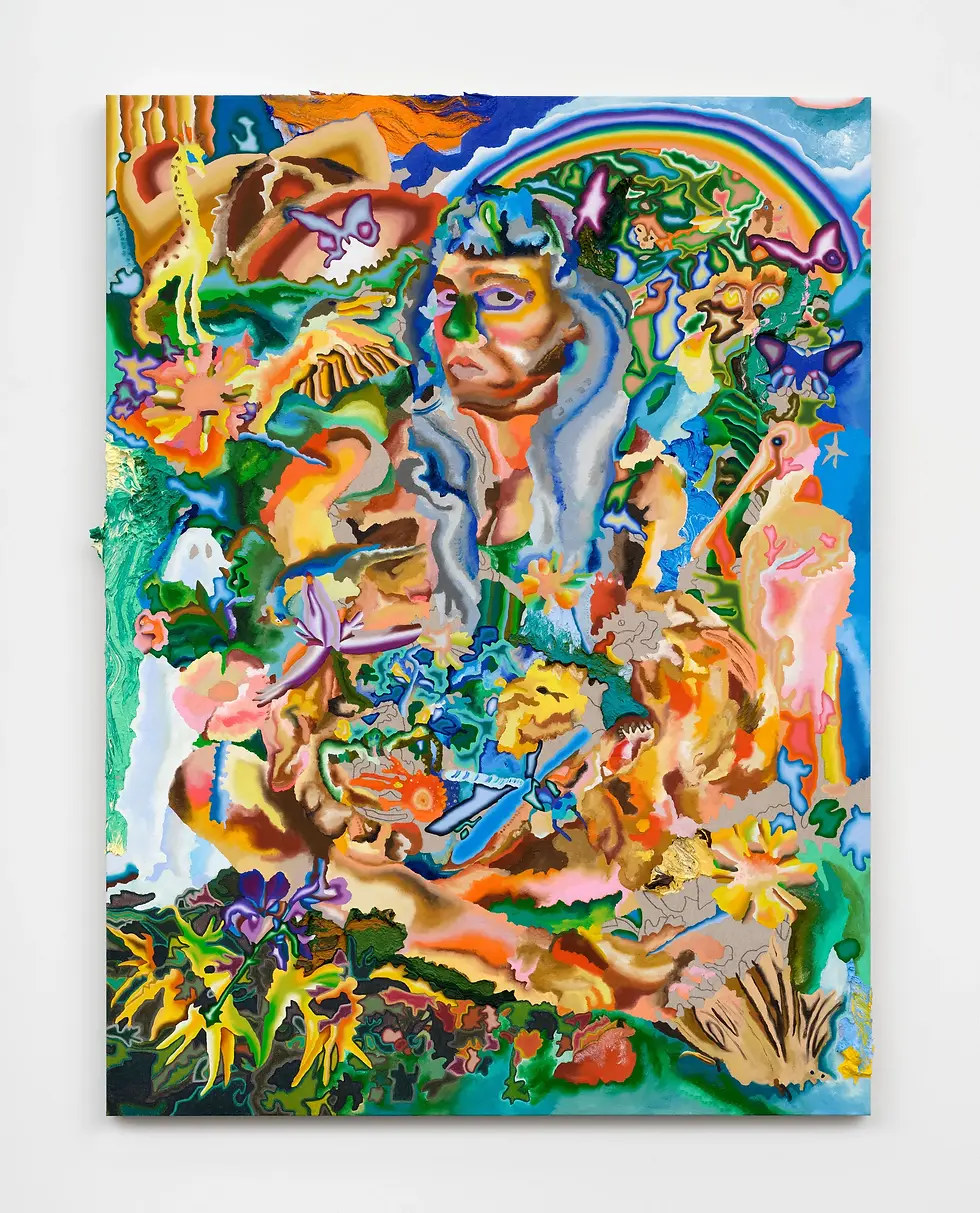
Cindy Phenix is a Montreal-born artist living in Los Angeles. She calls the monsters and ghosts in her paintings "the weirdos." When her mother recently sent her a box of her childhood drawings, she found similar figures in them. "I wonder if, subconsciously, they have always followed me," she says. In her work, people share the space equally with plants, insects and sea creatures. Phenix works from collages made of pictures from books, magazines and her own photos. Her work is in the collections of three major museums in Quebec. She is currently writing a poetry book and making a soundtrack from recordings she took at the Arctic Circle residency.

Q: Your work advocates for ecocentric thinking. How did you get there?
A: I perceive our existence as a rhizomatic structure, as we are all, more-than-humans and humans, interconnected. As individuals, we move within an uninterrupted rhythm, where this stimulation reduces the space for care. It led me to think about the limitations of language between entities and the possibilities of imagining shape-shifting dialogues. How would we access and use the same physical space through different modes of perception? How might silences and sounds interfere with and transform our own self-imposed rules? Because so much goes unnoticed, I wish to translate in my practice the value of wetlands, mosses, birds, marine life, fungi, microorganisms, minerals, currents and echoes, among others. Thinking about new forms of communication infuses my work with a sense of hope for the future, and building an ecocentric world is a path to sustainability.

Q: Tell us a bit about what a day in the studio looks like.
A: I'm an early bird. I arrive at the studio around 9am after my morning workout. I have a bit of a ritual: I water my plants, prepare some coffee and sit on my green sofa in front of the large windows to meditate on the day ahead. I start with logistics, emails and applications before focusing on a project. I have two large wood tables on wheels that I call 2D and 3D, one for drawings and watercolors, the other for sculpture models, mosaics and textile pieces. My paintings populate all the walls.
I enjoy the versatility of these stations; it's easy to jump from one idea to another. The day has spontaneous pauses to play with my little Cavalier King Charles named Camus. And I usually stay at the studio until 9pm. Before leaving, I like to take a few minutes to journal about the studio day.

Q: Who are the monstrous, spectral characters that keep turning up?
A: They're the weirdos! The shape-shifting characters that inhabit a liminal space, holding power and secrets. For me, the ghosts reflect the unseen and the traces of past ecological decisions that generated changes, losses and extinctions in our ecosystem.
The monsters reflect the unfamiliar forms that ecological restoration might take and the hope they carry. Perhaps, they are the many versions of the self. Strangely, a few months ago, my mom sent me a box full of drawings and bricolages that I made as a child, and I discovered that monstrous and spectral characters populated a lot of my childhood projects. They are colorful, jumping in the grass, attending L'école de la fusée. I wonder if, subconsciously, they have always followed me.
Q: There is no hierarchy in your paintings, insects and people get equal space. What made you paint that way?
A: At its core, my work evolves from a process of collage both within the materials and the narrations. Over the past decade, I have accumulated images on a wide range of subjects, from books, magazines, digital sources and my own photographs, forming an archive that serves as a starting point for my compositions. Removed from its initial context, each fragment represents a being that holds an inexplicable strangeness, uncertainty or elegance. When I translate the collage into painting, the pieces are further reinterpreted and flattened onto the same plane, mapped by the initial drawing marks on the raw linen.
The forms, marks and textures of the paint interact and respond to one another in a new context.
Together, they create worlds within worlds, where new storylines shimmer through an infinity of entry points. The process is charged and results in a beautiful controlled chaos that I enjoy.
Q: Your work is in the permanent collections of three major Quebec museums. How does it feel to have the work stay in the place you come from?
A: I'm very happy! Having my paintings remain in Quebec's public collections feels like a lasting connection to the place I come from. I feel grateful to the Quebec and Canadian art and cultural scene for supporting the development of my practice abroad. I am surrounded by a wonderful and deeply rooted community of artists, curators, collectors, as well as my gallerist Hugues Charbonneau, with whom I have been working for eight years. It's important for me to remain active and participate in the Canadian scene.

Q: What's ahead for you? Is there anything new you want to explore?
A: 2027 will be a very exciting year! I'm developing several projects at the moment. I'm working on a whole new body of work, deepening my research into narration and language. As part of this corpus, I'm experimenting with new materials for my sculptures and mosaics, as well as writing a poetry book. I'm also working on a soundtrack using recordings I made during my time at the Arctic Circle Artist & Scientist Residency.
I am collaborating with the Highpoint Center for Printmaking on a print edition. And more secrets to be shared in the near future!


