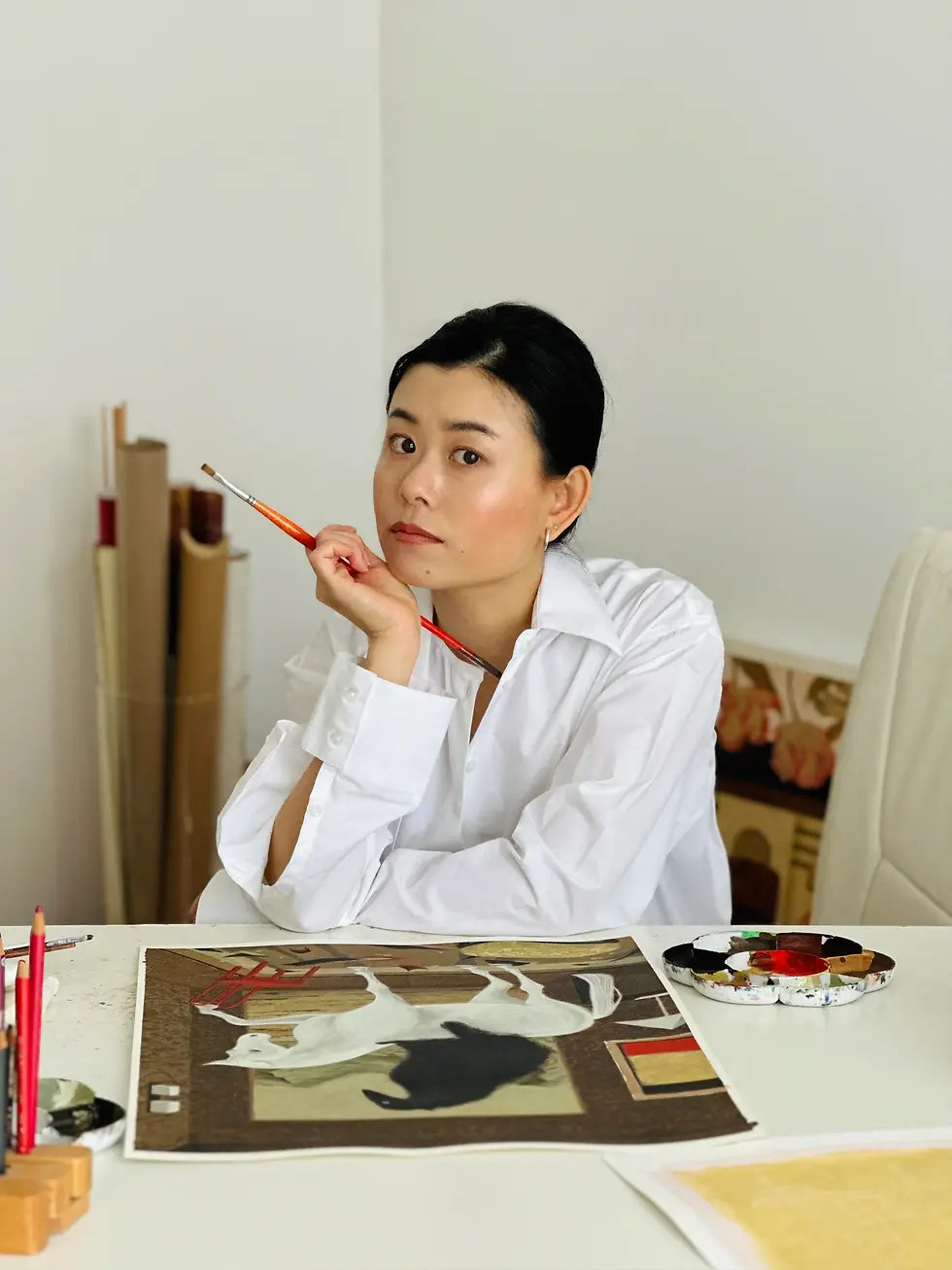
Joonhee Myung
Joonhee Myung, also known as JUNOS, is a multidisciplinary artist working between Seoul and Santiago. She uses photography, video, sound, drawing, and text, weaving them into projects that connect everyday experience with larger questions of place and identity. Her pieces often grow from fragments, dreams, or passing impressions, as seen in works like “Nomadic Fluidity Eternal,” “Fragments of a River Dream,” and “Rootless Tree.” Themes of ecology, history, and belonging surface throughout her practice, giving her work both intimacy and openness. While she continues to work independently across mediums, she is also looking toward collaborations as an important part of her future path.

Q: You often return to memory and absence. Why do these themes stay close to you?
A: Memory is all we have. Not only what historians record, but the fragments each of us carries, our own way of keeping a time alive. Absence, for me, is not just loss; it can be a chosen space where imagination begins. I resist the memories prescribed as truth by institutions or families, and instead write what I recall in my own language, however fragile. In doing so, the unspeakable begins to speak. Each of us carries a hidden voice, an “inner subaltern” that longs to be heard. Through questioning that voice, we do more than remember: we transform, or sometimes return to our harbors.
Recollecting dispersed memories as in "Teojeon (Hometown, 2022)," "Intentionally Left Blank (Sin Título, 2024)" or my zine "Zanmulgyeol (Ripples, 2025)" revives wayward moments which together form a cohesive emotion, even a quantum moment of their own: a grandmother’s gesture, an old neighborhood, a childhood diaspora or the sudden reappearance of a migratory bird on the city’s edge. Haunted shadows of women in history also return, as in "Intangible Asset Miin Byulgok (2015)."
In the end, I try to weave these remnants of memory into a language that brings new forms of presence into being. The medium, whether it’s photography, video, drawing, sound, text, or translation, is simply a matter of choice, like selecting an ingredient and a texture.

Q: Your work shifts between stillness and transition. What keeps you interested in that tension?
A: I have always lived a life of transition. Before turning thirty, my life was closer to migration than settlement, physically in constant motion. So when I abandoned my master’s thesis at thirty and turned suddenly to art, it was a profound shift.
That thesis had already been experimental and interdisciplinary, an attempt to merge science and art through the portraiture method pioneered by Harvard professor Sara Lawrence-Lightfoot.
It aimed to give voice to marriage migrant women in South Korea through research on everyday speech. Yet instead of completing it, I chose film, because there were two questions I felt compelled to answer from within myself first.
First: if cinema is about time and movement, how could I make that movement seamless, like wind, light, or sound? Second: like photography, could film carry a spirit, a photogénie, that reveals the soul of what is often dismissed as soulless images? Vertov once spoke of cinema as a kino-eye—an eye beyond the human, able to reveal unseen movements and hidden connections. For me, this was close to what I call the spirit of film: a search for the soul within images. In works such as "Bird Spirit (2013)," "Interludes (2016)," and "Born (2019)," as well as many of my later photographs, everything flows fluidly, as if captured in a single shot, never broken into rigid sequences. Over time, I realized these questions were not only about film itself but about a deeper search: a vision of a connected society, where nothing is purely individual nor purely collective, but always in flux. We are part of an unlimited continuum of time and space, like neural networks of the brain, like the universe itself, or like cells constantly interacting into one whole.
Through that tension, I come to know our present, its possibilities and its limits.
Q: You move between photography, sound, and writing. How does that shift affect the way you think about a piece?
A: I am still experimenting with what each medium can become. Whether it’s photography, text, sound, video or drawing, you name it, I’ve realized they all stem from the same root question and what I try to express eventually forms a language of its own. At first, my work emerges from what I was born into, influenced by, or programmed to understand. Many people connect with my work at this stage, it feels relatable, friendly, even endearing. But when I go deeper, when I start questioning, dismantling barriers, and breaking through preconditioned structures, narratives, and styles—or try to—the work becomes closer to who I am inside.
If stillness reflects my public persona, then transition or motion reveals my inner essence: subconscious, ethereal, transformative, experimental. That is the language I have come to recognize as truly my own.
Almost like at the end of "Teojeon (Hometown)," the protagonist breaks into a trance-like dance to an electronic beat, moving through the narrow alleys of Seochon as if releasing a lifetime of burdens. I imagine many restless souls of the world in that same motion, shedding, unbinding, struggling to break free from cages, nets, and prisons, yearning for infinite movement. And that’s how I engage between my mediums. Of breaking each other’s limitations free.


Q: Fragments and dreams appear in your practice. What do they give you as material?
A: Fragments and dreams give me nothing but the truth, the bare flesh of the soul.
You can cover it, rephrase it, dissect it again and again, yet it will always send out roots. Like a lizard’s tail that insists on regrowing, or a plant that learns to digest microplastics, life invents new ways to return.
From a single fragment, from the faint seed of a dream, whole territories of thought take root, bearing moments in film, lines of verse, sounds reborn into new genres, passages of time, unexpected encounters, and endeavors yet unnamed. Each fragment bores deeper, opening a door into another language of being. In the end, we can never truly exhaust one another. What is broken remakes itself, what is silenced finds a new voice. We are born again and again, not in perfection, but in continuity.
We live in a time when fragments and displacement are no longer an exception but a condition of life, whether through war, migration, or ecological collapse. My work does not offer solutions, but traces that remind us: survival is always imaginative. A migratory bird returning to a man-made stream, or a voice breaking through silence, become forms of resistance that speak to our present.
Q: Collaboration is part of your work. What makes a collaboration feel right for you?
A: Collaboration is the part of my practice I long for most, and also the part I feel is still missing. Through film I have had the chance to work with many people, but in photography, writing, translation, and music I have mostly worked alone. Film naturally demands collaboration, but if given the chance I would love to expand it into other fields—fashion, music, literature, opera, publishing—sharing ideas and creating something new together. There is no joy quite like that of making something collectively. I have always loved to learn from others. Researchers, scientists, curators, philosophers, artists, and cultural practitioners from around the world, if my work resonates with you in any wonderful way, I wholeheartedly welcome the chance to collaborate on something novel and intriguing. I don’t expect clarity, but resonance. If someone leaves with a fragment that lingers, a line, a sound, an image that refuses to fade, then the work continues to live within them.
What matters is not understanding, but the echo that unsettles and transforms. My future work will carry even more of this turbulence, offering not answers but deeper questions toward myself, and toward the world. And I hope collaboration will foster such dialogue and creativity into a new novel dimension.
Q: Ideas of movement and being in between show up often. How personal are these themes for you?
A: Perhaps it comes from a long life of migration, while inwardly bound within the rigidity of family and society. I could not bear to repeat that suffocation in my art. After years of bending myself to frames and grammars, across nations, cultures, languages, disciplines, even gender, I grew weary. What I longed for was movement: like a dog leaning into the wind from a car window, or a bear gazing quietly at the horizon, gestures of freedom, brief openings into the essence of the world.
Every movement carries its stillness, whether in death, in pain, or in the inevitability of pause. In those thresholds, we find we are never entirely outside, but always caught in-between, regardless of nation or border. Even now, as I care for my aging parents, watching them slowly surrender to stillness, I ask myself: where do we move, when helplessness is the only ground beneath us?
My answer—or perhaps my defiance—is to give that freedom wings: through image, through sound, through presence, through language, to break open and be born anew. It is the desire for which I would trade everything, and the question that still haunts me: to exist like Zhuangzi’s butterfly, drifting between dream and waking, or like Deleuze’s wolf, both intimate and cosmic, carrying a desire that is at once survival and wonder.