Gís Marí
Updated: Aug 14
Gís Marí is a Dutch painter based in Portugal. His parents were art dealers, so he grew up around art, but only started painting in his early twenties, while studying psychology. He works on a single painting for months, sometimes years, and signs only the ones that meet his standard. The rest he cuts into pieces. His studio is an old rice warehouse in Figueira da Foz, between the River Mondego and the ocean. He is now painting a series called Shadow Dancers, exploring different tones of black.

Q: Tell us about the path from studying psychology to painting full time. Where did that shift actually begin?
A: Since my parents were art dealers, I grew up surrounded by art. I recall lucidly that there were always newly acquired paintings spread over the house. The act of creating something out of nothing fascinated me, yet becoming an artist myself didn't cross my mind until I was in my early twenties and studying psychology. The beaten path of finishing my study and having a fixed job after didn't appeal to me at all, I was looking for freedom. I remember one day I bought some paint materials at a store around the corner and started to experiment with them. Over time I became more and more fascinated with the medium of paint and was reading more artist biographies than psychology books. I quit my study and rented my first atelier in an old shack at the NDSM wharf in Amsterdam. From that moment on, I dedicated my life to painting.
Q: You've moved from Amsterdam to Porto to Figueira da Foz. How did changing your base show up in the work itself?
A: In my studio in Amsterdam, I spent most of my time experimenting, learning by trial and error, exploring the medium of paint and its possibilities.
In Porto I was able to experiment with different paintings simultaneously and also started to work with oil paint. I lived in my atelier, obsessed and surrounded by my work all the time, taking my daily bath in a swimming pool nearby. During that period of solitude and focus I found my voice; conveying energy through paint.
In Figueira da Foz, where I live today, everything fell into place. My studio is an old rice warehouse with an incredible energy; I live beside the River Mondego and a five-minute walk from the ocean.
The ocean and river, the primal energy of ebb and flood, the wind, reflection of the sunlight of the water, they are all a big source of inspiration.

Q: You work on a painting for months, sometimes years, in constant conversation with it. What does that conversation actually look like day to day?
A: It is a strange combination of confidence and despair, of empathy and being rigorous. I interact with the painting and try to remain as receptive as possible. It is much like a dance, a continuous exchange in which I respond to what unfolds on the canvas rather than trying to control the outcome from the beginning.
But in the end, I as a painter need to be determined and decide in what direction the painting is going and whether or not I place my signature on the work.


Q: You only sign your best work and destroy the rest. How do you know when a painting has earned it?
A: I work on a painting for months up to years. This allows me to develop a relationship with each work. With some works this relationship emerges quickly, with others it takes much longer. That is why it is important for me to give each painting the time and space it needs to develop. If, after a period of observation and reflection, I decide that a painting does not meet my standard, I cut it into pieces.
Q: You call yourself a messenger between an inner world and the common one, like Hermes. What does that inner world look like when you're standing in front of a canvas?
A: That is impossible to explain in words because it is so particular and unique to each individual. In my work, I try to translate my inner world onto the canvas. For that reason, I believe the best way of answering that question would be to simply look at one of my paintings.
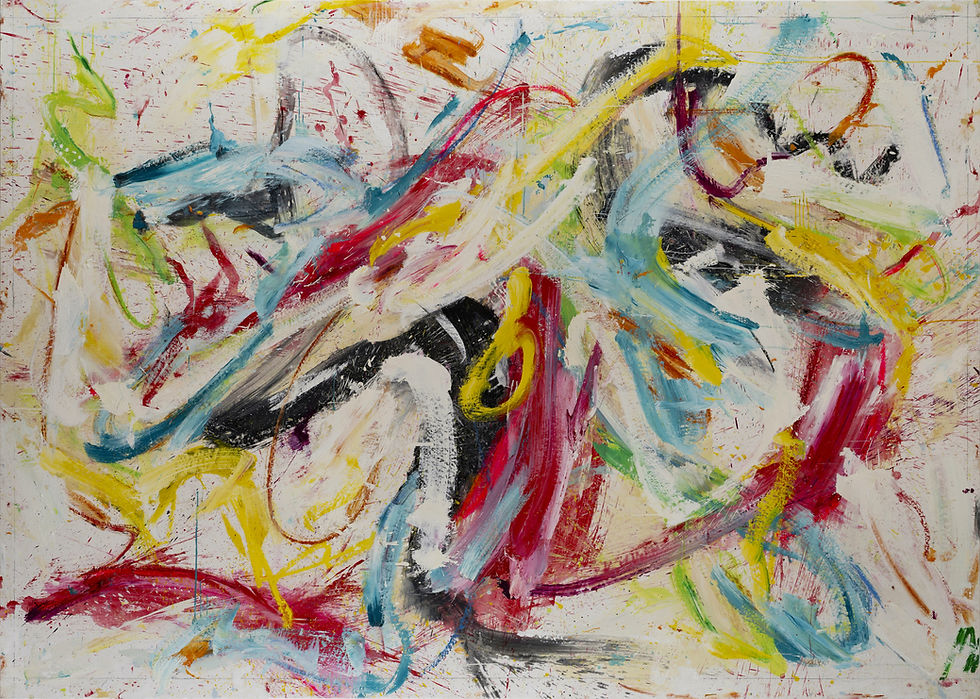
Q: What are you working on now, and where is it headed next?
A: Recently, I have been working on a series of paintings titled the "Shadow dancers", in which I explore the possibilities of working with different tones of black. Also, I have been working on a series of large-scale works, measuring 3x2 meters. These paintings have challenged me both physically and compositionally, because it is difficult to maintain balance and coherence on such a large surface. At the moment I am working on a series that explores the possibilities of abstraction that meets the figure.


