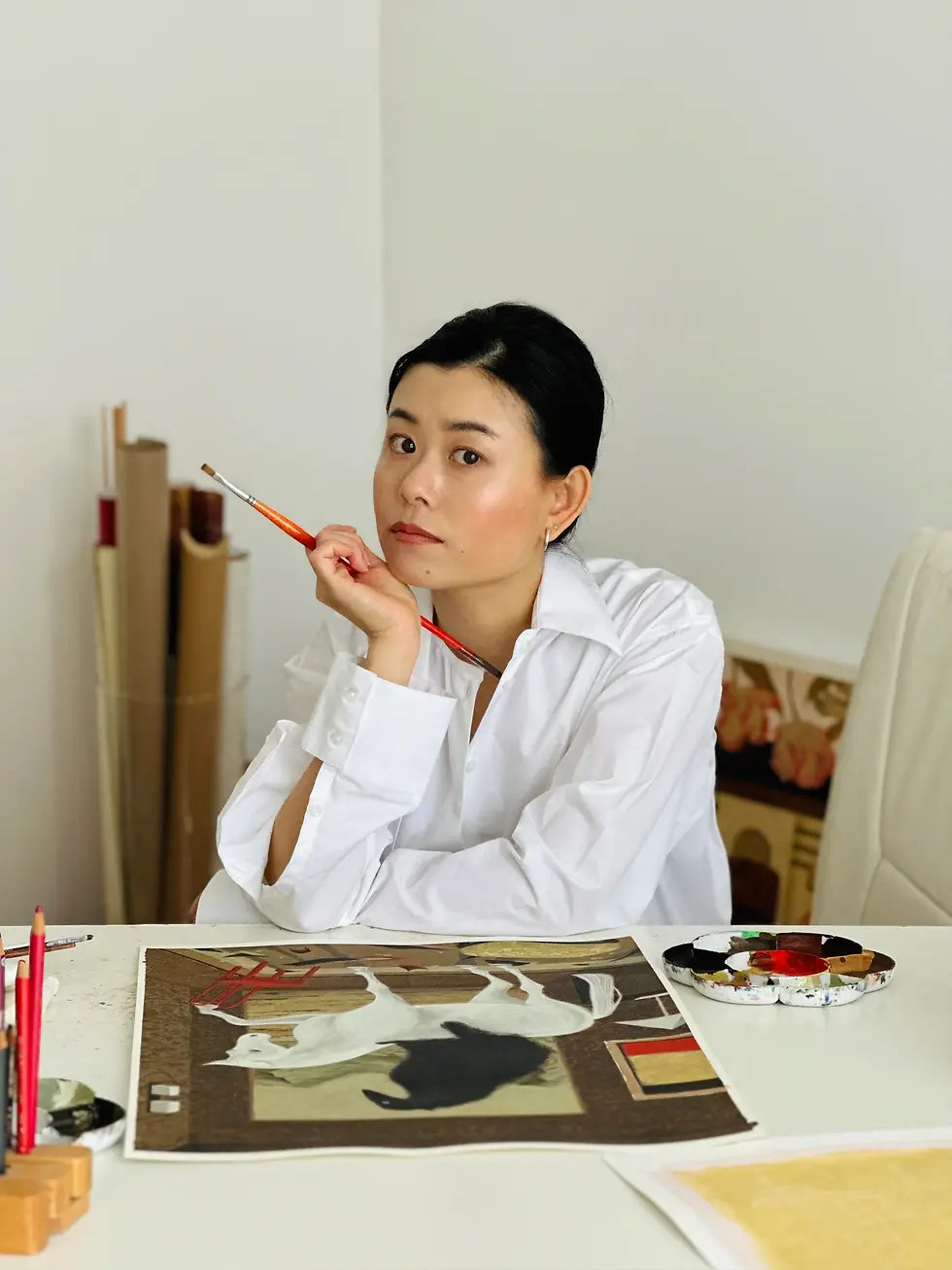
Filadelfa Rodriguez
Filadelfa Rodriguez is a Filipina artist based in Singapore whose paintings build through rhythm, color, and layers of movement. She works with acrylic, oil, and mixed media, often starting without a set plan and letting each mark find its place. Memory and lived experience guide her use of color, from warm ochres that recall summers to muted blues that carry the stillness of sky and water. Her background in interior architecture shapes her sensitivity to space and composition, giving each work a presence that extends beyond the canvas. Large or small, her pieces invite moments of pause, offering a quiet balance of clarity and openness.

Q: You studied interior architecture before painting. How does that sense of space show up in your canvases?
A: Studying interior architecture gave me a different kind of discipline, training my eye to see composition, proportion, and the way art belongs within its setting. From the lens of interior architecture, the space itself becomes the art. During my studies, I began to see each space as a canvas, adding elements one by one until it came together as a complete work.
I’ve learned that art does not stop at the edge of the canvas. The wall, the furniture, the light, and the atmosphere all merge into a single experience. When I paint, I imagine how a work will live within a space, how it will shift the atmosphere and invite the eye to linger. At home I often place my works halfway on a wall to sense how the art pieces breathe weight and presence into the space. For me, the real art is not only what is painted but the harmony that emerges when artwork and setting move together as one.
Q: As a kid you spread cartolina on the floor to draw. Do you still work with that same need for space now?
A: That early instinct for space never left me. As a child, I would spread cartolina on the floor because a wide surface felt like an endless possibility where I could immerse myself in creating. Today I gravitate toward large canvases for the very same reason. Working at scale allows me to think with my whole body, to move around the piece, and to let the painting unfold. The work reveals itself gradually, each mark and layer building until the whole comes into view, emerging organically over time, both in the making and in the seeing.
I approach large works by focusing on different areas of the canvas and then stepping back to understand how they speak together. Small marks accumulate into movement and rhythm, while the tiniest details weave the composition into coherence. Even when I work on a smaller scale, I try to preserve that openness, so the piece still carries a sense of presence.
Q: Your paintings move between stillness and motion. How do you know when a canvas feels finished?
A: I would not describe myself as painterly in the traditional sense. My style leans toward order and cohesion, which feels true to who I am. I find expression not in loose strokes but in the way refined gesture and color come together on the canvas.
Over the years, I’ve come to recognize that a work feels finished when it is in harmony and nothing unsettles me. I often begin with bolder marks, but I tend to refine them eventually. I’ve learned that following my own artistic voice matters most, and I find inspiration in what is clean, calming, and imbued with clarity.
I am drawn to works that feel resolved, and I find a sense of order in clean edges and put-togetherness. That is where I know a painting has reached its end.
I believe there is power in constraint and in being intentional with every choice. I sometimes find it amusing that I lose myself in a big canvas, yet still ensure that each part holds its order. Perhaps that is simply me.
Q: You often begin without a plan, letting instinct lead. What do you gain from working that way?
A: I still sketch and gather inspiration from everywhere: from unexpected places, shifting shapes, songs, or even the field of contemporary media.
My mind is never idle and is always seeking. I hold onto Picasso’s words, "Inspiration exists, but it has to find you working." For me, that means ideas rarely arrive if I sit and wait for them. They come when I am already sketching, painting, or experimenting. The act of working creates the conditions for inspiration to appear, and often what begins as something in my mind, a spark in the air, evolves into a tangible piece that feels personal and profound.
When I face a blank canvas, I am never starting from nothing.
There is always something I have seen, read, or felt that lingers with me, and without a rigid plan, I let that unfold through instinct and creative choices.

Q: Memory is central in your work. How do you turn a passing feeling into color?
A: Colors will always remind us of moments and visuals from the past, from fleeting moments to defining experiences that stay with us. In school, you can study color theory and learn what each color is supposed to represent, but it is one's lived meaning that ultimately defines what a color becomes. I resist fixing colors to theory, since memory and experience make them alive. For me, colors are recalled through memory and experience. A sense of warmth might surface as ochres and terracotta, recalling summers, while moments of stillness often emerge in muted blues or gentle greens, evoking the serenity of sky and nature. Earthy browns carry a grounding presence, tied to both memory and place, and rainy days often return in quiet, muted tones.
For me, color is a way of holding onto these fleeting impressions. It does not replicate the memory itself but carries its feeling and atmosphere into the canvas, where it can be experienced anew.
Q: Painting feels to you like returning to the child who painted without rules. What part of that freedom do you still look for today?
A: When you are a child, confidence comes naturally and fully from within. As an adult practicing art, you live through many opinions, criticisms, and even self-doubt that can hinder expression. We become sponges, absorbing so much from the world, and over time expression can feel depleted or reshaped by outside forces.
The freedom I seek today is that same instinctive confidence, the ability to create without hesitation or fear of judgment. When I catch even a glimpse of that state of simply being, I hold on to it. Painting becomes a way of recalling that freedom and returning to it, again and again.
And when someone chooses a work of art, they are not only taking home a canvas but the distillation of an artist’s years of practice, persistence, and the quiet work of self-preservation.