Daniela Savarese
Daniela Savarese is an Italian figurative painter, raised between Rome and New York. When her family moved to New York in the early '90s, her parents took her everywhere with them, to openings, dinners, and parties that ran late, where she drew for hours in coat rooms and at restaurant tables. She has painted people ever since. Some sitters come back painting after painting, her childhood friend Paul most of all. What she's after is the point where someone stops performing and something real comes through. She has lived and worked across Europe and now spends more of her time in Portugal.

Q: First of all, tell us a bit about yourself. How did your story with painting start?
A: Drawing and painting have always been part of my life, since I was a child. When we first moved to NYC in the early '90s, my parents had no childcare or family around, so they took me everywhere with them—to openings, dinners, parties, often late into the night. I grew up very much on an adult rhythm, surrounded by adults. I entertained myself in coat rooms or at restaurant tables with paper and coloured pencils. I loved it. I felt like a fly on the wall—tucked away, but in the middle of everything. I could lose myself for hours drawing. Those are my earliest memories of sketching and painting, and that language never left me.

Q: You were raised between Rome and New York, then lived across Europe. Did the painting change with each place?
A: Not in a conscious way. I think we're shaped by every place we live in. Every move changes us—we discover new things about ourselves and about other people, and that inevitably finds its way into the work.
The artistic and cultural traditions we encounter also influence our eye and our aesthetic, even if we don't realise it at the time.
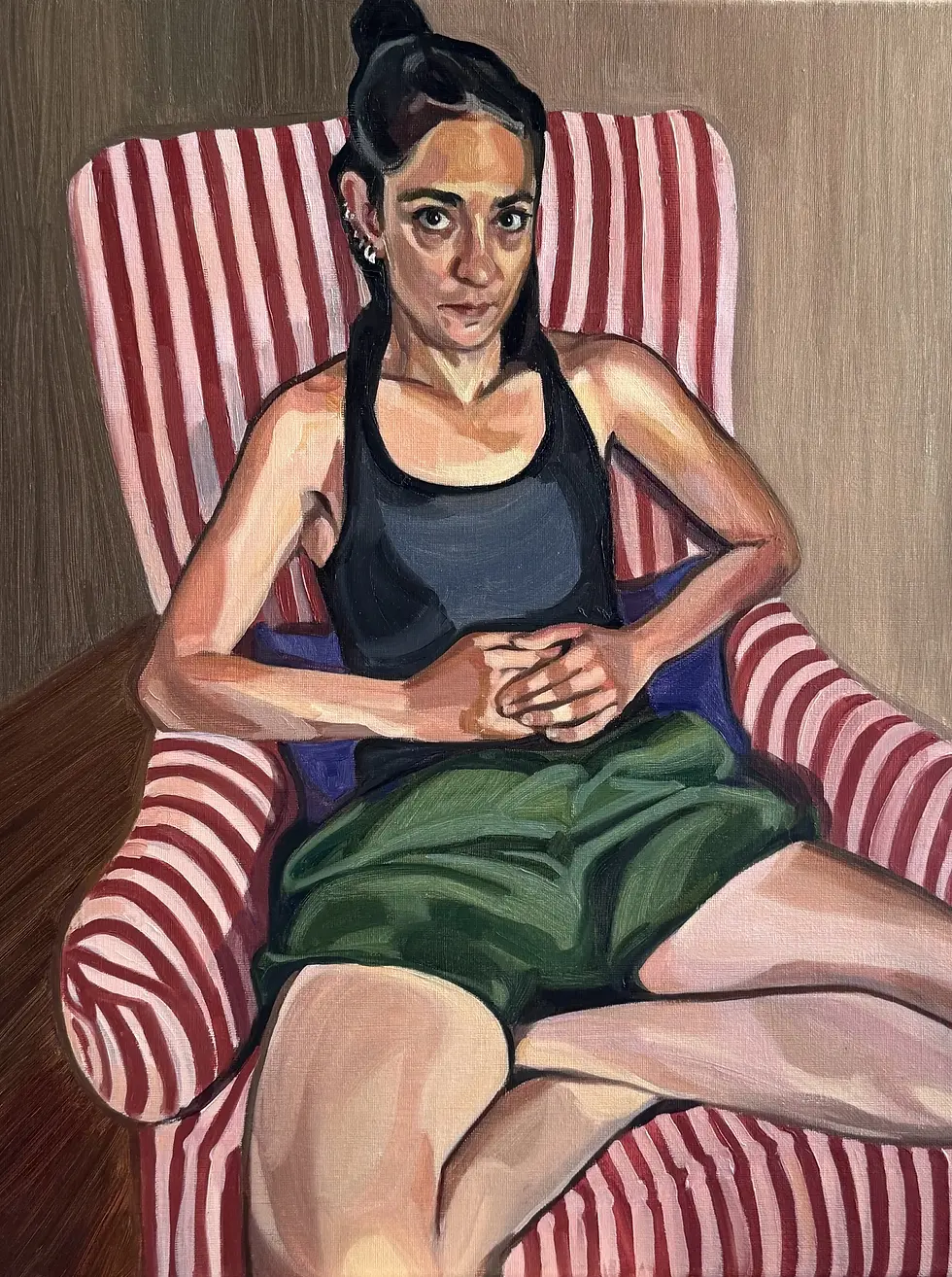
Q: Some of your sitters return in painting after painting. What keeps you coming back to the same faces?
A: I do have some preferred sitters. My childhood friend, Paul, is probably my favourite. We are practically sisters and she keeps me honest in my work. It's easy to be honest when you know someone so well. Their expressions speak louder than others'.

Q: You've called portraiture an encounter with the inner narrator. What does that encounter look like in a session?
A: It's a very quiet moment. You search your subject. The aim isn't to unravel them completely, but to catch something; move past the initial self-consciousness, or what they want you to see, to connect with something more internal. It's really an act of empathy. I have never wanted to paint anything but people. Landscapes, still lifes, and abstraction were never part of my visual vocabulary, not even as experiments. My focus has always been entirely fixated on the human form and experience.

Q: Your paintings catch the moment when the composed face gives way. What do you look for in a sitter before that happens?
A: A certain soulfulness. It looks different in everyone, but ideally I'm looking for layers and depth. Some faces, more than others, seem to have an access point to what's inside—a tell, if you will.
Q: What's ahead for you this year?
A: I'll be spending more time in Portugal and hope to become more rooted here, both personally and professionally. I'm looking forward to getting to know the local artistic community better and to building new relationships with curators, galleries and fellow artists. Alongside that, there are a few exciting opportunities taking shape abroad that I hope to share more about soon.


