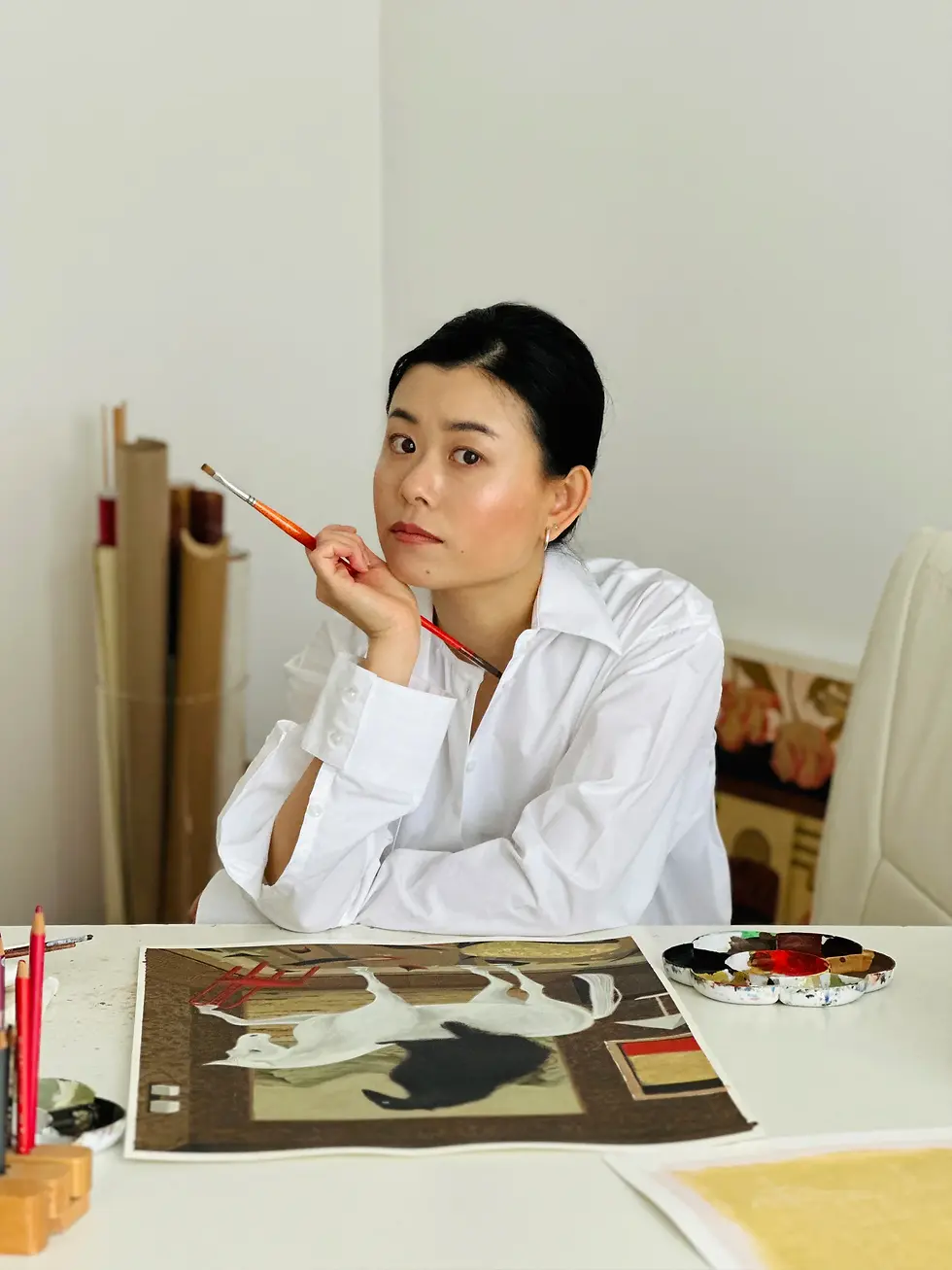
Christina Arark Manucharyan
Christina Arark Manucharyan is an Armenian artist who worked as an editor at Vogue before returning to art in her early twenties. Today she works in ceramics, painting and textiles. She set out to travel through every region of Armenia, keeping a digital diary of the ornaments she found, and now combines them with screenshots, codes and online messages. She calls herself "an overthinker with years of experience." This fall she started an MA in Fine Arts in Belgium.

Q: Could you tell us a bit about yourself and your background? How did your art career start?
A: I'm a multidisciplinary artist working mainly with painting, ceramics and textiles. I drew passionately as a child and went to two art schools, but for a long time I wasn't convinced that being an artist could be a real profession. So I chose journalism instead and even worked as an editor at Vogue.
And still I was very interested in research on how digital communication influences relationships, and I often made illustrations for the articles I was working on. In my early twenties, after leaving journalism, I decided to return to art and began studying contemporary art.
An important moment for me was participating in workshops at TUMO Studios in Yerevan, where I met many artists, including the ceramicist Jan Ernst. He encouraged me to expand my practice into ceramics. I think finding great teachers is incredibly important, especially at the beginning of an artistic practice.

Q: How did Armenian ornament and craft traditions come into your work?
A: It started with a desire to learn more about my own roots and cultural heritage. I gave myself a mission to travel through every region of Armenia and create a digital diary of the ornaments I collected along the way.
Armenian ornamental tradition is incredibly rich and I fell in love with its rhythm and visual power.
So I built my own archive of Armenian ornaments and began combining these references with contemporary digital traces like screenshots, codes, messages and fragments of our online communication. I like to explore this dynamic between ornamental and digital structures. And one of my biggest dreams is to come back to Armenia after my studies in Europe and create my own art residency and studio.
Q: Take us through your studio. Where does a new piece start?
A: I've just moved to Belgium, where I'll be working in a completely new studio at the academy, so for now I would say my work starts on my phone. I constantly save screenshots, memes, fragments of conversations, strange things I come across while scrolling and random images from my camera roll.
Then I make sketches and write stories around these fragments and from there I start thinking about the form. With ceramics I treat the surface almost like a map. Images, words and ornaments travel around it, disappear behind it and meet again on another side. Sometimes I hide messages inside a vessel, so part of the work remains invisible.
Right now, I'm also trying to bring the same freedom I feel with ceramics into working on canvas and paper. And also I'm very interested in exploring more with sculpture and textile!
Q: You put ancient vessels and phones side by side. Why those two?
A: Ancient vessels, such as the Armenian karas, carried practical things people needed in everyday life. Today, we carry our personal archives in our phones. Conversations, love letters, photographs, search histories, documents (and so far, lots of unnecessary information and 101032 videos we'll probably never rewatch again).
I'm interested in this parallel, how both become archives of the people who use them. And I find something poetic in painting our contemporary stories onto these ancient forms. So in my work, these two worlds come together through symbols, messages, fragments of information and even our fingerprints.


Q: What do you find in an unfinished conversation?
A: A blank page with lots of room for projection.And a huuuuuuuge space for overthinking (as an overthinker with years of experience, I can confirm).
This is why fragments of messages appear so often in my work. I don't necessarily want the viewer to know who was speaking or what happened before or after. I like giving them just enough information to start constructing their own version of the story. In that sense, an unfinished conversation is never completely empty. It becomes a space where another narrative can begin.

Q: Is there anything coming up you're excited about?
A: I'm currently moving to Belgium to begin my MA in Fine Arts at PXL-MAD in Hasselt. I'm excited to enter a new environment, meet my teachers and see how this shift in context changes my practice.
I want to continue working with ceramics, but also move beyond thinking through a medium and explore painting, textiles and sculpture. I'm particularly interested in researching how our online presence shapes the way we construct ourselves. I also want to bring my journalistic research skills into my artistic practice more consciously and work closely with digital archives, collected material and personal narratives.
I've also been dreaming about making an artist book. So the next year is about expanding my practice and allowing the research to lead me somewhere I can't fully predict yet.