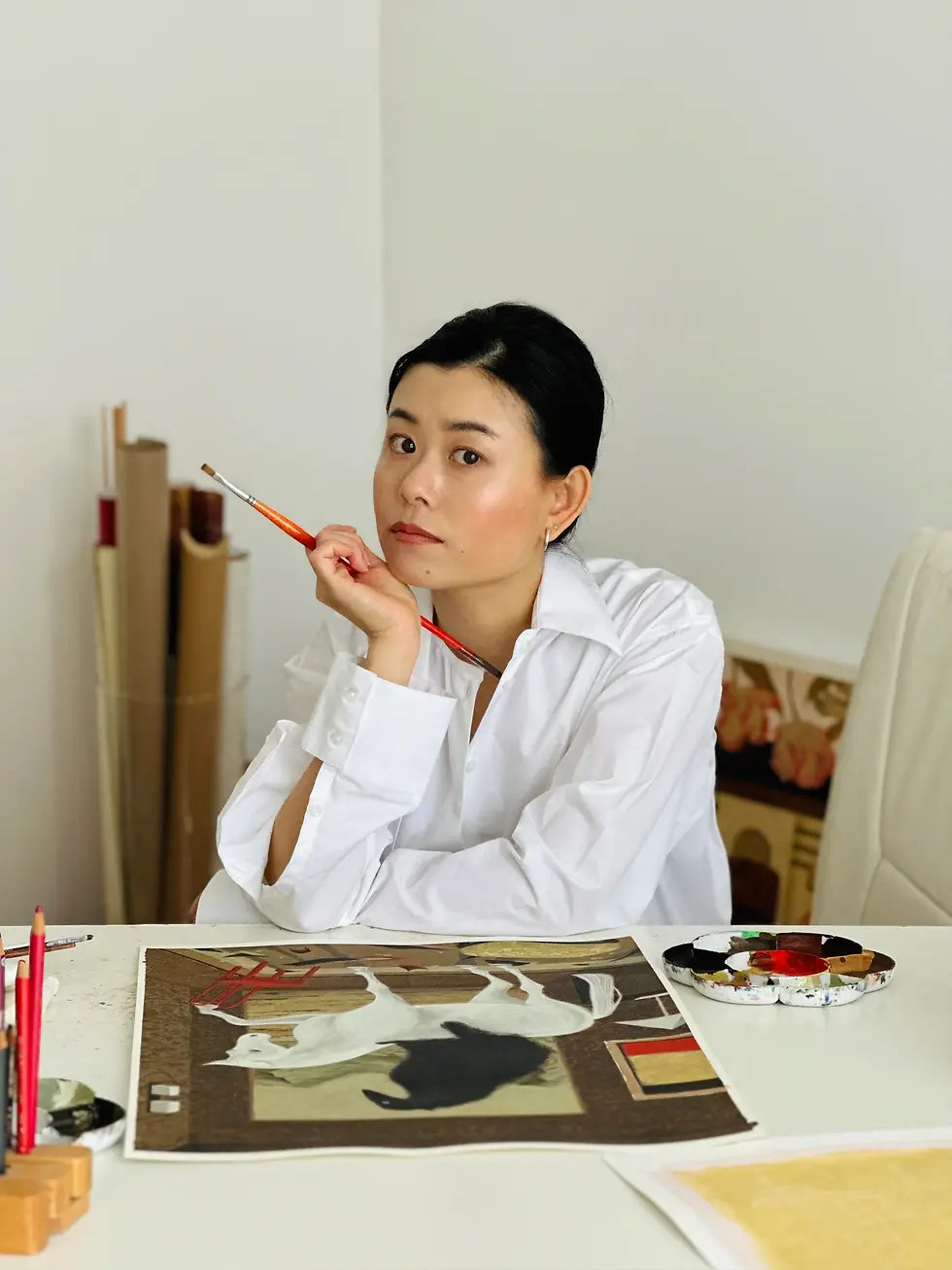
Anouk Wolse
Anouk Wolse is a Dutch Canadian painter based in Zürich. She studied fine arts in Canada, Australia and Italy. She paints figures in imagined landscapes, all in oil, using a small dry brush and building up color by scumbling. The compositions look pastoral but something in the body language, a hand, a shoulder, always suggests tension. Her recent show at Greg Podgorski Gallery was called Angles of Repose.

Q: First of all, could you tell us a bit about how painting became central to your life?
A: Art has always been in my life. I'm fortunate that I have very supportive parents who, rather than getting angry when I drew on the walls, recognized that this was something I loved and always supplied me with sketchbooks, pencils, and paints. We moved around a lot when I was younger but art was the constant; I never questioned that I would study Fine Arts at university. Oil painting in particular brings me a lot of joy and the times when I was unable to paint—living on a sailboat or in a small apartment during the pandemic with a baby for example—I was itching to pick up a brush again. I feel very lucky to have this thing in my life that gives me pleasure, purpose and challenges me as well.
Q: Your scenes feel calm at first, then become more psychologically charged the longer you look. How do you set that up?
A: Colour has such an immediate impact so how the palette develops really sets the tone for the finished painting. I always have my palette in my hand and mix as I go along, so the colours are continually shifting. I usually apply the paint with a small dry brush, scumbling and overlapping colours in a way that kind of diffuses them and creates very soft areas in the composition. There's an overall sense of calm, but the longer you look at the figures, their body language and expressions, the more you become aware of tension in a hand, evasiveness in a pose. So much can be conveyed in the articulation of a finger or the slope of a shoulder, which is why I think we never tire of figurative art.

Q: You write about nostalgia for something that never was. Where does that come from?
A: I think, unfortunately, nostalgia seems to be an inescapable part of human nature. The pastoral as a genre in both visual arts and literature predates industrialization and our modern technological concerns; in Ancient Greece they were already referring to a simpler time and lamenting a loss of connection with nature. It suggests a stubborn dissatisfaction with how we live in the world and makes clear that this perfect place and time has never existed. I'm both fascinated and alarmed by the idea that we haven't changed. We continue to make the same mistakes, seek comfort and respite in nature and bring all our emotional and psychic baggage with us. I think nature is indifferent and benefits from our absence but is also generous, which is why I portray it with so much colour and joy while also acknowledging the inability to escape human nature in it.

Q: Angles of Repose at Greg Podgorski Gallery was a recent show. What was behind that title?
A: For me, the beginning of a work never starts with words and trying to trace it back to or translate it into words can feel disingenuous or disconnected. That said, the ability of a word or phrase to suggest or direct interpretation is a powerful tool.
The title for this recent show was a term I came across that refers to the angle at which a material is stable and beyond which it will start to collapse. I liked the double meaning, in that it could refer to the poses of the figures in the paintings reclining in their environments as well as the feeling of calm that risks slipping the longer we look.
Q: You avoid anchoring your paintings to any particular narrative. Is that hard to maintain, or does it come naturally?
A: Painting for me is always guided by instinct. I used to interrogate each painting before I started, questioning why I wanted to make it, explaining it, and talking myself out of making it before I'd even picked up a brush. The more I recognized it was the emotional experience of art that I valued, the less I pursued that approach. My feeling is that if there is an urge to put something down on canvas or paper, it doesn't have to be completely understood to be worthwhile. I like the idea that the subconscious can be reached through art and can teach us how to accept not knowing. Of course I question and often recognize how and why certain themes emerge, but I believe that the viewer doesn't have to be aware of these to engage with my work and examine their own associations.

Q: What are you working on right now?
A: I had a large unfinished canvas in my studio for a few years. Sometimes there's a painting that you just can't make work. I recently got it to a point I'm happy with, which is extremely satisfying. Often I feel like there's a version of the painting that exists in the future that's just waiting for you to be ready for it. At the moment, I'm interested in interior scenes, where walls and tabletops offer surfaces to explore how light and shadow can frame the subject. These quiet tableaux offer a backdrop to the figures' interior worlds. I think I'm especially drawn to these intimate and slow images in response to the speed with which we consume imagery and information today.