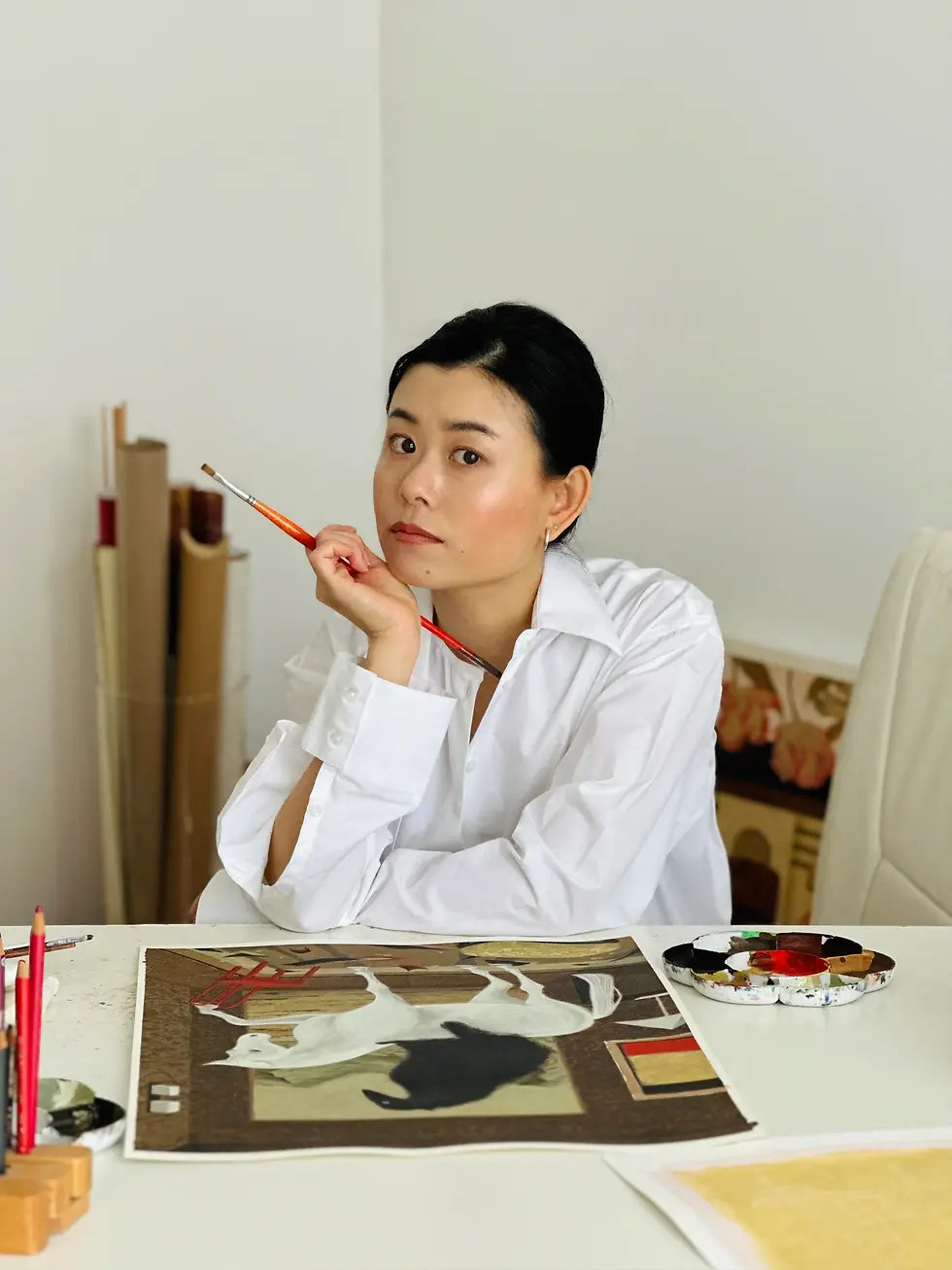
Annamária Rita Tóth
Annamária Rita Tóth works mainly with oil painting, focusing on texture, atmosphere and the play of perception. In her paintings, light appears as a presence that moves across the surface, giving each work a shifting mood. She is a founding member of the FŰZ collective, where research, fieldwork and conversations shape their projects. In both her solo practice and collaborative work, she often draws on her surroundings, from changing seasons to natural rhythms and everyday details. Rather than turning these into fixed symbols, she pays attention to how they feel in the moment and lets that experience take form on the canvas.

Q: Your paintings often move between abstraction and figuration. What keeps you interested in staying on that edge?
A: In my paintings, the delicate, living rhythm and dynamics of nature — its fleeting transformations — play a central role. These phenomena are at once temporal and timeless, spiritual and material. I am interested in the duality of presence and intangibility, the tension between tactile reality and elusive sensations or emotional connections. As a result, my works balance on the threshold between abstraction and figuration, where the struggle with material, expressivity, and the evanescent, sensitive qualities all hold equal importance. I aim to create an artistic fabric in which organically interwoven gestures can emphasize this sense of flow and movement. Spontaneity and intuitive image-making also concern me; thus, the painting undergoes continuous transformation throughout the creative process.
Q: Time and timelessness are central to your work. How do you try to paint something as elusive as time?
A: I seek both timelessness and constant transformation — a sense of connection with time, space, nature, and people. I aim to create boundless, timeless spaces into which the viewer can step, where it feels as though anything might happen. Time and space play a crucial role in my work, weaving together past and present, memory and tangible reality. The floating gestures and the transience of light emphasize both the time in which we live and a sense of timelessness — one that belongs more to a spiritual, contemplative space, intimately connected to emotion and lived experience.

Q: In works like "Biophilia III-IV" or "Yellow Light," nature is more than a backdrop. What role does it play for you in painting?
A: My paintings carry natural associations, yet they also speak of the tangibility of life — its physical presence, its perpetual cycles, and its continuous transformation. I am equally interested in the experience of contemplation: a meditative presence through which changes in our environment are perceived as impressions and sensations, gradually becoming elusive experiences — moments of possible connection. In "Biophilia III–IV" and "Yellow Light," I explore the duality of presence and intangible impressions by balancing on the boundary between abstraction and figuration. These works also evoke a sense of interconnectedness with nature.
We see gestures that create a painterly fabric, along with the interplay of light and shadow, forming a distinct atmosphere. Space, light, abstracted natural motifs, gesture and movement all play an essential role in shaping this visual language.
Q: You also experiment with materials like glassfabric in "Layers of mine II." What does this shift give you that canvas cannot?
A: In addition to oil-on-canvas works, I am increasingly drawn to exploring new materials, layering, and the possibility of extending the painting into space.
My multi-layered works on fabric woven from fine glass fibers emphasize timelessness even more strongly through the glassfabric material’s purity and its light, floating quality. The transparency of the fabric brings painterly gestures to the forefront, creating new spatial situations.
These glassfabric pieces are often installed hanging freely in the air, reinforcing a sense of weightlessness and suspension. This evokes notions of impermanence and elusiveness, allowing the works to speak about the connections between time, memory, and emotions.

Q: Movement and dynamism appear across your practice. Do you think about painting almost like choreography?
A: Movement and dynamism are important to me in my paintings. I strive to create compositions built from vigorous brushstrokes that pulse sensitively, visually embodying the continuous change and cycles that characterize life.
I enjoy working on large-scale canvases, as painting them often makes me feel physically immersed within the work — an exciting and immersive experience during the creative process.
Q: You co-founded the FŰZ art group in 2021. How has working within a group changed your own studio practice?
A: My artist friends and I founded the FŰZ art group in 2021. Our current members are Fanni Czinder (photographer), Kinga Juhász (visual artist), Zsuzsi Palman (visual artist), Abigail Wirth (visual artist), and myself. Our aim is to address themes in our exhibitions that are important and relevant to everyday life, yet often receive less attention — such as vulnerability, motherhood, transformation, and healing. We work with various materials, including painting, photography, installation, collage, textile, and ceramics. It is incredibly inspiring to work within such a creative community, to think together, and this kind of collaboration often deeply influences one’s own studio practice and perspective.