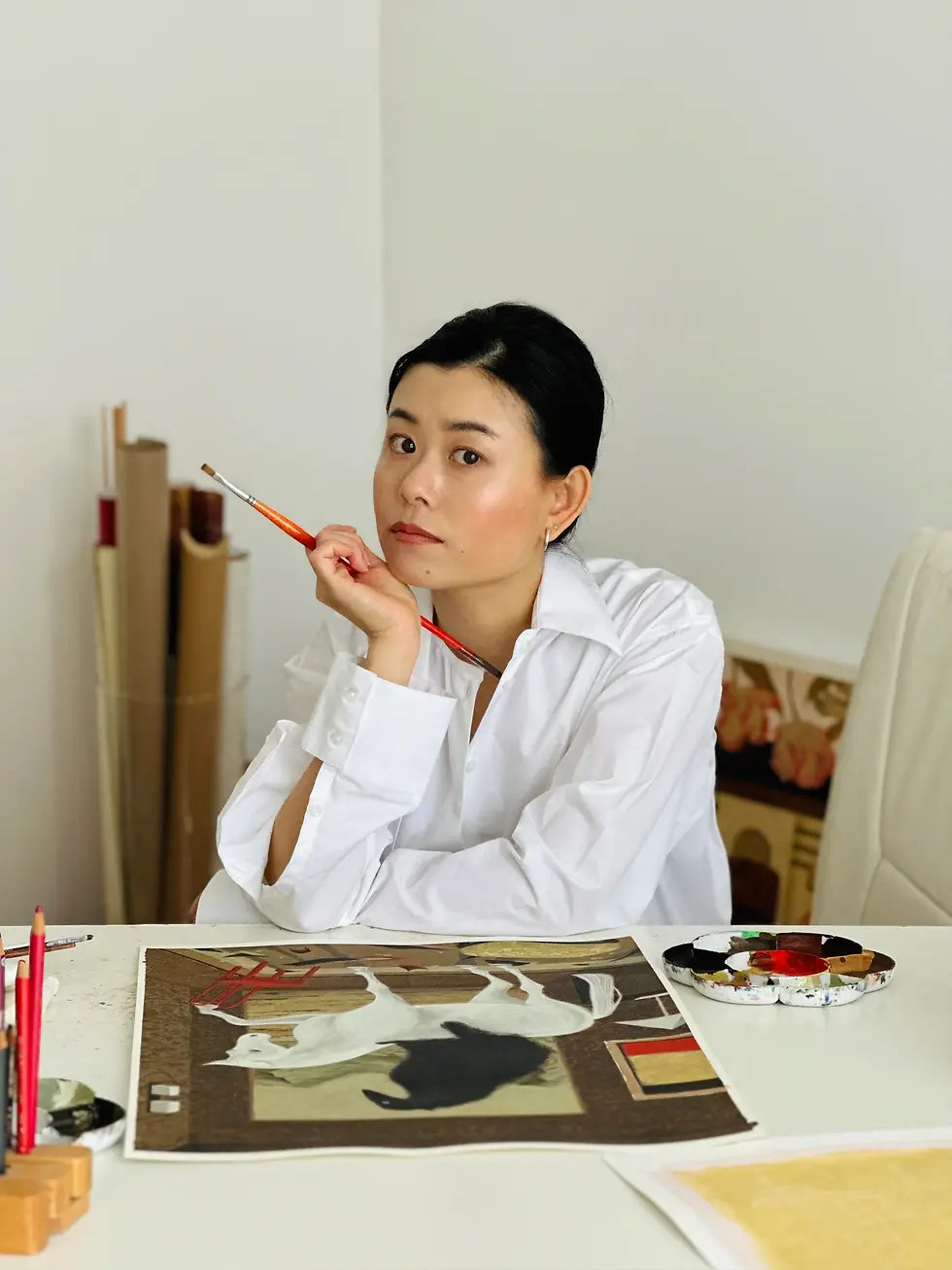
Anita Papp
Anita Papp is a Hungarian painter based in Budapest. She studied painting at the Hungarian University of Fine Arts and spent time in Rome on a scholarship, which is where she began to see classical images of the body differently. She paints figures caught in transformation, drawing on Ovid's Metamorphoses in Stephanie McCarter's feminist translation. Before she paints she photographs bodies through mirrors, chrome plates and magnifying sheets. She also works with cyanotype, kallitype and salt print, all by hand.

Q: How did your path from Budapest to Rome bring you to the work you're making now?
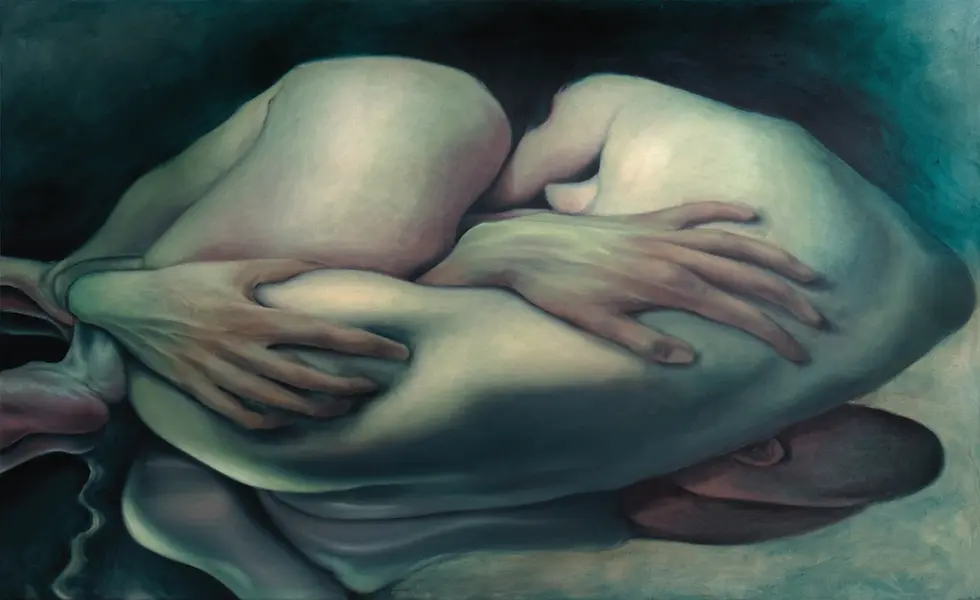
A: Studying at the Budapest University of Fine Arts gave me a strong foundation in painting, but my time in Rome changed how I think about the body. Being surrounded by classical representations made me more aware of how deeply idealized and constructed these images are. That tension between historical ideals and contemporary experience became central to my work. I became more interested in disrupting these inherited forms and exploring the body as something unstable and changing, rather than fixed.
Q: Ovid's Metamorphoses in Stephanie McCarter's feminist translation is a big reference for you. What did that book unlock?
A: McCarter's translation revealed the underlying violence and power dynamics in these stories I had previously seen as purely poetic. It shifted my focus toward transformation not as liberation, but as a response to vulnerability, fear, or control. This perspective deeply resonated with my work, where the body often exists in a state of transition. It helped me think of transformation as a complex, ambiguous space rather than a clear resolution.


Q: Before you paint, you photograph bodies through mirrors and reflective surfaces. What are you looking for in that stage?
A: In that stage, I'm searching for moments where the body becomes unfamiliar and begins to dissolve as a stable, unified form. By working with mirrors and reflective surfaces, I create distortions, overlaps, and fragmentations that disrupt direct perception. I'm not interested in documenting the body, but in capturing it as a shifting, sensitive entity in dialogue with itself and its surroundings.
These images often reveal transitional states, where the body appears suspended between inner and outer, visibility and concealment. I look for tensions that suggest vulnerability, estrangement, or transformation, where the figure begins to exceed its physical boundaries.
The photographs serve as a starting point, but also as a way to distance the painting from realism. They allow me to approach the body as something unstable, layered, and continuously renegotiated, opening space for emotional and psychological dimensions to emerge.
Q: You write that the grotesque is not the opposite of the sublime but its hidden reflection. That's a strong idea. Where does beauty sit for you?
A: For me, beauty is not aligned with smoothness, clarity, or immediate recognition. I resonate with Byung-Chul Han's idea that contemporary culture has reduced beauty to something overly consumable, polished and instantly pleasing. What interests me instead is a form of beauty that restores tension and resistance, something that unsettles perception rather than confirming it.
Rather than separating beauty and the sublime, I am drawn to their overlap, a condition where beauty can interrupt, destabilize, and exceed expectation, rather than simply comfort or resolve. In my work, this appears through the body as something unstable, always in a process of becoming.
At the same time, beauty requires distance. It cannot be fully consumed or exhausted through immediate visibility. I am interested in images that withdraw slightly, that hold back full disclosure, and therefore open a space for slower attention, contemplation, and sustained perception.

Q: You make experimental photography alongside painting. How did that start?
A: During Covid, I began experimenting with alternative photographic techniques such as cyanotype, kallitype, and salt print processes. Working with these slower, manual methods felt closer to graphic arts and painting than to conventional photography, and gradually shaped how I approach constructing images.
Throughout this period, I also started to bring mirrors into my photographic practice. From there, it expanded into working with different reflective materials like mirrored foils, chromed copper plates, magnifying sheets, and other surfaces that distort perception. It became almost instinctive to keep searching for new materials to experiment with.
I find joy in this physical, hands-on process, where everything remains manual and directly connected to touch and experimentation. Over time, photography and painting have become closely connected in my practice, constantly feeding into and shaping each other.
Q: You've shown in New York, Barcelona, and across Budapest. What are you working toward right now?
A: At the moment, I am part of an ongoing group exhibition at Apollo Gallery in Budapest. Alongside this, I continuously apply to open calls and keep looking for new opportunities to expand my practice. In my next paintings, I would like to work with more figures, moving toward compositions where they begin to merge and overlap more directly, creating denser and more complex image structures. This shift toward multiple figures also brings a change in scale; I am planning to work on larger canvases. At the same time, I would like to return more intentionally to photography as an independent practice, developing new series alongside my paintings, and revisiting alternative photographic techniques.