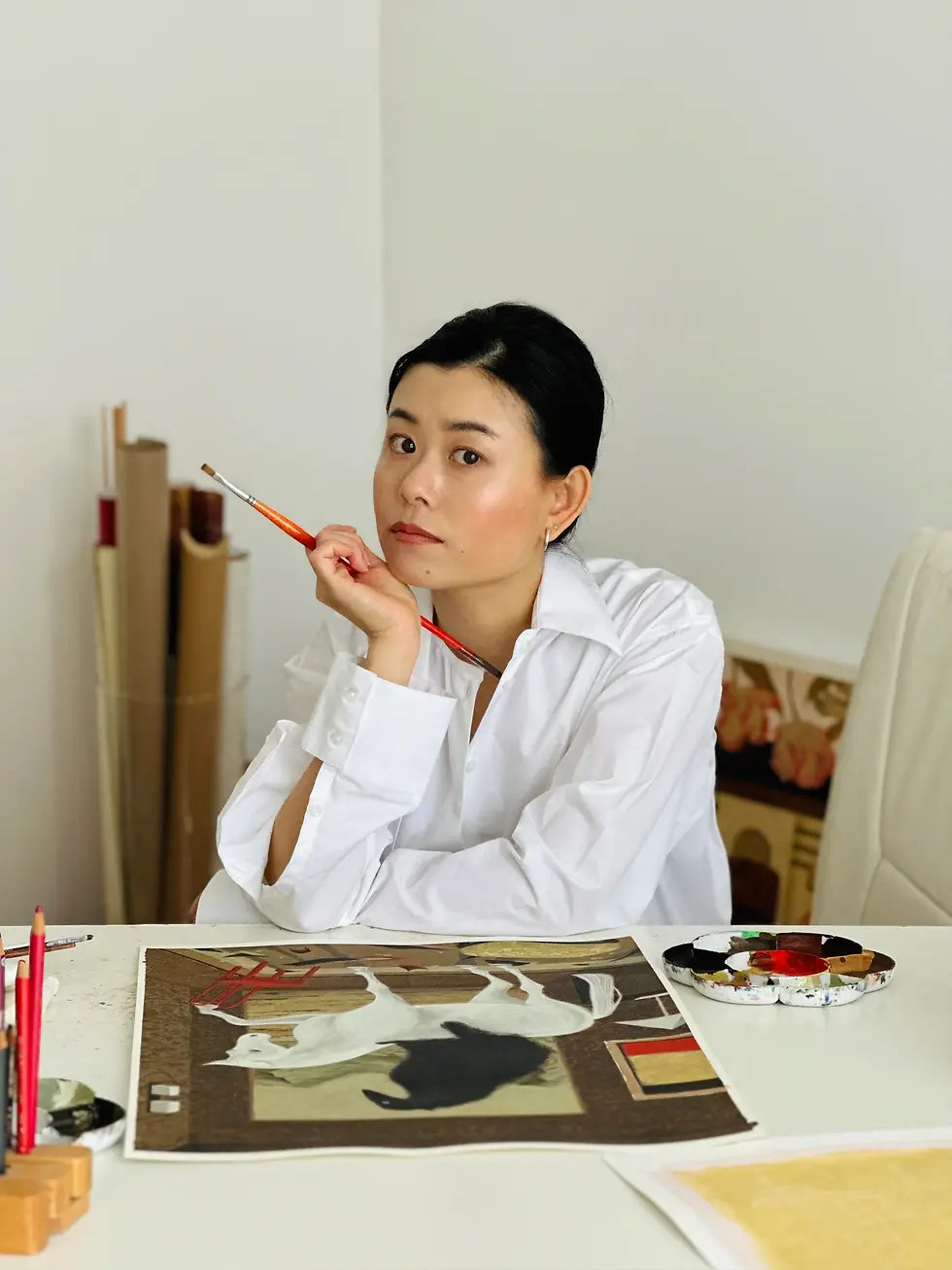
Amina Ben Ismail
Amina Ben Ismail was born and raised in Tunisia and is now based in London. She studied anthropology and theatre before finding her way to painting, something her grandmother had predicted years earlier through Tarot cards. She works with oil pastels layered onto bright acrylic or oil paint. Her most recent series, شاطئ, is about the Tunisian tradition of families bringing entire feasts to the beach every evening: tables, chairs, tea sets, homemade food. She says joy is a form of dissent, and the paintings look like it. She has a group show coming up this June at Les Métiers gallery in Tunisia, curated by Aïcha Gorgi.

Q: You grew up in Tunisia, trained in anthropology and theatre, and now you're painting in London. How did that come together?
A: My eccentric grandmother would read Tarot cards and tell me I was a painter. At the time, I ignored this. I felt like painting was too lonely. I always felt artistic, but a big part of my life was figuring out what to do with that. Anthropology became too serious, too academic. Then, I discovered acting and fell in love with it—it was like art and anthropology had a really playful, silly baby! But in the past few years, I found my way back to painting. I'm not sure how or why. Maybe I value time alone more. Maybe grandmother's spells are finally hitting. Either way, I felt like sharing my work with people, and things developed from there. Acting is giving over to someone else's vision and desires; art allows me to explore my own.

Q: Your most recent series is about Tunisian beach culture, families on the sand every evening. What made you want to paint that?
A: It's magical. People bring umbrellas, tables and chairs, homemade foods, sweets, whole tea sets... so much organisation goes into it! It's busy and loud, there's music, and laughter, and bright colours.
Class boundaries fade away, generations mix. I think there is deep wisdom in these summer evenings, in coming together and finding joy in the midst of a consistently violent world. It's like the hardships of everyday life can take a backseat for a few hours, while we bask in joy and in the connection to our land.
I wanted to capture this feeling through my paintings, to revisit the photos and videos again and again, and get to know the people who take part in these beach feasts. They say "paint what you like." I love this.


Q: You centre everyday objects in your compositions, a plastic chair, a cooler, a floral tablecloth. What makes those the right things to focus on?
A: I'm attracted to objects that evoke emotional memory, cultural or class identity and a sense of community. Objects that don't discriminate, that are accessible to all, that connect us. For example, I am very fond of the iconic plastic chair. It's easy to move, sturdy, cheap, and evokes a sense of community beyond any artifice: to me, it's synonymous with card games during Ramadhan evenings. But to someone else it might mean something completely different, but also not so different... These objects can conjure very intimate and culturally specific memories, and still be strangely universal. By centering them, I hope to invite the viewer in, to recognise themselves in the scenes, and to share a moment with the people outside the frame.
Q: You've written that joy is a form of dissent. That's a strong statement. Where does that conviction come from?
A: I think it comes from growing up in Tunis. Arab culture is deeply grounded in humour, derision and joy. Our people (and we're not alone in this) find strength in humour; it's a way to cope, to resist. No one can take that away from us. And I see it a lot in Tunisia—times are hard for the majority of the people, but there is always, always room for joy—a joke, a game, a story.
It's a way of not giving up, of not being a victim to our circumstances by finding humour and derision in them. It takes power away from the oppressor by not taking him seriously, by making a joke out of him; it completely dissolves his grip over us. There is hope in that. Joy is a form of dissent—of saying "no matter what happens, I'll be over here laughing."

Q: You like your paintings to feel a little rough around the edges, imperfect, unresolved. How do you resist the urge to keep going?
A: There is a perfectionist in me who really wants to finish the painting, which is why I find a lot of freedom in not doing so.
But I struggle with myself throughout the process. Sometimes I go too far and add too many details, so I paint over the section and reexplore it by doing less. I try to paint instinctively and let my gestures dictate how "well" I paint, without correcting myself too much.
The oil pastels really force me to be messy and imperfect; they're a really playful material for that. There is almost no deleting or correcting. But the line between an imperfect/unfinished painting that "works," that is balanced, vs. one that looks amateur or bad is thin, and I often have to start a painting from scratch, and learn from the mistakes that didn't work, and hope for mistakes that do.
Q: What are you working on these days?
A: I am continuing to develop my beach series. I have a lot of material and I want to keep exploring it and hopefully do an exhibition on the series in a few months. I am also working on a piece for a group exhibition this June at Les Métiers gallery in Tunisia, curated by Aïcha Gorgi. I'm exploring painting on different kinds of traditional Tunisian fabrics, in place of the canvas. I'm excited to see how the paint and pastels react to the fabrics!