Paula Hayes
Paula Hayes is a sculptor and land artist based in the Hudson Valley, New York. She works with plants, grasses and soil and has been making landscapes from living materials for over thirty years. Her Birdbath was in MoMA's Sculpture Garden. Her latest project, The Paula Hayes Garden at Lyndhurst Mansion, is her first publicly accessible landscape.
In our interview, Hayes talks about working with living things, the three-year Lyndhurst commission, and what it means to make a garden that is also a sculpture.

Q: You're a sculptor and a land artist. How did you start working with living landscapes?
A: My parents went "off the grid" in the 70s when I was a teenager to a very rural part of upstate New York and started an agricultural farm, and I learned along with them. I also did an internship while at Skidmore College with a biodynamic organic grower, while studying weaving and art history as an undergraduate. I never stopped working with plants.

Q: The Paula Hayes Garden at Lyndhurst is your first landscape open to the public, after years of private commissions. How did that change your approach?
A: I'm in a time of my life and career where integration is a natural focus – integration of parts that I've been working on for decades – so it's a natural progression that the public part of making works and the longevity part that's in the goal of a garden are integrated in this project. I'm really grateful for the opportunity.
Q: Laid out as a mandala, the garden reads as a meadow from the path, but its colored circles only appear when seen from above. Why two ways of seeing it?
A: It's fortunate that the position of this viewing garden is lower than the mansion, so that the place for being perched on the hill to view the river and look up at the mansion and have a view that makes the mansion even larger in a way. The position also affords the view from the house to the overall view of this garden to be from above. When approached from the pathways we don't feel the overall mandala form as dramatically. The layout of the sculptures and the activity of the pollinators with the plants can be intimately experienced from the viewing platform. There are differences to the point of view, which adds to the feeling.
Q: The original birch couldn't be replanted because of climate change. How did that affect the garden you made?
A: It forced us to rethink the entire concept while being respectful that this is in fact a historic landscape site. It was and is important to all of the team members involved that the overall vibe stayed harmonious with the mansion and existing landscape. I personally didn't want this garden to break the flow of the landscape. I believe the floriferous-ness and movement in the pollinator garden does indeed feel "belonging" in the Victorian garden language. Certainly the sculpture types (gazing balls, bird bath, and garden Gnome) do belong to the Victorian garden language.
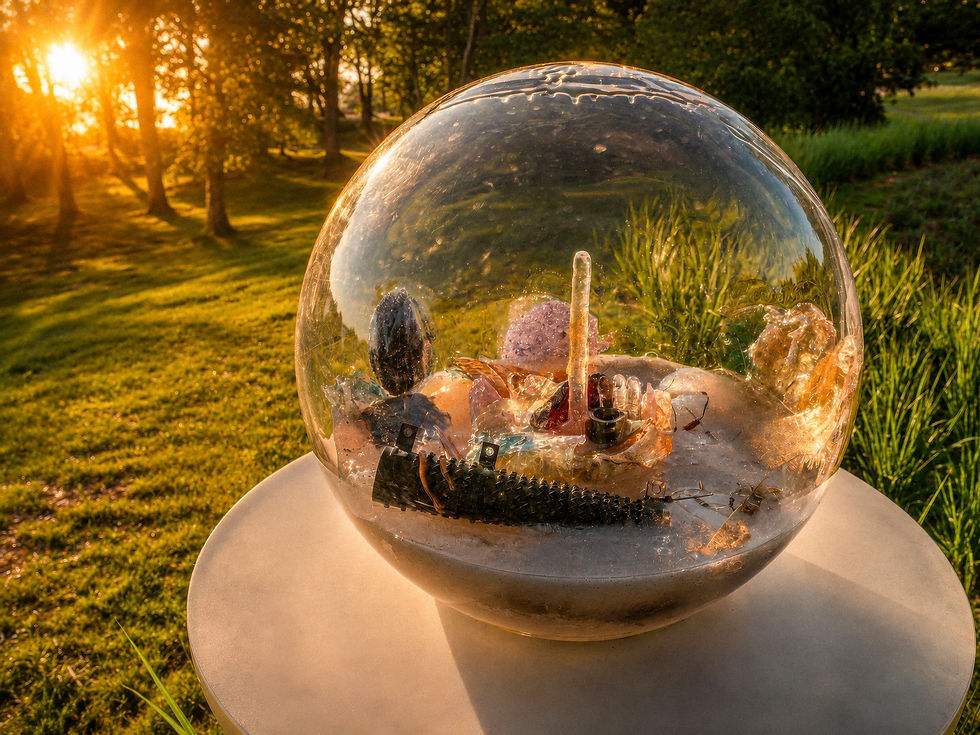
Q: Inside your Gazing Globes there are upcycled radio parts and pulverized CDs. Why bring old technology into the garden?
A: I work to bring contemporary issues, albeit difficult to talk about issues such as climate change, or what actually are "green materials," or the role of technology in society, into the joyous garden. I don't feel it ruins the garden's pleasure. I believe when we search for truths in our sanctuaries, especially a public park, we're integrating the challenging with the generative.

Q: This project took three years. How did the work change over that time?
A: One of my favorite things is when I visualized the mandala as a giant, more fragmented layout, like a large circular brushstroke on the landscape throughout the entire garden, that was a cool realization. I love it when something opens up and starts to be part of the project's own internal system.
Q: What are you working on next?
A: I'm working on a new body of work with resin casting that involves both the human head, domes, and infinite reflections with light. Since my permanent commission at Crystal Bridges also just opened in the same month as the Lyndhurst Garden – I've realized how important some things they have in common are to me and I'm exploring more in this new work.


