Ma Er
Ma Er grew up deep in the mountains. Her parents moved there in their twenties to plant trees and restore the bare hills. There were no other children around, so she started drawing. Ma Er was also curious about fruit and would cut it open to look inside. Only after moving to the city did she realize how much those years had shaped her. Today she lives in Shanghai and makes abstract paintings, pouring the paint straight onto canvas laid flat. One of her recent series began on a trip home, when she found a waterfall from her childhood frozen solid. She is planning a new project called Journeys Nearby, about the everyday things around her.
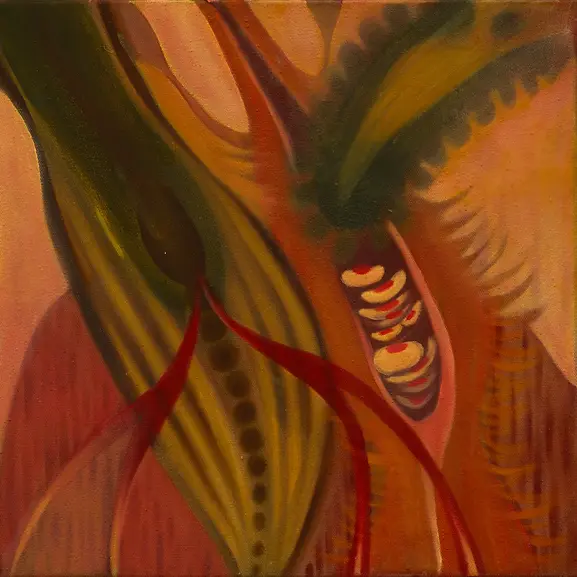
Q: You spent your childhood in mountain forests, cutting fruit open to look at the patterns inside. How did you get from there to painting?
A: It feels distant to speak about where I grew up here. Most people might assume a childhood spent in nature must have been warm and healing. In truth, my parents moved back to the mountains from the city in their twenties to plant trees and restore barren hills. My father will turn sixty in a few days, and they still live in the mountains to this day.
Material comforts and entertainment were extremely scarce back then. We lived deep in the mountains, isolated from neighbours, so I had no playmates. I suspect I first started drawing simply because there was nothing else to do.
Yet I firmly believe drawing is innate to humans — we drew before we ever learned speech or written language. I loved wandering the hills to pick flowers and fruits. I felt a primal curiosity about the inner structures of fruit, eager to cut through their skins and become absorbed by the formations hidden inside. Naturally, these elements found their way into my paintings.
When I grew older, I moved to the city. Like many young people, I believed the future and opportunities lay out in the wider world. It was while living in the city that I sensed an inner friction, a kind of resistance within myself. That was when I realised how deeply my mountain upbringing had shaped me. My fascination with plant anatomy became my way of engaging with the world: cutting through the surface to see what lies beneath.

Q: You empty yourself out before you paint, and only begin when the intuition has risen. How do you know you're ready?
A: I've always wished I could be like most professional artists, walking into the studio on a set schedule and putting in at least eight hours of consistent work each day — haha. But over time, I've realised painting every single day is difficult for me.
It is not that I wait for intuition to surge up before I pick up my brush; rather, I accumulate sensations. I pursue the concept of qi within painting. Qi is invisible, yet it runs through everything.
Waiting for inspiration is unreliable. Instead, I repeatedly empty myself like an empty glass, observing life as fully as I can.
The moment the glass fills with water is when I begin to paint. In Lao-Zhuang philosophy, this is known as letting nature take its course — to follow the inherent laws of how all things unfold.
Q: What does a day in the studio look like?
A: My studio and home are in the same building, a 600-square-metre villa in the outer suburbs, with the studio as a separate dedicated space. I start each morning by walking my dogs and having breakfast, then check on the vegetables I grow in the yard. If you observe closely, they change every single day. I see plant growth as nature's most exquisite transformation of energy.
Then I head to the studio to start my workday. The first thing I always do is clean my desk; for me, this act is like clearing my mind. Mornings are usually for online communications and shooting content, since I also work as a content creator on social media. Painting feels to me like cooking a dish, and showing the work to viewers is the "plating" part. Exploring different ways to present my art is also deeply interesting.
I normally start painting after lunch. On days I do not paint, I read or do handcrafts. The light at this time of day is the most pleasant. I stop working at 6 p.m. and spend half an hour with my dogs in the yard. The sun is about to set, and the clouds are stunning. I love lying on the lawn, lost in thought, or cycling around with my dogs.
In the evenings, I paint if I am in the right state of mind. Most nights, though, I watch films. This is roughly how my days unfold. I rarely go out, only once or twice a month.


Q: Lao-Zhuang thought runs through how you live and how you work. How does it show up on the canvas?
A: I have thought about this question for a long time, hoping I can explain clearly how Lao-Zhuang philosophy influences the details of my creation, yet I never find the right words.
Lao-Zhuang philosophy lets me see a vaster world and recognise how tiny I am. When I paint, my consciousness is like a grain of sand dropped into the ocean, light and peaceful. Painting is nothing more than my practice, not really an achievement. I follow its current, not knowing where I will drift.
Q: You've written about the elasticity of time in your paintings. What do you mean by that?
A: I began my 《大象》 series last Spring Festival. The title comes from the ancient phrase "大象无形". Only after staying far away from my hometown for many years could I view it with a more objective perspective. During that trip, I went back to my childhood secret place, a small waterfall. It was entirely frozen.
The frozen waterfall appears to be just one frozen instant, yet it is built by days and months of slow accumulation. Beneath the quiet ice rests enormous energy. I wanted to practise this elasticity of time in my paintings.
I spread the canvas flat and pour paint onto it to capture an uncertain moment. After it dries, I layer more paint to enrich that moment. Within this practice, I keep reflecting on how time shapes and changes all things, and questioning what is real. For me: what the eyes see is illusion; what emerges from the heart is the essential truth.

Q: Travel and residencies have changed what you make. What's next for you?
A: I travelled to the other side of the world last month, to Copenhagen in Denmark and the Faroe Islands.
A teacher I admire once said: "In this age, there is no travel, only tourists."
More often than not, we simply chase that sense of first sight, sensory excitement detached from our own lives. I believe real travel is about building a genuine connection with a place. It is never about the destination, but the way we look.
I plan to launch a new project called Journeys Nearby. I want to rebuild my relationship with the things around me, beyond their practical uses. I hope to explore my everyday surroundings with the same spirit of discovery that ancient sailors had when finding new continents. I am genuinely excited about this work.


