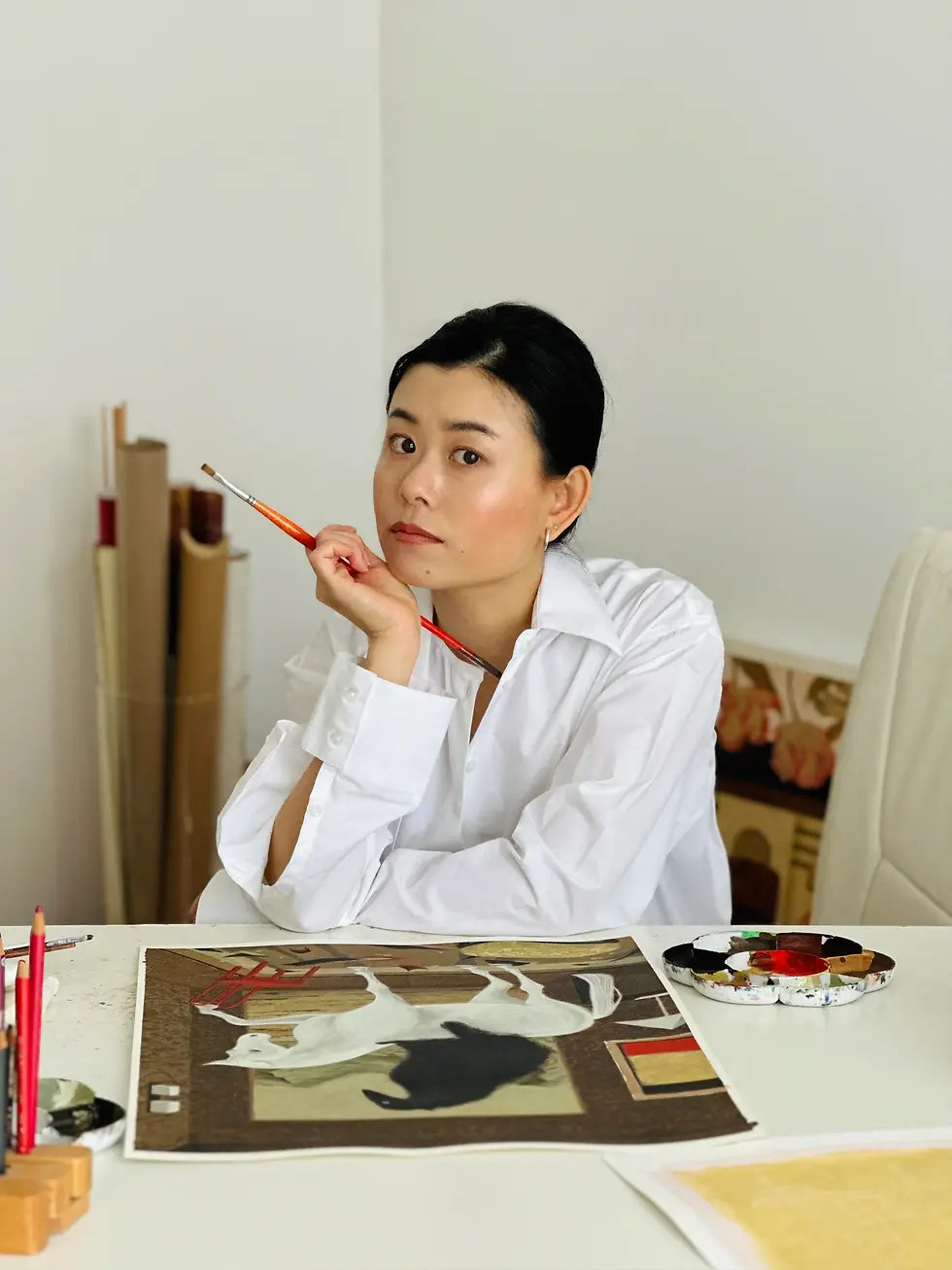
Heidi
Heidi is a Spanish visual artist based in Lisbon. She works in 3D and illustration, using both to experiment with how ideas can change forms. Her work examines light and shadow, not only visually but also as elements of human experience. Through fluid, partly figurative shapes, she gives emotions a physical form. In her recent work, she explores how an image changes as it shifts from drawing to digital modeling to sculpture. Works like “Æther Matter” and “Ether Render” illustrate this process. Each form keeps changing, much like emotion itself.

Q: What got you into working with both 3D and illustration?
A: I’ve always loved drawing, but at one point in my life, I stopped completely. I couldn’t draw anymore. I used to describe it as a hand block. It made me really sad because drawing had always been my way of expressing myself. That’s when I decided to look for another form of expression, since my hand wasn’t “available” at that moment.
A friend of mine, Guillermo Solas, who’s also an artist, introduced me to Blender, and I started learning 3D on YouTube. Working in 3D opened my mind, it gave me new ideas for drawing, and my drawings started inspiring new things in 3D.
Then I began sculpting digitally, and I was fascinated by the idea of drawing in three dimensions. Once I started mixing these two worlds, I realized the possibilities were endless.
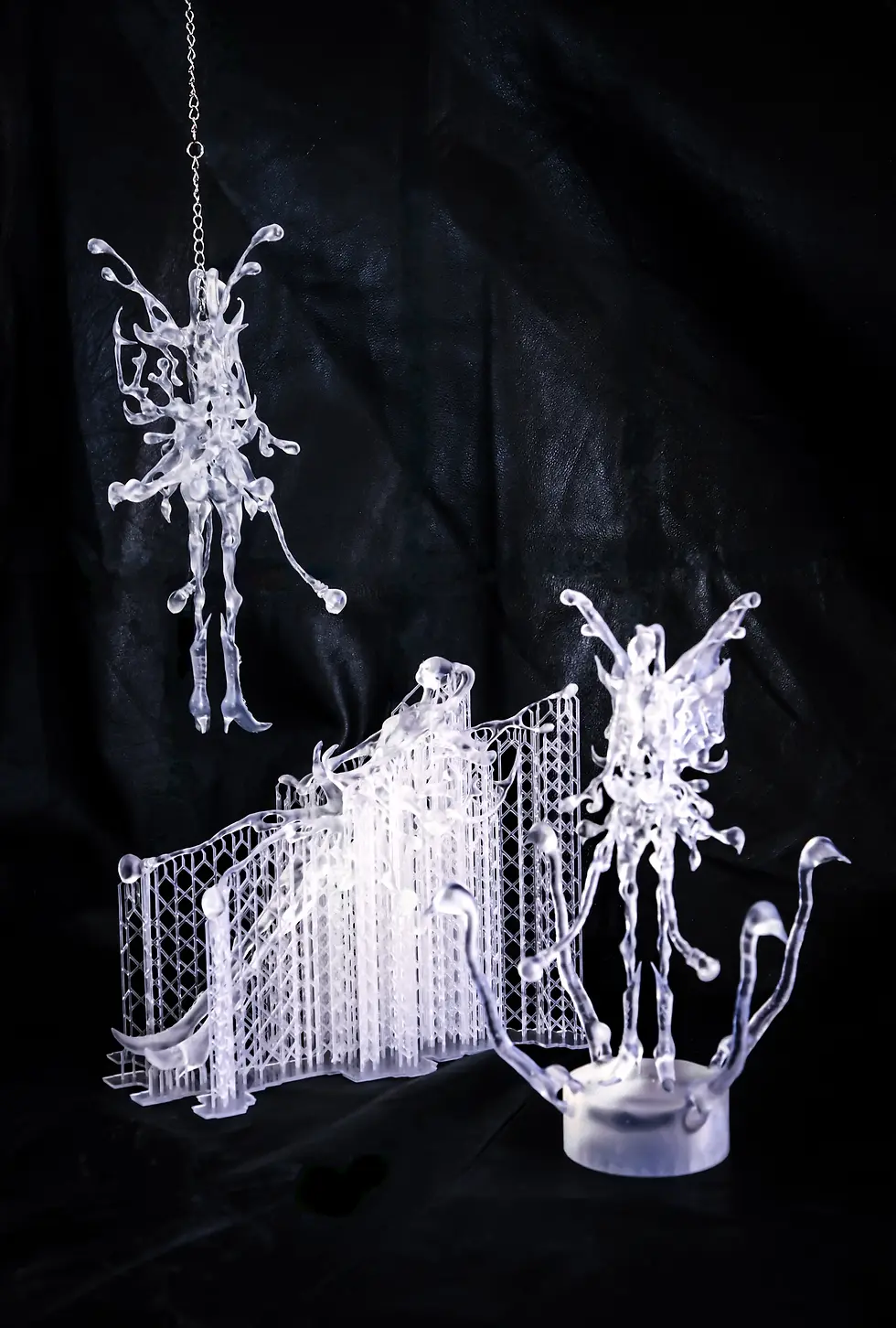
Q: In “Æther Matter,” what did you want to find out by turning a drawing into something physical?
A: “Æther Matter” was an experiment, so I wasn’t trying to find anything specific. I just wanted to observe what would happen, how a drawing would behave once it left the paper, how its presence and texture could shift in space, and whether it would still feel like the same piece or become something entirely different.
It was more about watching that transformation unfold than searching for a clear answer.

Q: You often work with light and darkness. What keeps you coming back to that theme?
A: Everything has light and shadow. I love when they find balance, because that’s when something feels pure. When something is too bright, it feels false to me, but when it’s too dark, it becomes pessimistic. I think we always need a little of both. That balance is rich in meaning; it’s where things feel honest and alive.
Q: “Ether Render” feels both digital and real. How do you get that mix right?
A: I think it’s the details that bring a character or image to life. I’m very meticulous, I pay attention to every tiny adjustment, testing and refining until I can stop looking for what’s missing.

Q: When did the idea of moving one work between mediums start to interest you?
A: It began during an exchange semester in Rio de Janeiro, at PUC. I was taking a studio class where we had to develop a project throughout the term. There I met another exchange student, Phiona, who works with photography, painting, and artificial intelligence. She was the one who introduced me to the concept of remediation, and one day she raised the question: is drawing a photograph still art?
I started thinking that everything is remediation, a continuous translation of meaning. A simple everyday object, if photographed in a certain way, can become art.
A work of art, when rephotographed or redrawn, transforms again… that was also the idea when we photographed “Æther Matter” with Cecilia Violeta, to see how the piece would change once it became an image again.
What is the artwork: the original or the reinterpretation? That game of shifting meaning between mediums really captured me.
Q: How do you tell when a form or piece feels finished to you?
A: That’s always difficult. I never really feel something is finished. I always want to keep adding or changing. That’s why I started working on projects rather than isolated pieces. It allows me to explore the same concept over time, giving it small endings instead of one definitive closure. Maybe things don’t really end, they just pause in the right place.