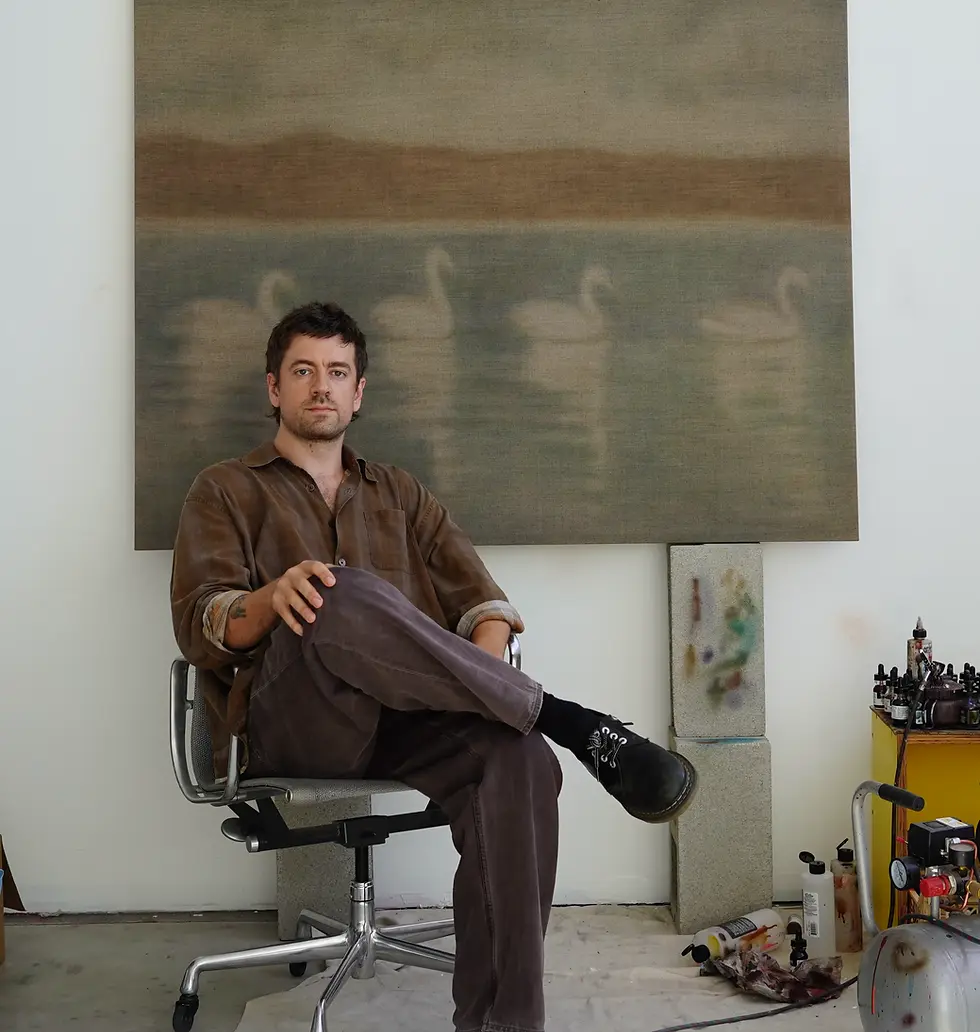
Geneviève Fatzer
Geneviève Fatzer has been a painter, a gallerist and a curator. She is Swiss-South African and lives in Paris, where she founded Studio Veive. She now advises collectors and mentors artists from South Africa, Brazil and other countries of the Global South. In our interview, we talk about what happens when they bring their work to Paris, what collectors there are looking for, and two of her artists, Ana Paula Sirino and Ruschka du Toit.

Q: First of all, tell us a bit about yourself. You've been a painter, a gallerist, a curator and now an advisor. How did you get from the studio to working with collectors?
A: I think all of those roles are still very much present in what I do. Painting was my first real education in truly seeing. When you make work yourself, you develop a deep sensitivity to the things that don't necessarily emerge immediately: the decisions, the hesitations, the strange little things that make a work feel alive. You also learn how intensely vulnerable the process can be, and how much can be lost when too many other voices enter the room.
Working in galleries and curating gave me another perspective. I began to understand how work moves through the world, how context changes its reception, and how much of an artist's career is shaped by things that happen outside the studio. Sometimes the art world can be wonderfully perceptive; sometimes it can be remarkably unimaginative.
Advising collectors felt like a natural extension of that experience. I wanted to bring the eye of an artist and the thinking of a curator into a much more personal relationship with collecting. There is something profoundly intimate about helping someone build a collection. You're not simply matching a person with an object. You're helping them articulate a point of view, sometimes before they even know what that point of view is.

Q: You work closely with artists from South Africa, Brazil and the wider Global South. How do you find them, and what do you look for?
A: I'm not particularly interested in finding artists who already look like the next big thing. By the time everyone agrees that something is interesting, you're often a little late.
I'm drawn to practices that have their own internal logic. Work that feels as though it could only have come from that particular person, with that particular set of experiences, obsessions and contradictions. It doesn't have to be loud or immediately legible. In fact, I often find myself returning to work that takes a little longer to understand.
My relationship with Southern Africa is obviously important to the way I look. Being Swiss-South African, I have a personal relationship with different cultural frameworks, and I'm interested in the ways artists navigate those frameworks without necessarily trying to reconcile them. Brazil has also become an important part of my practice, particularly through artists whose work is deeply connected to place, memory and lived experience.
But I'm not looking for a regional aesthetic. The Global South isn't a style, and it certainly isn't a single artistic position. To treat it as one would be to miss the point entirely.
I find artists through conversations, studio visits, exhibitions, recommendations and, increasingly, the relationships that develop over time. I'm also looking for a certain intentionality. Not necessarily a fully articulated career plan, but a sense that the artist is asking something of themselves. I want to see a practice that has room to grow, to fail, to become stranger. I'm less interested in whether an artist fits neatly into the current conversation than in whether they might change that conversation altogether.

Q: Many artists feel they have to adapt their work for a European audience. What does that cost them?
A: It can cost them the very thing that made the work interesting in the first place.
There is a particular kind of pressure that comes with entering an international art market. Suddenly, your work has to be explained. It has to fit into a conversation that collectors, curators and institutions already understand. Certain references become desirable because they're familiar, while others are treated as obstacles that need to be translated.
The danger is that an artist begins anticipating the audience before they've even finished thinking through the work. They start making decisions based on how something might be received in Paris or London, rather than following the questions that brought them into the studio in the first place.
Of course, art has always traveled, and context inevitably changes how we see it. I'm not interested in some romantic idea that artists should remain untouched by the outside world. Exchange is essential. But exchange is very different from assimilation.
Take an artist whose work emerges from a specific community, history or material tradition. If the only way for that work to gain international recognition is to strip away the very things that make it specific, then what exactly are we recognizing?
My approach is to work on the conditions around the artist, rather than asking the artist to change the work. That might mean building the right institutional relationships, finding collectors who are genuinely curious, or creating a context in which the work can be encountered without being reduced to a convenient narrative.
I think we have to become comfortable with not understanding everything immediately. There is nothing wrong with a work that asks something of you. In fact, that is often where the most interesting relationships begin.

Q: How do collectors in Paris react when they meet this work for the first time?
A: There is often a moment of recognition, although not always for the reasons people expect. Sometimes a collector is drawn to the material or the composition before they know anything about the artist. Sometimes it's the opposite: they hear about the artist's context and suddenly begin to see the work differently.
What interests me is the moment when the conversation moves beyond the initial explanation. When a collector stops asking what a work represents and starts asking why it feels the way it does. That's usually where something more meaningful begins.
Paris has an extraordinary history of absorbing artistic ideas from elsewhere. But it also has a tendency to organize what it discovers into familiar categories. An artist arrives, the work is given a framework, and quite quickly everyone knows how to talk about it. There is comfort in that, but it can also close down the possibilities.
I'm interested in collectors who are willing to resist that impulse. People who don't need a work to confirm what they already know about art, or about the world. Collectors who are prepared to spend time with something that doesn't immediately fit into their existing collection.
And I think there is a real appetite for that in Paris. People are curious.

Q: You advise collectors and also mentor artists. What does each side misunderstand about the other?
A: Artists sometimes assume collectors are primarily motivated by investment, status or the desire to own something that other people want. Of course, those motivations exist. It would be naïve to pretend otherwise. But many collectors are looking for something much more personal. They want to live with work that changes the atmosphere of a room, that gives them a relationship with a world outside their own.
A good collector isn't necessarily the person with the most sophisticated vocabulary. Sometimes they're simply the person who knows they cannot stop thinking about a particular painting.
Collectors, on the other hand, can underestimate how much is happening behind the work they see. A painting is not an isolated object that appears fully formed at a fair. There is an entire practice behind it: years of experimentation, failed attempts, material decisions, uncertainty and persistence. When collectors focus exclusively on the finished object, they risk missing the artist's longer trajectory.
There is also a tendency to assume that artists should be naturally equipped to manage every aspect of their careers. They're expected to make the work, communicate its value, cultivate relationships, understand pricing, negotiate sales, maintain visibility and somehow remain entirely focused on their practice. It's an absurd amount to ask of one person.
This is where I see my role as an advisor and mentor intersecting. I want artists to understand the market without becoming psychologically dependent on it. And I want collectors to understand that buying a work can be the beginning of a relationship, not simply the end of a transaction.
Both sides benefit from greater transparency. Artists need to understand how decisions are made, and collectors need to understand the realities of sustaining an artistic practice. The relationship works best when neither side feels that the other holds all the power.
Ultimately, the best collections are built on trust, and trust requires a little more than a price list.

Q: What would you change about the way Paris looks at artists from outside Europe?
A: I'd stop treating geography as the most interesting thing about an artist.
That might sound obvious, but it has real consequences. Artists from outside Europe are often introduced through their nationality, their political circumstances or their relationship to a particular history. These things can be important, of course, but they shouldn't become the entire framework through which the work is understood.
An artist from South Africa should be allowed to make a painting that is simply a remarkable painting. An artist from Brazil should be allowed to be difficult, funny, formal, abstract, contradictory or completely uninterested in representing their country. They should be allowed the same complexity we readily grant artists who already belong to the European canon.
I'd also like to see a shift away from the language of inclusion. The idea that we are generously making room for artists from elsewhere still places the European institution at the center, as though it has the authority to decide who gets to enter.
There is a difference between opening a door and questioning why you were the one holding the key.
Paris has the potential to be a place where different artistic traditions meet without one automatically becoming the reference point for the others. But that requires more than programming a few exhibitions or acquiring a handful of works. It requires a sustained commitment to artists, to their institutions and to the intellectual frameworks from which their practices emerge.
And it requires collectors to take those artists seriously over time, not just when their work fits a particular cultural or political moment.
I don't think the goal should be to make the art world more diverse in appearance while leaving its underlying habits untouched. I'd rather see a more ambitious kind of exchange, one in which artists from elsewhere are not simply brought into an existing conversation, but are allowed to change what the conversation is about.
Q: Which of your artists should we be watching next, and why?
A: Ana Paula Sirino is someone I would encourage people to spend time with. She lives and works in the quilombola community of Torra, Brazil, and her paintings emerge from a close relationship with the histories, memories and everyday life around her.
What I find compelling about her practice is that it doesn't feel as though it is trying to explain itself to an outside audience. The work is grounded in a particular lived reality, but it doesn't become illustrative. There is an intimacy to it, and a confidence in allowing the paintings to exist on their own terms.
Ruschka du Toit is another artist I'd encourage people to look at closely. What interests me about artists like Ruschka is the way a distinctive visual language develops over time, through a process of experimentation and a willingness to follow an idea beyond its most obvious conclusion. I'm interested in practices that have their own internal logic, that don't simply respond to what's happening in the market but are building something more enduring.
Both artists speak to something I care deeply about: the importance of allowing an artist's practice to unfold without forcing it into a predetermined narrative. I'm less interested in telling people what an artist represents than in giving them the opportunity to encounter the work and discover what it does to them.
I think that's an important distinction. We often talk about international visibility as though it requires an artist to become more universal, when sometimes the opposite is true. The work becomes more interesting as it becomes more precise, more attentive to its own conditions.
For me, watching an artist isn't just about anticipating their next exhibition or predicting where their market might go. It's about paying attention to what they're building over time, and recognizing when a practice is entering a new phase.
Ana Paula and Ruschka are amazing; I'd encourage people to encounter their work directly, spend some time with it, and resist the urge to decide too quickly what it means.
That's generally good advice for looking at art, and probably for most other things, too.
More info: studioveive.com
Portrait credit: Alexandre Carvalho