Brofoz
Brofoz is a London-based painter and illustrator from Boise, Idaho. When she moved to London, she started sketching strangers on public transport, sometimes several faces a day, and recently in pubs. The faces she likes best end up as paintings in acrylic, oil and oil pastel. Her latest series, VIVARIUM, comes from her own chronic menstrual pain and the time she spent in doctors' offices. A vivarium is an enclosure used to observe living organisms, and she felt her body was seen the same way, "as both inhabitant and specimen." The series helped raise money for Endometriosis UK.

Q: You came to London from Boise with a background in illustration, and started sketching the people you met. How did that turn into painting?
A: I lived in Idaho my whole life, so moving to London was... overwhelming at first. I quickly noticed that the more people I sketched, the more I began to understand the city itself. I became obsessed with the idea of sketching multiple faces a day, and in return, I felt closer to London and began understanding its personality through the people who exist here.
Admittedly, some faces inspired me more than others. I began selecting a handful of sketches and translating them into paintings. I fell in love with the intimacy and exploration that came from moving between drawing and painting, allowing a quick observation to develop into something more like a friendship. That process has become my new normal.

Q: What are you looking for in someone's face when you sketch them?
A: I am absolutely drawn to faces with exaggerated features, but at the core of my practice, I actually don't care all that much about someone's face when I choose to sketch them. Instead, I observe their body language, behaviour and personality first. This alone tells me the story I'm looking for. The face is the end result of trying to understand the person next to me.
Q: How do those imagined stories come to you? Where does a piece start?
A: The majority of my observational sketching happens on public transport. There's something about the plainness of going from A to B, especially underground where there is no cell service, that creates this rare opportunity to simply watch people exist without distraction. You can see them thinking, wondering, dreaming.
Oppositely, my recent obsession has been sketching at the pub. Regardless of where I am, my work is a translation of what I imagine my subjects' lives are like, based on the micro-expressions I observe over 10–30 seconds. Of course, the stories I imagine for my sketched subjects will never be entirely true, but that's not the point. I'm building a narrative based on my intuition, so a piece starts the moment I choose to really, truly look at someone.
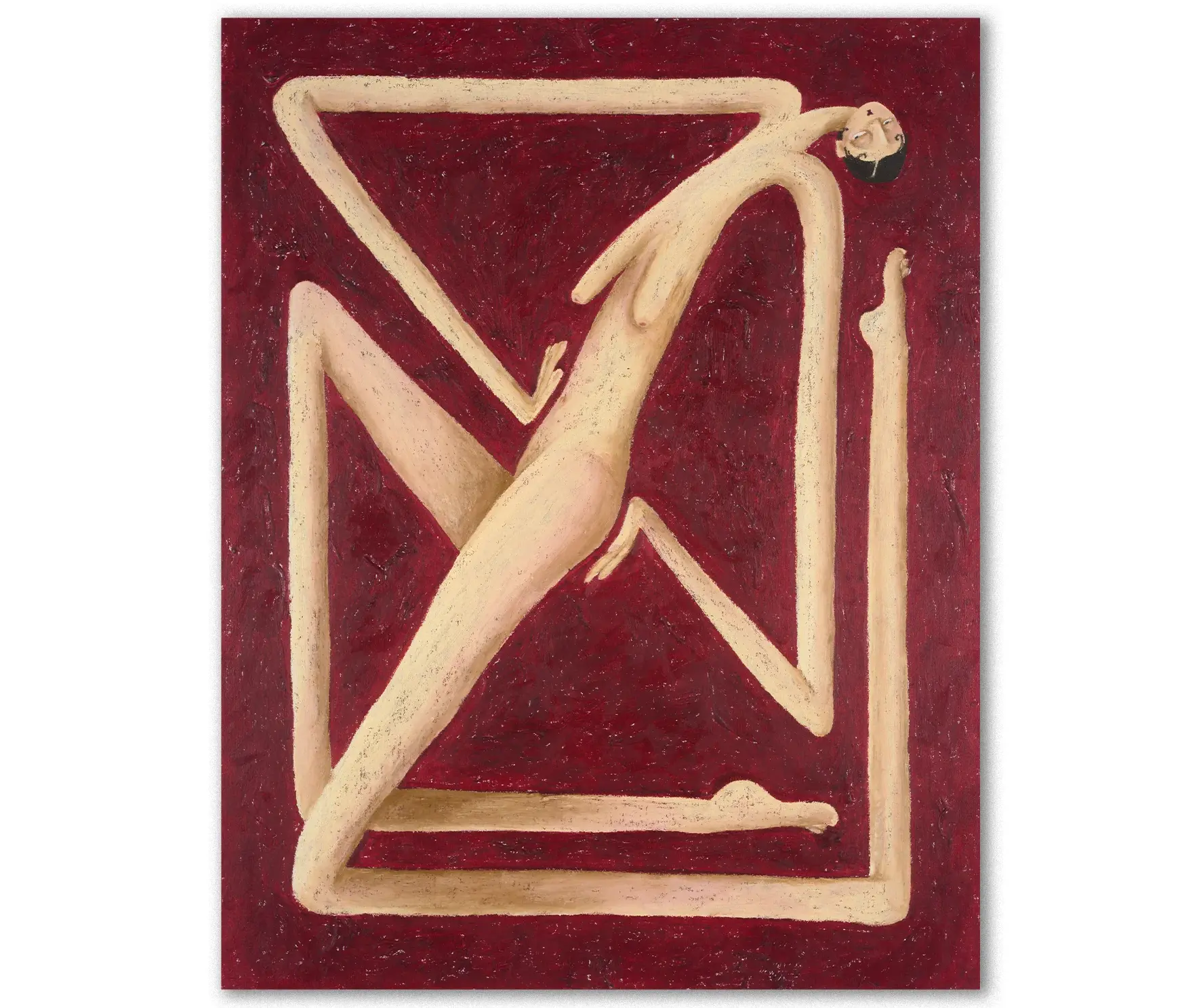
Q: VIVARIUM came out of your own experience of chronic pain. Tell us about the series.
A: Earlier this year, the abnormal menstrual pain I have experienced on and off throughout my life returned with a force. I was angry, frustrated and, honestly, completely consumed by it. I needed a way to make sense of what was happening to my body, so I started painting it.
At the same time, I was learning more about women's health and spending more time in doctors' offices, where I often felt like my body was being examined without actually being seen. That contradiction became the starting point for VIVARIUM.
The series depicts women's bodies distorted and confined within the canvas. A vivarium is an enclosure used to observe living organisms, and I began to feel as though my body was seen in the same way, as both inhabitant and specimen. We are observed, examined and documented, yet often dismissed and left without answers. VIVARIUM makes that frustration visible, and uncomfortable.

Q: You want your painting to do something beyond the gallery walls. What do you have in mind?
A: I think it's important to connect art with action whenever possible. Art has the ability to communicate and create an emotional response on its own, but when that response is paired with action, it has the potential to reach further.
With VIVARIUM, I wanted the impact of the work to continue even after it had left the gallery. The series helped raise money for Endometriosis UK, but just as importantly, it created conversations and encouraged people to learn more about women's health. Continuing to pair charitable efforts with my work is something I want to carry forward as I progress throughout my career.


