Alice Herbst
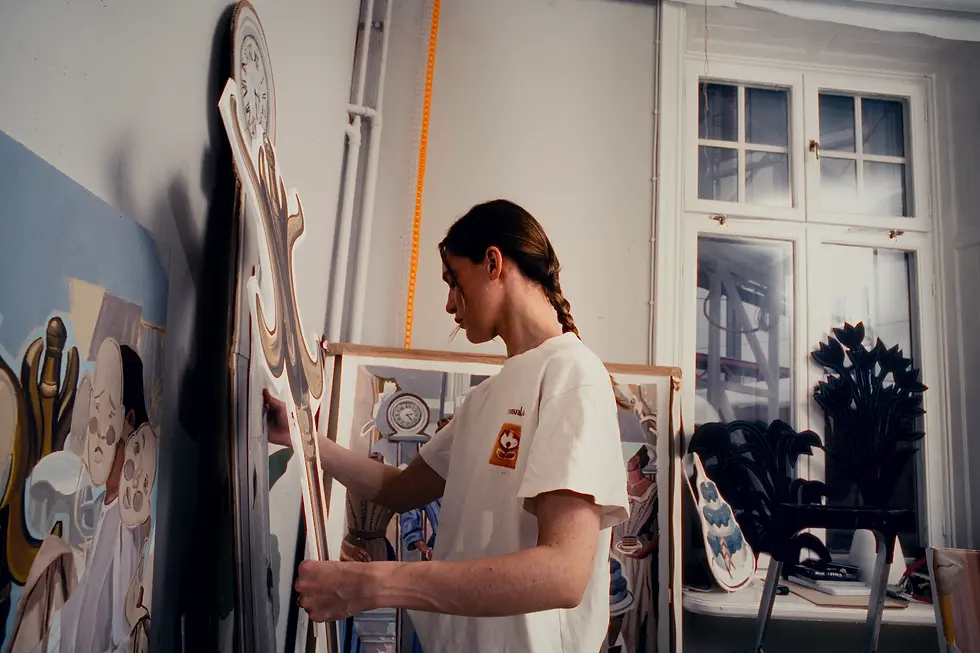
Alice Herbst is a Stockholm-based painter who creates her images by first constructing physical scenes in the studio. She makes props from cardboard, paper, fabric, and plaster, sets them up like stage environments, photographs them, and then paints from these setups. She often steps into the scenes herself, using costume and masks, so the body becomes part of the composition. The same objects and characters return from work to work, reappearing in new roles within an ongoing series she calls The Whispering Game.
In our interview, she talks about starting out with handmade dioramas, why building everything by hand matters to her, how she plans a scene before painting it, and what it means to use her own body as a character.

Q: How did you first start building small worlds and placing yourself inside them?
A: It has been evolving in a slow phase into what it is today. Back in art school around 2016, I played around with creating small dioramas out of cardboard and clay. These were then photographed and used as inspiration for paintings and drawings.
Initially, I was drawn to that type of process since I always liked the crafting aspect of creation. It was a big part of my childhood. Oil painting actually first became a choice of medium in art school. For a while, I practiced painting so much that I forgot about my love for craft, and I did not reflect on how to combine them.
Instead, I started to use myself as a character, with wigs and dresses, and built up worlds around me in post-production, which my partner, and artist, Christofer Högman, assisted with photographing. A few years later, I got the idea to invite elements of drawing into the set. I created a couple of paper masks, very simplistic two-dimensional ones. They were part of a story with two characters, played by myself, cutting out these masks with scissors. With them being placed around the room, they became their own creatures.
After this moment, my process became more and more focused on the initial planning of the set. I made paper cut-out clothes, a crinoline, and plaster masks.

Q: What made you move from working with a few props at home to building full environments in a studio?
A: It is extremely tough to keep inspiration and ideas inside the mind without the possibility to bring them to life. It is a similar feeling to wanting to scratch your skin when it itches.
I had many ideas, but they were not possible to execute in the apartment, and since both my partner and I work as artists, we needed a space. Naturally, we now feel like we have grown out of our current studio space again, and I feel quite the same way as when we had the apartment. At the moment, I store ideas that can’t be realized due to the space situation, but this is also what makes it fun to practice art: the ideas grow and keep one motivated.
Q: When a new work begins, what usually comes first for you?
A: It varies a little bit. But I receive a lot of instinctive visual images when I need to. I build up the initial painting in my mind and write down the things that I need to create in order to make it work. I see the props in front of me and a color scheme. These things are then moved around and transformed till I create them in reality.

Q: What do you gain by making your own props from cardboard, paper, and fabric instead of using ready-made objects?
A: I actually like to invite elements of ready-made objects and artificial ones and combine them in my process, so it is never my intention to replace reality completely. When I create these objects, I feel in charge of what I plan to paint. I gain exact knowledge of the look and feel of the objects, which loads them with memory and anticipation.
The self-made paper objects also vary in detail and simplicity. Some objects look realistic and cast realistic shadows, but reveal their flat nature. Other objects are clearly cut out and present a style reminiscent of a cartoon.
I also see it as a real-life collage building, where different styles merge together and, in the end, transform into oil paint.

Q: How did stepping in front of the camera become part of your practice?
A: I have quite a complex relationship with the camera. I grew up being interested in recording things, and I always borrowed our family’s film camera from the age of seven. I started to document things I created, come up with sketches, and pretend to be characters. This was kept for myself only.
When I reached my teenage years and social websites gained traction around 2007, my experiences evolved into something we frequently read about today—but didn’t back then. Nowadays, there are many articles and research about Body Dysmorphic Disorder and the consequences of unrealistic ideals, but when I was 13–14 years of age there was no real knowledge about this diagnosis. Before it got better, it got really bad. I remember learning to “fake” confidence, as advised by my psychiatrist, and this became a daily practice.

After a few years, things took a turn again. While it being one of the most unclever things a person could ever do (having been diagnosed with BDD), I decided to apply for a modeling competition on TV. I had demonstrated fake confidence enough to build something closer to the real deal, and as an 18-year-old, being a model was something many people dreamed about. I remember not expecting anything from it, but I saw it as a revenge for myself back then.
I ended up winning the show’s contract with a modeling agency in Los Angeles and worked as a model there for no longer than a few months, until I came back to Sweden with an eating disorder. This was how I truly learned that I tend to want to control aspects of my own body when I lose control of everything else.
A part of my healing process was to start painting and drawing. I began including myself in some of the works, and it later evolved into practicing proportions and drawing my own body in strange yoga poses—it slowly made me accept my appearance.
How I use myself as the character in my works continues to evolve, but it always serves the same purpose. I do not do it with anyone else in mind, and to sum it up—it heals me.

Q: When a staged scene becomes an oil painting, what changes for you in that process?
A: The photographed, physical set first goes through an additional transformation in post-production, so it is rarely painted as is. It is built up in many steps because I like to see the initial idea go through stages physically, digitally, and then physically again. This is what my project is all about: repetition and transformation.
When you fall in love with oil paint, you realize that there are so many uniquely made choices in every brushstroke. How the color behaves, and with what rhythm it has been placed on the canvas. To see the staged scene as an oil painting gives it a different dimension, incomparable to photography in my opinion. It demands a closer look.

Q: Your sets can feel both symbolic and theatrical. How do you think about that while building a scene?
A: The reason for this is very intuitive, but I believe I have become more connected with my inner dialogue and understanding of how to work with it. The aspects reminiscent of theatre have evolved naturally from an interest in identity expression and narrative. If I have a very clear feeling or memory of something, there is always a way to give life to it through visual cues.
I want to give an example. I have recently been thinking about and comparing my symbols to emojis. Some emojis have a strong, collectively understood implication, while others need to be put into context to be interpreted. Sometimes emojis change meaning through generations. I like to think that my symbols and props often don’t mean anything at all—but by placing them in relation to other props, they inspire a narrative to take shape.
This narrative may be perceived differently depending on the recipient, which is also an interesting aspect, and I like not to interfere with it.

Q: In “The Whispering Game”, images and characters return and transform. What interests you in letting motifs change over time?
A: It has always been about giving in to control. Seeing how something evolves and takes on a new meaning. The idea of using the project title of a children’s game—“The Telephone” (in Swedish: The Whispering Game)—is to remind myself to make the process as interesting to myself as it was when I was a child, while at the same time allowing for it to evolve like a language.

Q: You’ve spoken about the importance of a slow process. What does slowness give you in your work?
A: It gives me time to connect to what I am making, since every painting carries all the memories and moments of its creation.
With each new painting in planning, I also create a few props, and they remain part of my prop archive for future paintings. This collection grows larger, and the more I create, the more complex the sets may become. I always knew it would be a slow way to operate, but also that everything would become more clear with each painting.

Q: Looking ahead, what would you like to explore?
A: I will continue to evolve the language of my paintings with “The Whispering Game” and see how this can be explored as an installation genre. Even the process videos, which used to be purely documentation, have started to become a form of visual expression. I like both the process and the result to be equally important.
My partner and I also share an art practice under the name Herbst & Högman, which allows us to give form to something new shared between us. It has been quite different from what we both do separately, since we wanted to tell new stories we have dreamt up together over the years. We had our first solo show as a duo at Gallery Sonder this fall, and we plan to begin new projects. It will be a busy year, it seems, and I am in the midst of making it all align.


